Berlin Tempelhof Airport
The Spy Who Came in from the ColdTempelhof Airport is the Berlin arrival point where Alec Leamas’s apparent return to familiar ground becomes a final test of whether he will continue into East Germany. The airport offers a momentary sense of recognition and possible escape, but its corridors lead onward: Leamas leaves with Peters, crosses the sector border, and proceeds east into the staged defection that will define his fate.
Setting and Historical Context
Tempelhof appears against the wider reality of a city divided by the Berlin Wall. The Wall’s sudden construction had taken British and allied intelligence networks by surprise, forcing some agents to operate as stay-behinds through hidden radios and prearranged secret writing. The frontier made espionage more clandestine and dangerous, while the checkpoints and new fortifications turned movement between sectors into a controlled operation rather than an ordinary journey.
The border’s violence is made concrete in Karl Riemeck’s escape attempt. From a position near the crossing, Leamas watches Karl reach the Customs hut and pass the barrier, only to be caught by searchlights when he pedals toward the remaining line between him and safety. An East German sentry shoots him in his own sector. That failed crossing establishes the lethal stakes of the border before Leamas arrives at Tempelhof: the same divided landscape through which he is about to travel has already made escape a matter of life and death.
Arrival and Hesitation
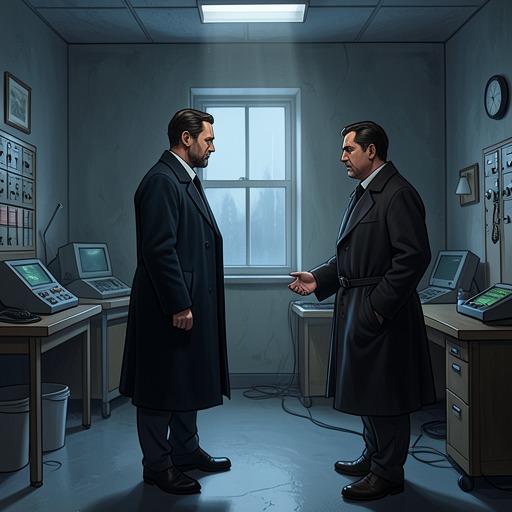
Leamas lands at Tempelhof nearly in darkness. He sees Berlin’s lights rise toward the plane, feels its thud on the runway, and watches Customs and immigration officials approach. The scene is compact and physical, but the arrival carries a conflict he has not resolved: he fears that someone from his former life may recognize him, yet, as he walks through the airport with Peters and no familiar face appears, he understands that this anxiety has also been hope. Some circumstance might still have stopped the journey.
Peters’s conduct reinforces the airport’s status as a staging point. He no longer makes a show of disowning Leamas, as though West Berlin were safe enough for vigilance to relax; to him, it is only a technical passage on the way east. At the main reception hall he abruptly changes direction and leads Leamas to a smaller side exit. Beneath its light, Peters sets down his suitcase, folds his newspaper into his raincoat pocket, and picks up the case again. A pair of headlights flashes on in the car park, dips, and goes dark: a signal that carries them from the public airport into the next arranged stage.
From the Airport to the East
The drive away from Tempelhof gives Leamas one last opportunity to refuse. Sitting with his hands on his knees, he considers attacking Peters or escaping from the car, and knows that people in Berlin might help him. He does nothing. His stillness is not the disappearance of choice but its decisive exercise: he allows the operation to continue despite the available possibility of breaking away.
The crossing itself is unexpectedly easy. The cars wait for what Leamas guesses is a prearranged time; a DKW roars past the Mercedes to approach the West German checkpoint, and both vehicles then go through together as the barrier rises. Across the fifty yards between checkpoints, Leamas notices the Eastern side’s dragon’s teeth, observation towers, and double aprons of barbed wire. At the second checkpoint the booms are already raised, and the East German guards watch through binoculars as the Mercedes passes without stopping. The DKW reappears behind them, and instead of stopping to change cars or celebrate, the party drives on through East Berlin and farther east.
Narrative Significance
Tempelhof is more than a point on the route: it is the hinge between the possibility of turning back and Leamas’s continued participation in his staged defection. The absence of an old acquaintance, which he first experiences as anxiety and then recognizes as hope, makes the airport a scene of inward hesitation without requiring an explicit confrontation. The side exit, the headlights, the timed crossing, and the raised barriers place that private uncertainty inside a carefully managed system of signals and permissions.
The airport also gains force from its contrast with the exposed border. Karl’s crossing is illuminated by searchlights and ends in gunfire; Leamas’s passage through the checkpoints is arranged, escorted, and almost effortless. That contrast does not make his journey safe: the Eastern fortifications remain visible, and the cars continue beyond the city rather than pausing at a place of refuge. Tempelhof therefore marks not an escape from the Wall’s world but the point at which Leamas accepts a route deeper into it.