Charlie Checkpoint
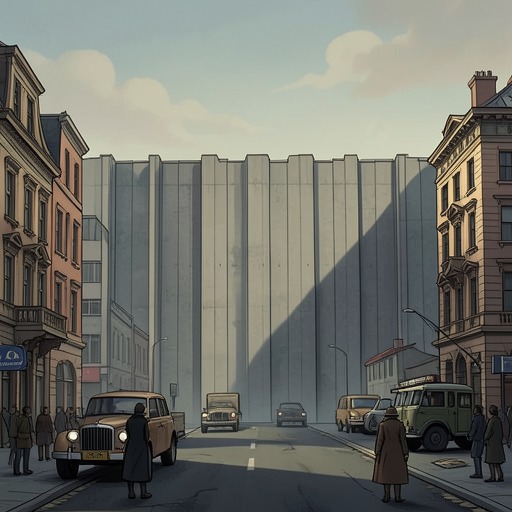
The Spy Who Came in from the ColdCheckpoint Charlie, the Friedrichstrasse crossing point, is both a real border crossing and a pressure point in the novel’s action: here the division of Berlin becomes a sequence of barriers, inspections, armed sentries, and perilous decisions. The crossing’s stark procedures govern who can move between sectors, while its exposed roadway makes escape attempts visible and vulnerable.
Setting and Historical Context
The name Checkpoint Charlie quickly came to be used for the Friedrichstrasse crossing. In the broader crisis recalled around the Wall’s construction, the crossing stood at the center of a confrontation that seemed capable of becoming a wider war: American and Soviet Bloc tanks faced one another across a hundred-yard strip of road, their guns trained on each other’s turrets. Their engines roared as if to keep them ready to advance, but the gesture also resembled boxers psyching each other before a fight. The checkpoint was therefore not simply a gate between sectors; it was a tightly watched edge of the Cold War’s military standoff.
That history also reshaped intelligence work. The Wall had caught British, American, French, and West German networks unprepared, and agents on either side had to adapt to a more clandestine and perilous world. Some became stay-behind agents, relying on hidden radios and prearranged secret writing. The crossing’s visible controls were thus part of a larger transformation: movement and communication alike became more constrained, dangerous, and dependent on secrecy.
Inspection and Controlled Passage
The novel gives the border its force through small, procedural actions. Leamas watches two East German policemen at a car: one speaks to the driver while the other waits, and a third walks around to the boot. He asks for the key, opens and inspects the boot, returns the key, and goes to speak with a solitary sentry standing midway between the opposing checkpoints. Under the glare of the arclight, the officials’ conversation is described as self-conscious. Their scrutiny does not end with the search: the car is waved forward, halted again beside the sentries in the middle of the road, and only then allowed to continue into the Western sector.
Another crossing makes the apparent mechanics of passage part of a larger operation. Leamas travels in a Mercedes behind a DKW, with the cars approaching the West German checkpoint together. The DKW passes first; when the barrier rises, both cars cross the short stretch between checkpoints, the Mercedes following with its engine straining in second gear. From the car, Leamas registers the Eastern fortifications—dragon’s teeth, observation towers, and double aprons of barbed wire. At the second checkpoint the booms are already raised, and the Vopos watch the cars through binoculars as they pass without stopping. The sequence shows that crossing depends not only on visible inspection but on timing and arrangements that the traveler may not control or fully understand.
Karl’s Escape Attempt
The checkpoint is also the setting for Karl Riemeck’s attempted escape, which turns the border procedure into a deadly trap. Leamas watches Karl approach with a bicycle, wearing an old Wehrmacht macintosh. After clearing the document check and Customs hut, Karl waves cheerfully to the man at the barrier; the red-and-white pole rises, and he appears to have made it through. But the route to safety is not yet complete: a sentry remains in the middle of the road, between Karl and the Western side.
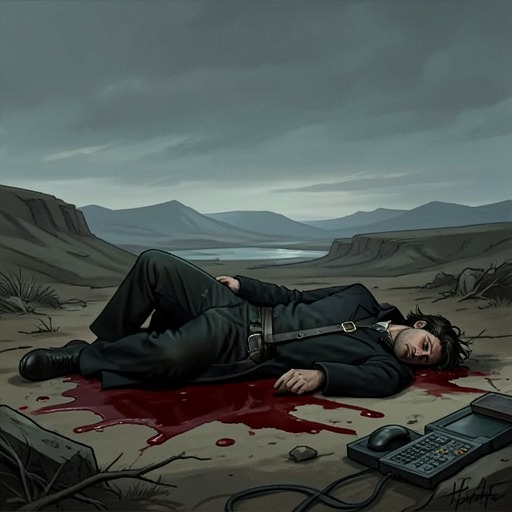
Karl seems to sense danger, looks back, and pedals furiously. Searchlights flare on and hold him in their beam while a siren wails and orders are shouted. In front of Leamas, two policemen drop behind sandbagged slits and ready their automatic rifles. The East German sentry fires into his own sector. The shots first thrust Karl forward, then pull him back; still on the bicycle, he passes the sentry before sagging and falling. The clatter of the bicycle marks the end of the attempt. Leamas hopes Karl is dead, a response that registers the immediate horror of what he has watched without making the outcome less uncertain in that moment.
Narrative and Thematic Significance
The checkpoint’s repeated barriers make the difference between the two sectors concrete, but they also expose how little control an individual has over the conditions of passage. A vehicle can be searched, stopped, questioned, and released; a person on a bicycle can appear to clear Customs and still be caught by a sentry’s gun. In each case, the border’s formal steps promise an orderly process while the armed force behind them determines whether movement is possible.
The historical recollection of tanks confronting one another gives the crossing a second scale: individual attempts unfold under the shadow of international confrontation. The Wall is described as both theatre and symbol, and the checkpoint’s brightly lit road, guarded barriers, and armed watchers make that theatrical quality material. Yet the spectacle is not safely symbolic. Karl’s fall and the close scrutiny of the cars show the cost of treating the boundary as a stage on which power displays itself. Checkpoint Charlie concentrates the novel’s conflict between the appearance of controlled passage and the lethal authority that can stop it.