Control
The Spy Who Came in from the ColdControl is the senior British intelligence officer who assigns Alec Leamas a final operation against Mundt, and the novel’s central voice for the moral logic of the Service. He speaks of sympathy, defense, and ordinary people’s safety, yet authorizes a scheme whose success depends on deception and on people being treated as expendable. The gap between his humane manner and the operation’s consequences makes him less a simple villain than the composed representative of an institution that calls its compromises necessary.
Identity and Manner
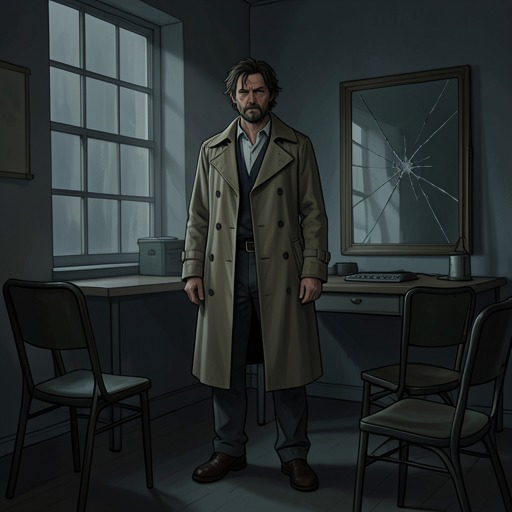
When Leamas returns to the Circus, Control shakes his hand with careful, almost clinical attention and invites him to sit, apologizing that he must be tired. His voice is described as a donnish bray, and his manner combines paternal solicitude with the formal authority of a superior assessing a subordinate. The courteous gestures do not make the encounter intimate: Control is measuring Leamas while preparing to ask him to serve again.
Control also presents himself as a reflective moralist. He tells Leamas that people in the Service cannot live entirely without sympathy, even when they perform hardness toward one another, and invokes the idea of coming in from the cold. His language recognizes the human need for connection, but the recognition becomes a prelude to asking Leamas to remain isolated and useful for longer.
The Case for the Operation
Control explains the Service’s ethic as defensive: it does disagreeable things, he says, so that ordinary people can sleep safely. He admits that it sometimes does wicked things, then argues that the opposing side’s methods must be compared with its own methods, and one side’s ideals with the other’s ideals. His argument is not that British methods are innocent; it is that they cannot afford to be less ruthless merely because the government’s stated policy is benevolent. In this account, necessity narrows the space in which moral judgment can operate.
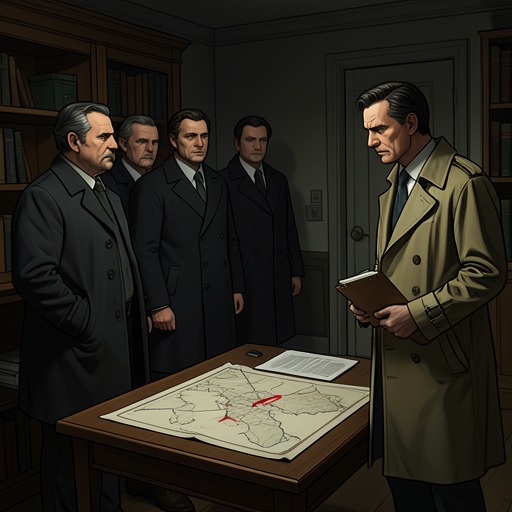
On that reasoning, Control wants to get rid of Mundt. Leamas objects that the British have nothing left in East Germany to protect after Riemeck, the last remaining source, is gone. Control’s response is not to dispute the loss but to ask whether Leamas is tired of spying. If Leamas were finished, Control says, the Service would have to find another way to deal with Mundt; the proposed plan is out of the ordinary. The exchange makes Leamas’s exhaustion part of the operational calculation: his willingness to continue is itself a resource the Service needs to establish.
Control and Leamas
Control turns the language of care into a recruitment instrument. He asks whether Leamas is burnt out and acknowledges that the prolonged performance of hardness cannot be sustained indefinitely. Yet, after eliciting Leamas’s assent to the defensive rationale, he tells him to stay out in the cold a little longer. The tender metaphor and the hard instruction arrive together: Control understands the price of isolation, but understanding does not exempt Leamas from paying it.
He calls the assignment Leamas’s last job and promises that afterward he can come in from the cold. He also asks whether anything should be done for Liz, such as providing money. Leamas says he will take care of her when the operation is over; Control agrees that acting now would be insecure. Their exchange establishes that the Service recognizes Liz as someone affected by Leamas’s work, but keeps assistance subordinate to operational security. Control offers a future beyond the mission while accepting that its present demands constrain Leamas’s personal choices.
The Hidden Hand in the Case
Control’s involvement reaches further back than the assignment conversation initially suggests. During the investigation into payments associated with the agent network, Leamas explains that Control was running the case and feared that a Resident might be recognized at a bank. Control therefore used Leamas as a postman. This detail recasts Leamas’s role: he was not merely a field officer attached to events, but a component in a carefully managed financial procedure whose purpose was to protect the network’s identities.
That management also helps explain why Control can speak of the loss in East Germany as a strategic problem while continuing to direct the response. Leamas’s assertion that there is nothing left to protect does not end the matter; Control’s goal has shifted to removing Mundt. The surviving evidence of the network, its destruction, and the attempt to act against Mundt belong to one chain of decisions overseen from London, though the people carrying them out have limited knowledge of the whole design.
Responsibility and Consequence
The eventual outcome tests Control’s rhetoric against what the operation has done. Leamas tells Liz that the operation has paid off and that this is the only rule, while also admitting that it makes him sick with shame and anger. His account identifies London as the winner, but also recognizes the operation as foul. The novel does not present this as an uncomplicated vindication of Control’s defensive ethic: the strategic gain coexists with the destruction of people caught within the plan.
Control does not appear in the final scene at the Wall, where Leamas finds Liz dead and is then shot. His absence is significant in relation to the command structure he represents: the people who decide and justify the operation are separated from the immediate human cost borne by those who enact it. The promise that Leamas could return from the cold cannot undo that ending. Control’s role therefore embodies the novel’s central ethical tension—not simply whether the Service can defend itself, but whether the claimed necessity of collective security can make an individual life expendable without leaving those who authorize the sacrifice morally implicated.