Deutsche Demokratische Republik
The Spy Who Came in from the ColdEast Germany, or the German Democratic Republic, is the state on the eastern side of the divided German border and the setting for the novel’s decisive intelligence and political proceedings. Its fortified frontier makes clandestine work physically perilous, while its security institutions turn the search for a hidden British agent into a struggle over evidence, authority, and survival. When Alec Leamas is brought there, the Zone is not simply the destination of a defector: it is the political system in which his story is examined and the truth of Operation Rolling Stone is forced into view.
Territory and the Divided Border
The novel places East Germany within the dangerous geography of a divided Berlin and a broader East–West confrontation. The Berlin Wall is described as both a practical barrier and a political spectacle: its guards embody the state’s force, while the Wall becomes a symbol of ideology made physical. At the Friedrichstrasse crossing, soon known as Checkpoint Charlie, American and Soviet Bloc tanks face each other across a strip of road, their crews keeping their engines ready in an atmosphere likened to a pre-fight contest. The Embassy’s evacuation discussions and uncertainty about where anyone could flee give the border crisis an existential scale.
The Wall also changes the conditions under which intelligence can operate. British, American, French, and West German networks had not, so far as the narrator knew, predicted its construction. Some agents would become stay-behind operatives, relying on hidden radios and prearranged secret writing. The new frontier makes espionage more clandestine, perilous, and crowded; even agents who remain in West Germany are not literally trapped, but face greater administrative obstacles in maintaining secret lives. The account thus connects East Germany’s territorial division to a transformation in the practical methods and risks of intelligence work.
The boundary is reinforced beyond Berlin. During Leamas’s transfer east, the cars cross at a prearranged time, passing the Eastern fortifications: anti-vehicle obstacles, observation towers, and double layers of barbed wire. They proceed through checkpoints without stopping at the second barrier, while East German border personnel watch through binoculars. These details establish that crossing is controlled by an organized apparatus, even when a passage has been arranged in advance.
Security Apparatus and Political Power
East Germany’s intelligence service, the Abteilung, is central to the country’s role in the novel. Hans-Dieter Mundt rises from a minor official working under cover in London for the East German Steel Mission to the head of its Ways and Means Department, which allocates currency, equipment, and personnel for special tasks. After a struggle for power, he becomes deputy director of operations. Jens Fiedler leads counterintelligence, while Jahn takes over the facilities department. The shift in leadership reduces the influence of Soviet liaison officers and removes members of the old guard, placing the service’s internal politics alongside its foreign operations.
The Abteilung’s work depends on the ability to identify, recruit, and protect sources, but its networks are vulnerable. Leamas recalls that Berlin had once been crowded with low-grade agents and competing services; intelligence was so commonplace that recruitment and betrayal could follow one another with unnerving speed. A promising source, Feger, provided a breakthrough, but the service later needed higher-grade intelligence than the material available to it. The account makes East Germany’s intelligence landscape one of overcrowded networks, compromised contacts, and prolonged waits for information of real value.
The changing leadership is accompanied by a pattern of lethal pressure on agents. A courier is shot after leaving a West Berlin cinema. A discarded agent from Peter Guillam’s network is found dead beside a railway line, and two members of another network under Leamas’s control are arrested and sentenced to death. Leamas comes to understand that these losses are not unrelated accidents. By the time Karl Riemeck is in danger, the accumulated damage has left Leamas departing Berlin without an agent he considers valuable. East Germany’s security contest is therefore registered not only through institutions and titles but through the progressive destruction of the networks operating against them.
Leamas’s Arrival and the Intelligence Case
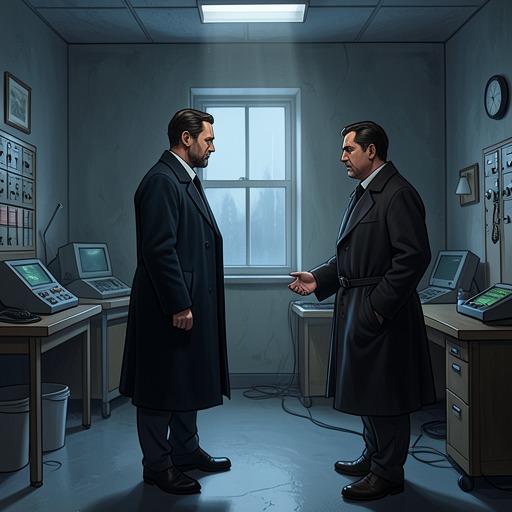
Leamas’s entry into East Germany is presented as a managed transfer rather than an escape into an unknown territory. After crossing the sector border, he expects to travel farther east, but Peters tells him that they have reached the German Democratic Republic and that accommodation has been arranged. They will remain there briefly so that the Germans can question him. The sequence places East German interrogation between his initial handling in the West and the next stage of his journey, making the country a site of transition as well as confinement.
The arrangement reveals the constraints under which East German officials operate. Peters explains that the first interrogation was conducted in the West because an embassy could provide the necessary link, facilities, communications, and immunities. The German Democratic Republic had no embassies in the West at that point, so its liaison section had to use the Soviet Embassy in The Hague. Fiedler calls this a matter of necessity; Leamas recognizes that the use of a Soviet intermediary had also shaped his trust in the people handling him. The episode shows how diplomatic limitations directly affect the mechanics of an intelligence operation.
In East Germany, Leamas’s account becomes material for Fiedler’s investigation of Operation Rolling Stone. Fiedler argues that the information Leamas has already supplied about Riemeck and the Berlin organization is accurate but insufficiently valuable to explain the sum associated with the operation. The unresolved question is whether Rolling Stone points to a spy at a particular level or department, and what further evidence could identify that person. Fiedler tells Leamas that the operation was directed against the German Democratic Republic, a revelation that gives the inquiry a national and institutional stake rather than leaving it as a general search for an unknown agent.
The financial trail gives Fiedler a way to test the suspicion. A Copenhagen bank records that money deposited by Leamas under the name Robert Lang was withdrawn by the account’s co-signatory one week later. Fiedler connects the date to a clandestine visit Mundt made to Denmark, where he met an American agent. At the Tribunal, the same evidence is laid out more precisely: Leamas deposited ten thousand dollars on June 15, and the co-signatory withdrew it a week later, on June 21, when Mundt was in Copenhagen. A later deposit in Helsinki supplies another line of comparison: Leamas visited around September 24, and Mundt made a clandestine journey to Finland on October 3. Fiedler uses the pattern to argue that the evidence implicates Mundt, while the Tribunal’s proceedings make clear that a correspondence of dates still has to be interpreted within a contest over political power.
Tribunal and the Limits of Proof
The Tribunal is convened expressly by the Praesidium, and its presiding officer states that the proceedings are secret and that the body is responsible to the Praesidium alone. It will hear evidence as it sees fit. Fiedler begins with papers bound by black cord and presents himself, in Leamas’s assessment, as a man regretfully accusing his superior. The formal setting promises a test of evidence, but its secrecy and restricted accountability also locate the hearing within the Party’s political order.
Fiedler’s case relies on the procedural handling of Operation Rolling Stone as well as the bank records. He recalls the security rules governing the file’s circulation, the letters to the Copenhagen and Helsinki banks, and the reply that came from Copenhagen but not Helsinki. The missing reply remains unexplained; the surviving one records the movement of the money. Fiedler asks the Tribunal to compare the dates of Leamas’s deposits and Mundt’s travels. The case thus turns on a sequence of partial signals—some documented, some absent—and on whether their pattern is strong enough to overcome the institutional danger of accusing a senior official.
The hearing does not deliver the straightforward resolution Fiedler seeks. After the Tribunal’s president says that Leamas is already under arrest and that the Tribunal has no executive power, Leamas suddenly understands the larger deception. Later, he tells Liz Gold that Mundt is London’s agent, recruited while he was in England, and that the operation was designed to protect him from suspicion. In his account, the British service had arranged matters so that Fiedler, who had begun to suspect Mundt, would be destroyed. East Germany is consequently the setting for a reversal: what appears to be an internal investigation of a hostile agent has also served the interests of an agent working for Britain.
Narrative Significance
East Germany’s geography and institutions make the novel’s central uncertainty concrete. A border crossing can be arranged yet remain surrounded by fortifications; an intelligence service can possess extensive files yet struggle to establish who is working for whom; and a secret Tribunal can hear evidence without holding executive power. The country’s political structure determines where Leamas can be questioned, how Fiedler can bring his case, and why the discovery of a possible British agent inside the Abteilung becomes a threat to more than one side.
The novel’s depiction of the Zone also connects state power to the ordinary vulnerability of individuals and networks. The Wall leaves agents dependent on clandestine communications, while the Abteilung’s internal hierarchy governs the fate of sources and officials alike. By bringing Leamas into East Germany and making him a witness in its secret proceedings, the narrative turns the divided state from backdrop into an active mechanism of the plot: the place where political secrecy, compromised evidence, and competing loyalties converge.