Division of Berlin
The Spy Who Came in from the ColdDivision of Berlin is the political and physical condition that gives the novel’s espionage its geography and its menace. The Wall is at once an ideological spectacle, a hardened border, and an obstacle that converts movement between the city’s sectors into a matter of surveillance and possible death. Its presence constrains agents and fugitives alike, making the division not merely a setting but a force that shapes what can be known, attempted, and escaped.
The Wall as spectacle and political boundary
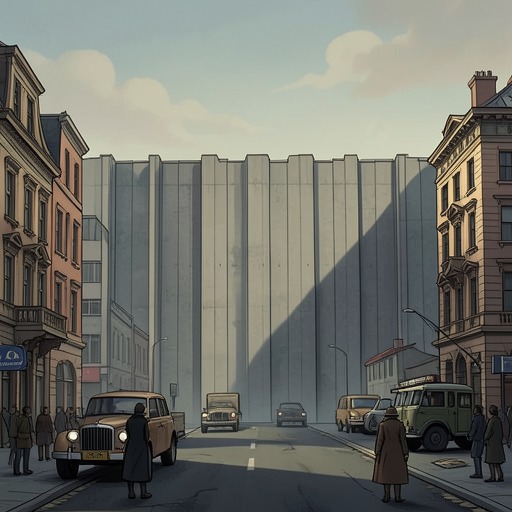
The Wall’s construction is presented as an abrupt shock rather than a background detail. The narrator recalls flying from Bonn to see it as soon as it began to go up. Watching its guards, he describes an involuntary grin that sat uneasily beside the disgust and terror he felt. That contradiction captures the Wall’s theatrical power: it was appalling in human terms, yet also a stark, almost staged image of ideology made physical. Its force lay partly in making political division visible and immediate.
The crisis extended beyond the barrier itself. When the first barricades were reported, workmen painting a dining room in Königswinter quietly washed their brushes and went home. At the embassy, officials privately discussed evacuation plans, although the prospect of a world-ending confrontation made the question of where to evacuate feel almost impossible. At the Friedrichstrasse crossing, soon known as Checkpoint Charlie, American and Soviet Bloc tanks faced each other across a hundred-yard strip of road, their guns trained on one another. Their engines roared as if they were preparing to advance, but the narrator compares the display to boxers psyching one another before a fight. The division therefore carried the threat of a local border crisis expanding into a confrontation between armed blocs.
The Wall also changed the conditions of espionage. British, American, French, and West German secret-agent networks had been caught unprepared; to the narrator’s knowledge, none had forecast the event. Some agents had other allegiances, while others became stay-behind operatives, relying on concealed radios and prearranged forms of secret writing. With the barrier in place, clandestine work became more perilous and crowded, and the secret lives of agents on either side became harder to administer. The boundary did not simply separate territories: it disrupted intelligence systems and forced them into more covert methods.
A border made harder to cross
The division is not static in the novel’s recollections. The Wall remains standing and is strengthened and heightened; mined strips and carefully smoothed earth make attempts at escape easier to detect. The narrator lists different ways people nonetheless tried to get out: climbing, crashing through, digging underneath, or building a glider. The range of attempts measures both the border’s material severity and the persistence of those who sought to cross it. Because successful escapees were few, the narrator regards them as heroes, and sees their acts as a vanguard of a later popular movement against East Germany’s regime.
In the novel’s immediate landscape, the border appears as an ugly structure of breeze blocks and barbed wire. At night, cheap yellow lighting falls across it, while searchlights and arclights illuminate the checkpoint. Beyond the barrier, the unrestored parts of Berlin are rendered as a half-world of ruins, seemingly flattened into two dimensions. This visual arrangement makes division feel like more than a line on a map: it separates not only political jurisdictions but also distinct fields of visibility, danger, and movement.
Crossings, surveillance, and failed escape
The checkpoint scenes show how closely a crossing depends on timing and official scrutiny. A bicycle can be carried through document checks and Customs, but passing those stages does not mean reaching safety. During Karl’s attempted escape, he rides toward the barrier after apparently clearing the paperwork and Customs inspection. A sentry remains on the bridge; then searchlights abruptly catch Karl in their beam, a siren sounds, and orders are shouted. East German policemen take up positions behind sandbagged openings and load their automatic rifles. The sentry fires into his own sector. Karl is hit, continues moving briefly, then collapses as his bicycle clatters to the ground. The crossing’s apparent routine gives way in seconds to a lethal demonstration of the border’s control.
Leamas watches the attempt through binoculars. At first he believes Karl has made it through the document check and needs only to pass the remaining barriers to safety. The sudden illumination and gunfire reverse that expectation. The scene makes surveillance tangible: the border is watched from the bridge, exposed by searchlights, and defended by armed men whose view is organized through fortified firing slits. Escape is not simply a matter of courage or a valid document; the crossing can be transformed into a trap by the authorities’ capacity to observe and act.
A later passage presents a different crossing, this time as a controlled movement eastward. Leamas rides in a Mercedes with Peters while a DKW draws attention at the checkpoint. After a delay of about ten minutes, the DKW overtakes them and stops at the police hut. The barrier rises for that car, and both vehicles cross together, the Mercedes accelerating across the checkpoint. The passage describes the crossing between the two checkpoints as fifty yards, with dragons’ teeth, observation towers, and double aprons of barbed wire visible on the eastern side. At the second checkpoint, the booms are already lifted; the guards watch the Mercedes through binoculars but do not stop it. The DKW later reappears behind them, and the cars continue east through Berlin rather than stopping to change vehicles or celebrate.
The contrast between Karl’s exposed bicycle and the escorted cars reveals how the same divided city produces radically different terms of passage. A would-be escapee meets searchlights, gunfire, and an uncertain route to safety. Leamas, by contrast, crosses with Peters under an arrangement whose timing and coordination have been prepared in advance. The border is dangerous, but its danger is not distributed evenly: papers, vehicles, escorts, and prior coordination can determine whether a crossing becomes a fatal attempt or an apparently easy passage.
Historical and narrative significance
The narrator’s retrospective account links the bravery of individual escapees to the eventual liberation of the many. He argues that the East German regime was hated by those it governed and that accusations against its leadership were, in the end, justified. This historical perspective reframes the Wall: its power to obstruct people and to terrify observers did not make it permanent. The rare person who crossed successfully could be seen not only as an individual fugitive but also as part of a longer challenge to the regime.
At the same time, the Wall’s enduring presence gives the novel a deliberately unresolved pressure. It remains fortified; crossings remain difficult and unequal; and the intelligence services that might have anticipated the division are shown as fallible, compromised, and forced to adapt after the fact. The city’s division binds political spectacle to practical procedure: a wall seen from a distance, a checkpoint measured in yards, a searchlight catching a cyclist, or raised barriers allowing a convoy through. Through these details, Berlin’s partition becomes a continuing test of agency. People can choose, scheme, and attempt escape, but the border’s institutions and weapons decide how narrow the available paths will be.