Karl Riemeck’s escape attempt and shooting
The Spy Who Came in from the ColdKarl Riemeck’s escape attempt and shooting is the fatal border-crossing that makes the risks of the Berlin intelligence network immediate to Alec Leamas. From a checkpoint hut, Leamas watches Riemeck pass inspection on a bicycle and come within sight of safety; then searchlights expose him, an East German sentry fires, and Riemeck falls. The escape fails, but the intelligence he carried—and the questions his access raises—continues to shape the novel’s investigation of the hidden loyalties behind Operation Rolling Stone.
Causes and Setting
Riemeck’s attempt unfolds in the divided Berlin of the Berlin Wall, where crossing is not a simple passage from one side to another but a sequence of inspections, barriers, armed observation, and exposed ground. The crossing point is organized around a white demarcation line, a sandbag emplacement, a telescope, and a Vopo hut. These details make the border a working apparatus of surveillance: movement is watched, described, and controlled, while the exposed traveler has little room to conceal a mistake or change course.
The Wall’s broader context intensifies the danger. It had become a symbol and a practical instrument of ideological division, while the networks of British, American, French, and West German agents had been caught unprepared by its construction. The resulting espionage was more clandestine and perilous, with some agents reduced to hidden radios and prearranged secret writing. Riemeck’s bicycle escape gives that altered landscape a human scale: the political barrier is encountered not as an abstraction but as a route whose last few yards can decide whether an agent lives.
Leamas is already at the checkpoint when a policeman calls him to the observation window. A younger policeman reports a man with a bicycle, and Leamas recognizes Karl despite the distance and the old Wehrmacht macintosh that shrouds him. The recognition changes the scene from routine observation to personal suspense: the man approaching the barrier is not an anonymous traveler but an agent whose fate Leamas has a direct stake in.
The Crossing and the Shooting
At first, Riemeck appears to be getting through. He leans his bicycle against the railing, walks casually to the Customs hut, emerges, waves cheerfully to the man at the barrier, and sees the red-and-white pole rise. Leamas follows each step and believes Riemeck has passed the document check, leaving only currency and Customs behind him. He thinks the escape has succeeded, while still recognizing that the Vopo in the road and the line itself remain between Riemeck and safety.
The turn comes when Riemeck seems to hear something or sense danger. He glances over his shoulder and pedals furiously, bent low over the handlebars. A lone sentry on the bridge is watching him. Searchlights suddenly illuminate the road and hold Riemeck in their beam; a siren sounds and orders are shouted. Inside the hut, the two policemen drop behind the sandbagged slits and ready their automatic rifles. The transition from casual movement to armed response is swift, and the bright beam makes concealment impossible.
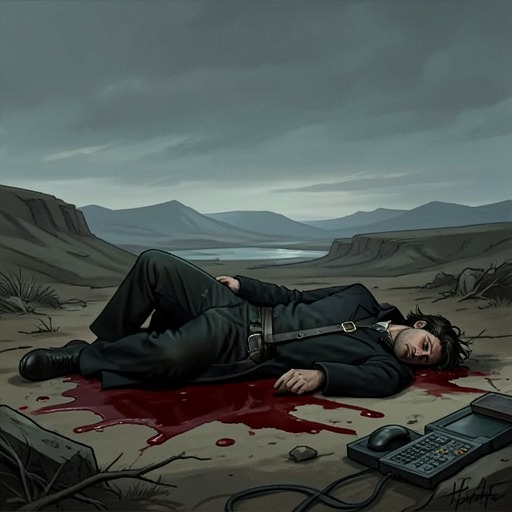
The East German sentry fires into his own sector, away from the observers in the hut. The shots appear to thrust Riemeck forward and pull him back, yet he continues on the bicycle past the sentry as the firing continues. Then he sags and rolls to the ground; the clatter of the falling bicycle is plainly audible. Leamas hopes Riemeck is dead. The narrative confirms the shooting and the fall, but this immediate scene leaves the precise outcome unstated; later discussion treats Riemeck as dead and his escape as a fatal failure.
Intelligence and the Questions Left Behind
Riemeck’s importance is not limited to the attempted escape. The intelligence associated with him includes the minutes of the Praesidium’s last meeting, a draft revision of East Germany’s relationship to COMECON, and a breakdown of the East German Intelligence Service, including departmental functions and personnel. When Peters hears how much information came from Riemeck, he doubts that Riemeck could have obtained it alone and concludes that he must have had help. That doubt becomes a lasting analytical problem: the escape and shooting remove the agent, but do not settle the question of who contributed to his intelligence.
Leamas remembers that Control had asked about Riemeck’s access as well. He knows Riemeck had some helpers, including guards by the canal, but regards them as minor; Peters’s insistence that there was a higher-level collaborator suggests a different scale of assistance. Leamas wonders whether this collaborator was the Special Interest whom Control was anxious to protect from Mundt, and whether Riemeck and that person together supplied what neither could have obtained alone. The escape’s failure thus feeds directly into the novel’s larger problem of inference: the same intelligence can point toward an agent’s access while concealing the identity of the person behind it.
Fiedler later argues that Leamas’s account of Operation Rolling Stone is incomplete. Leamas acknowledges that the evidence would make him uneasy if he were investigating a possible spy, but says that an indication of a mole does not by itself permit the arrest of an entire government service or the laying of traps for a whole department. In this reasoning, Riemeck’s case is not a closed explanation but a clue whose meaning depends on other evidence. His death leaves the intelligence service with the traces of his work and a dangerous gap where direct testimony might have been.
The Case Against Mundt and the Reversal
The later case against Mundt draws on financial records linked to Leamas’s visits to Copenhagen and Helsinki. Fiedler points to a Copenhagen deposit in the name Robert Lang: the co-signatory withdrew the ten thousand dollars a week after the deposit, on a date that coincided with Mundt’s visit to Denmark. In the Tribunal, Fiedler sets out the corresponding dates for the Copenhagen and Helsinki transactions and Mundt’s clandestine journeys. The sequence is offered as evidence that Mundt was the hidden collaborator whose activities connect the accounts to Operation Rolling Stone.
The pattern appears persuasive because it turns movements and money into an intelligible chain. Yet the Tribunal’s conclusion does not deliver Leamas the certainty he expects. After the President says Leamas is already under arrest and describes him as a British agent provocateur and murderer, Leamas looks toward Mundt and suddenly understands the trick. That recognition reframes the preceding evidence: the case built around Riemeck’s intelligence, the money, and the suspected collaborator has been part of a larger deception. The escape attempt therefore resonates beyond the border scene. It is the first visible rupture in a chain of evidence that appears to reveal the hidden agent, only for the later reversal to expose how carefully the apparent truth has been arranged.
Narrative Significance
The crossing is staged through observation rather than direct access to Riemeck’s thoughts. Leamas watches through a window as others use binoculars and a telescope, while the policemen’s commentary turns the traveler into a sequence of visible actions: arrival, inspection, movement toward Customs, and the final dash. The reader shares Leamas’s changing assessment—from cautious hope, to belief that Riemeck is through, to the certainty of gunfire and collapse. The border’s surveillance does not merely record the event; it governs what can be seen and how quickly apparent safety can become exposure.
The bicycle and its audible fall give the scene a concrete ending, but the consequences remain open. Riemeck’s escape is stopped by the armed border, while his intelligence continues to circulate among rival interpreters. His shooting makes the cost of clandestine work visible and, at the same time, leaves an evidentiary absence: he cannot clarify how he obtained what he knew or identify the possible high-level help. That gap becomes part of the machinery of suspicion through which Leamas, Fiedler, Peters, Control, and Mundt are understood. The scene’s decisive force lies in this double outcome: a failed escape that appears to close one life, and an unresolved intelligence trail that keeps moving toward the novel’s final exposure of betrayal.