Leamas and Liz Gold’s deaths at the Berlin Wall
The Spy Who Came in from the ColdThe deaths of Alec Leamas and Liz Gold at the Berlin Wall conclude their attempted escape and expose the human cost of the operation that has carried Leamas into East Germany. The crossing does not deliver them to safety: Liz is killed at the wall, and Leamas, who returns to her rather than escaping alone, is shot there. Their deaths make the border both a physical barrier and the final measure of the competing claims of duty, survival, and individual life.
The Wall as setting and threat
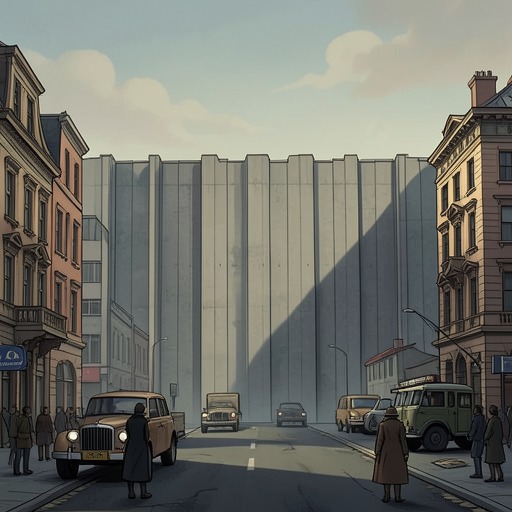
The novel’s ending gives a specific, immediate force to the Berlin Wall, which the author describes elsewhere as both theatre and a symbol of ideology gone mad. Its danger is not abstract. The escape takes place in a border landscape where observation, searchlights, sirens, armed sentries, and rapid orders can turn a crossing into a lethal confrontation. Earlier, the attempted escape of Karl Riemeck has already shown how quickly a person on a bicycle can be caught in the lights and shot while trying to cross. The final attempt repeats that pattern, but now the people exposed at the wall are Leamas and Liz.
The wider history surrounding the barrier sharpens the ending without making it inevitable in a simple way. When the Wall first went up, embassy officials discussed evacuation, while American and Soviet Bloc tanks faced one another at Checkpoint Charlie. Intelligence networks had been caught unprepared, and the author expected espionage to become more clandestine and perilous. The novel’s final crossing brings that historical danger into the lives of two individuals: the wall’s machinery of division is also a system that can decide who is allowed to pass and who is left exposed.
The crossing and the gunfire
As Leamas and Liz attempt to get over, massive lights converge on them. Blinded, Leamas turns away and pulls at Liz’s arm, at first believing that she has slipped. He calls to her and keeps drawing her upward, unable to see clearly amid the confusion. The scene’s abrupt change from attempted escape to exposure is marked by sirens and shouted orders; there is no gradual return to concealment once the lights have found them.
Leamas is half kneeling astride the wall when he takes hold of Liz with both hands and draws her toward him inch by inch. He is himself close to falling. Then shots are fired, and Liz’s arms slip from his grasp. From the Western side, someone calls, “Jump, Alec! Jump, man!” The voices of English, French, and German speakers overlap, and Smiley asks where the girl is. The shouted appeal to Leamas to save himself arrives at the instant when Liz’s fate has already interrupted the escape.
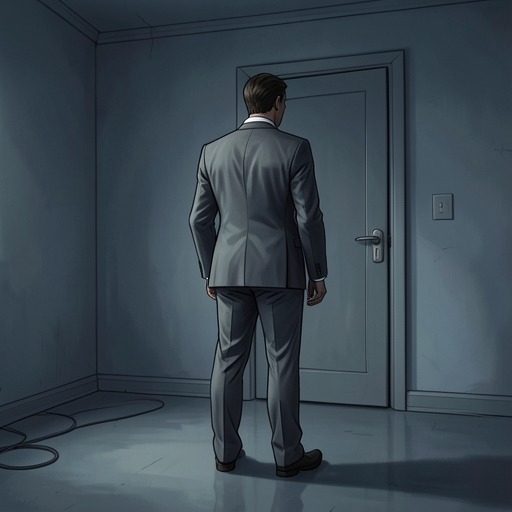
Shielding his eyes, Leamas looks down and sees Liz lying still. He hesitates, then climbs back down the same rungs and stands beside her. She is dead. Rather than continue toward the Western side, he returns to her at the foot of the wall. The guards then fire again; after the shots strike him, he falls. The attempted crossing ends with both of them dead, not with either reaching safety.
Choice, consequence, and the operation
The ending gives Leamas a final choice within a situation built by other people’s plans. Earlier, while being driven toward the crossing, he considers killing Peters or trying to run; he knows there are people in Berlin who could help him escape. He does neither. Instead, he travels with his captors across the sector border, where checkpoints, raised barriers, and a coordinated passage carry him eastward. Those earlier possibilities make his return to Liz at the wall consequential: when escape is again possible, he turns back toward her.
That choice follows a novel in which the language of necessity repeatedly competes with the value of a single life. Control describes the Service’s ethic as defensive, arguing that its disagreeable acts protect ordinary people, while admitting that it sometimes does wicked things. Fiedler, in turn, asks whether London would kill him if he were the person its operation required; the answer is that it depends on need. Leamas later acknowledges that the operation has paid off and that London has won, while also calling it foul and saying it makes him sick with shame and anger. The deaths at the wall make the cost of that reasoning concrete, without supplying a clean moral resolution.
Final significance
The ending is not simply an escape that fails. It closes the conflict between Leamas’s professional acceptance of expendability and his response to Liz as a person whose death he will not leave behind. His return cannot undo the operation or save her; it does determine that he will not use the final opportunity to leave her alone. The consequence is fatal, and the scene withholds any easy division between triumphant rescue and successful service.
The last image returns the novel to the divided world beyond the two dead figures. As Leamas falls, he sees a small car crushed between great lorries, with children waving cheerfully through its window. The everyday cheer of the children and the violence of the border coexist in the same glimpse. The book’s closing passage thereby places private loss beside a larger political landscape, but does not make the loss disappear into that landscape. The operation can be counted as a success by its institutional measure; at the Berlin Wall, its ending is the deaths of Leamas and Liz.