London
The Spy Who Came in from the ColdLondon is the setting in which the novel’s intelligence machinery and its human costs meet. It is the headquarters of the Circus, where Alec Leamas returns after his Berlin network has been compromised, but also the city of a squalid rented flat, failed attempts at ordinary work, public parks, and Liz Gold’s room. Its significance lies in that double role: a center of organized espionage and a landscape in which a discarded agent must try to live without it.
Institutional Center and Return
After the collapse of his Berlin position, Leamas is flown back to London and sees the Tempelhof runway sink beneath him. The return does not restore him to professional security. He understands himself as written off, comparing the condition to cancer or imprisonment, and regards Mundt as the man who has metaphorically drawn his teeth. In his account of the intelligence trade, results are its one moral law; he had stayed in Berlin, resisting a desk career in Whitehall, because his operational work produced results. His failure therefore means not simply a change of location but the end of the identity through which he had justified his life.
The Circus’s presence in London is made concrete at Cambridge Circus. Leamas and Fawley park near the junction, enter the building, and encounter the small administrative ritual of a visitor’s slip: Fawley asks whether Leamas has a pass, while Leamas protests that McCall knows him. The exchange sets a familiar, informal working culture against the institution’s formal procedures. London is where the returning operative must again pass through the doors of the organization, even as its judgments and personnel have already begun to leave him behind.
A Life After the Service
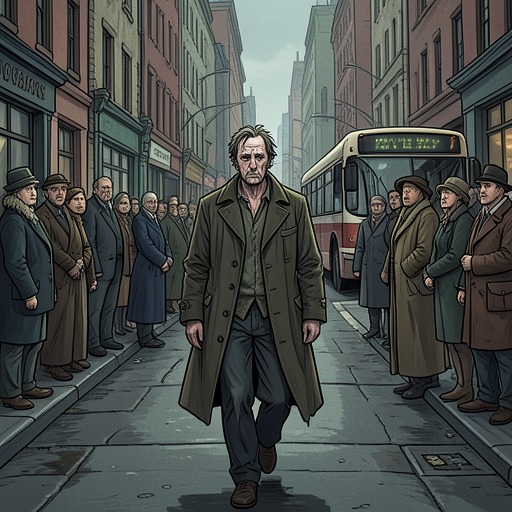
Leamas’s post-Service London is materially shabby. His small flat, painted brown and facing the grey backs of three stone warehouses, contains little to soften its neglect: fraying carpets, unlined curtains, clumsy dark furniture, and a yellow, crumbling geyser that gives hot water for a shilling. He buys lampshades and replacement sheets, but otherwise tolerates the rooms. The details make his isolation domestic and measurable; the setting offers neither the glamour of espionage nor the comforts of a settled civilian life.
He needs work and has no money. A job with an industrial adhesive manufacturer lasts only a week: the smell of decaying fish oil soaks into his clothes and hair, and he eventually cuts his hair close and throws away two good suits. He next tries selling encyclopedias to suburban housewives, but cannot make a sale. After abandoning the sample in a telephone booth, he gets drunk at a pub, shouts at a woman who approaches him, and is thrown out. The city’s ordinary employment and social spaces do not absorb him; instead, each attempt at civilian life exposes how little use he has for the roles available to him.
A probation officer later proposes that Leamas become a male nurse at a mental home in Buckinghamshire. He agrees to apply, takes down the address and train times from Marylebone, and hears that the railway is electrified as far as Great Missenden. The practical plan briefly gives his London days a possible direction. Yet the same encounter leaves him with a parcel he feels he must dispose of, and the episode turns an apparently routine walk into a return to the machinery of his past.
Parks, Parcels, and the City’s Hidden Traffic
With a little money in his pocket, Leamas plans to walk through Hyde Park, Piccadilly, Green Park, St. James’s Park, and Parliament Square, then down Whitehall to the Strand for a steak near Charing Cross station. The spring day is described as beautiful, with crocuses and daffodils in the parks and a cool wind from the south. Against this open, ordinary route, the parcel becomes an awkward burden. The litter baskets are too small, and he cannot bring himself to remove the papers inside: an insurance card, driving licence, and E.93 in a buff official envelope.
He sits on a bench, places the parcel beside him, shifts away from it, and eventually leaves it behind as he walks toward the footpath. A man in an army macintosh calls after him, holding the brown-paper parcel. The scene turns London’s public space into a place where the agent’s discarded identity can be retrieved by others. Even the planned journey toward a cheap meal is interrupted by the administrative remnants of his former life.
London also appears in the wider history invoked around the novel. The narrator recalls flying from Bonn to see the Berlin Wall as it went up, and describes the Wall as both theatre and a symbol of ideology’s violence. At Checkpoint Charlie, American and Soviet Bloc tanks faced each other across the road; intelligence networks had failed to forecast the barricades, and the resulting border made espionage more clandestine and perilous. These references are not London street scenes, but they clarify what the city’s intelligence center is responding to: a divided Europe whose boundaries shape the risks and failures that send Leamas back to the Circus.
Liz Gold and the Limits of Civilian Connection
Liz Gold’s room lies at the northern end of Bayswater. It has two single beds and a charcoal-grey gas fire whose modern hiss supplies the room’s light when Leamas is there. She used to sit beside him on the bed and kiss him, or watch the fire with her face pressed against his. After his departure, she fears that thinking about him too long will make her forget what he looked like, and holds to brief recollections of small things he said or did, including the more painful memory of how often he ignored her.
The room is defined by the scarcity of what remains: Liz has no photograph, no souvenir, and no mutual friend through whom she can keep a connection to Leamas. She visits his former landlord, who says that Leamas paid his rent like a gentleman and that a shy man with spectacles later paid what remained owing. This small domestic testimony contrasts with the secrecy and calculated appearances of the intelligence world. London contains the traces of a relationship, but not the means to make it secure or legible to the people left behind.
The City as Intelligence Geography
The novel’s London is more than a headquarters on a map. Cambridge Circus represents an organization whose work is justified by results, while Leamas’s rooms and failed jobs show the personal cost of being discarded when those results end. Bayswater’s gas-lit intimacy offers a counterpoint: affection and memory persist in a small private room, but Liz has no photograph or shared circle to anchor them. Across parks, offices, pubs, and rented rooms, London joins institutional power to ordinary vulnerability, making the city the place where the supposedly professional life of espionage is exposed as something that continues to shape even those trying to leave it behind.