
Main Story Flow
The StrainMajor events ordered chronologically by story time.
increasing Bearing strength in each event
 decreasing
Bearing strength in each eventdecreasingRegis Air Flight 753 incident
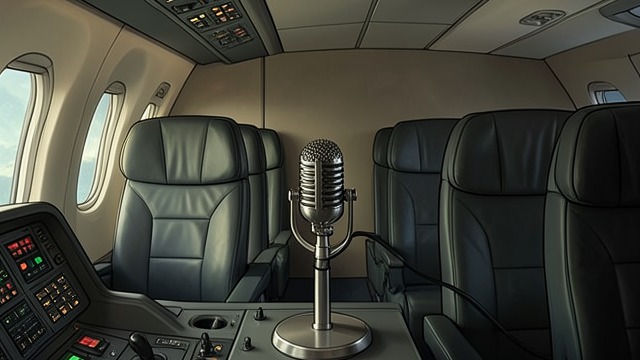
Regis Air Flight 753 incident is the catastrophic disappearance and apparent mass death aboard a commercial flight from Berlin to New York. Its arrival at JFK turns an inexplicable aviation emergency into the first major breach between ordinary public life and the hidden vampire contagion. The airplane is at once a crime scene, a medical puzzle, and a sealed vessel carrying the logic of the coming disaster: silence replaces communication, the dead become vectors, and the institutions summoned to contain the crisis initially lack the language to recognize it.
The Flight and Its Sudden Silence
The incident begins in the cockpit of Flight 753, identified in the NTSB transcription as aircraft N323RG on the Berlin-to-New York route dated September 24, 2010. The crew’s recorded exchanges initially belong to the reassuring routine of commercial aviation. First Officer Ronald W. Nash IV reports that the landing gear is clear, while Captain Peter J. Moldes remarks on coming home. The ordinary rhythm ends abruptly with banging, static, and a high-pitched noise. The transmission then stops. Nothing in the available cockpit record explains what happened, and the abrupt acoustic rupture becomes the first formal trace of an attack that cannot yet be named.
The aircraft nevertheless reaches John F. Kennedy International Airport. In the tower, the radar display is described as a glowing green monochrome dish, crowded with coded blips, each one standing for hundreds of human lives, or souls. That image gives the incident its first moral scale: the controllers are not merely tracking machinery but shepherding large concentrations of vulnerable people. The plane’s expected transition from monitored flight to safe landing is therefore violated by the silence that follows. Flight 753 arrives as an object that can be seen and handled, but not understood.
The Empty Airplane as Emergency Scene
The response at JFK proceeds according to the procedures available for a major aviation emergency. The maintenance crew positions oxygen tanks beneath the fuselage and prepares to cut into the aircraft through the Boeing 777-200LR’s designated rear chop-out area, between the aft cargo doors. The aircraft’s long-range design, with auxiliary fuel tanks in the rear cargo hold, makes the location of the cut a matter of technical necessity rather than improvisation. An Arcair exothermic torch is selected because it is portable and oxygen-powered, avoiding hazardous secondary gases such as acetylene; the cut is expected to take about an hour.
Yet the physical preparations cannot conceal the central anomaly. No one on the tarmac expects a happy outcome because there have been no 911 calls from inside the aircraft and no light, noise, or other signal from the passengers or crew. The plane is not visibly destroyed, but it has ceased to behave like a populated human environment. A Port Authority emergency-services unit establishes a mobile command vehicle behind powerful construction lights. Its SWAT personnel arrive equipped for evacuation, hostage rescue, and antiterrorism operations, while German shepherds search around the landing gear. These ordinary tools of emergency governance—cutting torches, tactical teams, dogs, and floodlights—are placed against an event whose cause lies outside their working assumptions.
Discovery of the Survivors
The first decisive reversal occurs when the investigators find Captain Doyle Redfern alive. Redfern lies on the floor with his eyes open, his throat working and his open mouth apparently struggling against the air. Ephraim Goodweather recognizes that the aircraft is not simply a mass-casualty scene and announces that there is a survivor. He requests a Kurt isolation pod for the pilot and insists that the entire airplane must be searched passenger by passenger.
The discovery changes the meaning of the flight. A living pilot creates the possibility of testimony, but his condition also makes him a potential source of infection. The response consequently shifts from recovery of bodies to controlled medical investigation. The survivors become crucial not only because they may have witnessed the event, but because they may have been involved in it or altered by it. Jim Kent later reports that all four survivors are in critical but stable condition in the isolation wing at Jamaica Hospital Medical Center: Redfern, a thirty-two-year-old third pilot; a forty-one-year-old lawyer from Westchester County; a forty-four-year-old computer programmer from Brooklyn; and a thirty-six-year-old Manhattan and Miami Beach musician known professionally as Gabriel Bolivar.
The passenger manifest also reveals two figures of particular interest. Jim identifies federal air marshal Charpentier, seated in the exit-row window seat at 18A. A second marked passenger is Rolph Hubermann, a German diplomat seated in business class, second-row seat F, who is in New York for United Nations Council talks on Korea. The possibility that Hubermann carried a diplomatic pouch prompts German officials connected with the United Nations to travel to New York to retrieve it. These details widen the incident beyond a local airport emergency: the flight carries security implications, international attention, and information whose importance is not yet clear.
Institutional Containment and Concealed Scale
The handling of the dead demonstrates how quickly the incident strains the boundaries between aviation, public health, and municipal administration. Because Queens has jurisdiction but Manhattan headquarters is better equipped, the bodies are to be distributed among facilities in Manhattan, Brooklyn, and the Bronx, approximately fifty to each. Their transport is arranged through refrigerated trucks, using a precedent associated with the recovery of remains from the World Trade Center and involving the Fulton Fish Market in Lower Manhattan. The comparison gives the event a grim civic scale while also showing how institutions repurpose existing disaster procedures when confronted with something unprecedented.
Ephraim’s contact with the crisis begins through a phone call that arrives despite his absence from the on-call schedule. His mobile phone displays a local 718 number labeled JFK QUARANTINE. The Centers for Disease Control and Prevention maintains a quarantine station inside the international terminal, a modest way station with offices and an examining room intended to identify or delay outbreaks before they reach the wider United States. Its ordinary cases include ill passengers with diseases such as meningococcal meningitis or severe acute respiratory syndrome. Flight 753 enters this system as though it were another public-health emergency, but its scale and silence expose the inadequacy of the familiar categories.
The four survivors are therefore treated as the key to the mystery. They might have witnessed what occurred inside the aircraft; they might also be the first recognizable patients in a new form of contagion. The quarantine station, isolation wing, morgues, transport network, and airport command structure form a chain of containment, but the chain is already being asked to manage an enemy that does not remain confined to the bodies first recovered.
The Incident’s Hidden Consequences
The later course of the outbreak reveals that Flight 753 is not an isolated disaster. Its victims participate in a process of vampiric infection and return. The turned dead seek family and friends who remain uninfected—their “Dear Ones”—and come back at night with the instinct to feed, hide, and nest. The event therefore converts the airplane’s passengers from anonymous casualties into mobile nodes in a spreading ecological and emotional network. What appears to be a completed mass death becomes the beginning of repeated domestic incursions.
That pattern is visible in the return of Emma Gilbarton. Her father, Gary Gilbarton, opens his door after midnight and finds his barefoot daughter standing on the welcome mat. He falls to his knees in disbelief, touches her to make certain she is real, and embraces her. Later, after saying good night to a daughter who does not respond or sleep, he waits alone in his bedroom until he hears her approach again. The reunion’s tenderness is inseparable from its threat: grief becomes the mechanism by which the returned dead gain access to the living.
A similar transformation affects Ansel Barbour. Ann-Marie Barbour finds him lying half in a bed of soil, his face raised toward the doors, visibly dying. She remembers that he had sacrificed the dogs Pap and Gertie and willingly taken their place in order to save her and the children. Now the husband she loves needs to hurt someone else to revive himself and live. His return turns an earlier act of protection into a new demand for violence, showing how the outbreak corrupts existing bonds rather than merely severing them.
The most intimate consequence reaches Ephraim Goodweather’s own home. Kelly Goodweather stands before him without expression or blinking, a dead thing returned to its home. Her eyes find their son Zack Goodweather, her Dear One, and she has come for him. The personal stakes of Flight 753 thus culminate in the destruction of the boundary between professional investigation and private life: the disease first encountered as an aviation mystery eventually enters the investigator’s family.
Political and Narrative Significance
While public agencies attempt to classify and contain the flight, Eldritch Palmer recognizes its value from a different position. He is seventy-six, chronically ill, and sustained by nightly hemodialysis, yet he has no intention of giving up anything, least of all life. His gaunt appearance conceals enormous power: thirty thousand elite investors have entrusted Stoneheart Group with at least two million dollars each, giving Palmer extensive economic leverage. During the crisis, he divests from equities and buys gold, silver, palladium, and platinum bullion, positioning himself for collapse while others still interpret the recession through conventional market language.
Palmer’s response makes Flight 753 part of a larger economy of catastrophe. He does not merely fear the disaster; he prepares to exploit its consequences and to pursue his own refusal of mortality. When he learns that Dr. Ephraim Goodweather, the epidemiologist associated with the Canary project, has escaped, he seeks to stop him. The Master’s reply—that Goodweather is not the one they want—reveals that Palmer’s alliance with the hidden power behind the outbreak is conditional and subordinate. The flight has therefore initiated several converging trajectories: a public-health investigation, a vampire expansion, a financial strategy built around crisis, and the eventual collapse of Palmer’s confidence in his agreement with The Master.
Regis Air Flight 753 incident is decisive because it begins as a failure of communication and ends as a failure of separation. The cockpit recording stops; the passengers cannot call for help; the airplane becomes a silent sealed container; the dead leave the morgues and return to those who mourn them. What first appears to be a singular aviation catastrophe is instead the opening movement of the New York vampire outbreak, in which infrastructure, institutions, markets, and family attachments all become channels through which the hidden contagion advances.
2010年纽约日全食事件
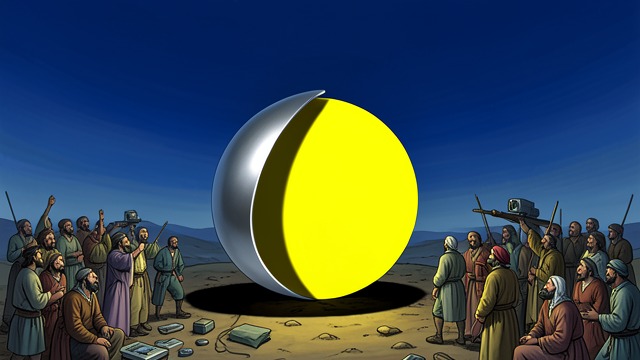
The 2010 New York solar eclipse event, also called an occultation, transforms an anticipated civic spectacle into the atmospheric threshold of the New York vampire plague outbreak. As the moon passes between the sun and the earth, New York experiences an uncanny interval of darkness at the same moment that officials suppress the significance of the 206 dead passengers from Regis Air Flight 753. The event therefore carries two simultaneous meanings: it is a precisely observed astronomical occurrence and the visual opening of a catastrophe that public institutions insist has already been contained.
Astronomical Event
The event begins with the moon’s first contact, a slender black nick entering the western edge of the sun. The encroaching darkness initially changes neither the apparent quality nor the quantity of daylight, leaving the ordinary world marked only by the crescent cut into the sky. The narrative pauses to distinguish the popular term “solar eclipse” from the more exact astronomical description of an occultation: the moon does not enter the sun’s shadow but passes between the sun and the earth, obscuring the sun and casting its own shadow onto the earth.
The geometry of the event gives it an almost uncanny precision. The earth is approximately four hundred times farther from the sun than the moon is from the earth, while the sun’s diameter is approximately four hundred times that of the moon. From the earth, the two bodies consequently appear roughly equal in size. Totality is possible only during the moon’s new phase and near perigee, when the moon is closest to the earth. Although totality can never last more than seven minutes and forty seconds, this occurrence is calculated to last exactly four minutes and fifty-seven seconds—just under five minutes of nighttime in the middle of an early fall afternoon.
As totality approaches, daylight loses its ordinary reliability. The sky takes on a dusky cast without the warmth of sunset; sunlight turns pale and diffused, shadows lose their certainty, and colors bleed from the normal spectrum. Roving shadow bands, produced by atmospheric refraction, move across the ground like wavering forms at the edge of vision. The final crescent contracts into a curved line, then into individual beads of light shining through valleys along the lunar surface. A brief crimson flare from the sun’s chromosphere precedes the disappearance of the sun itself.
The Eclipse and the Flight 753 Crisis
The eclipse occurs while New York is still trying to interpret the disaster aboard Regis Air Flight 753. Director Barnes presses Ephraim Goodweather to become the public face of the Canary project because officials want a broadcast issued before the solar event. Barnes’s proposed message describes a profound loss of life, promises that the Centers for Disease Control and Prevention is investigating, and assures the public that the incident is contained, apparently unique, and no cause for further alarm. The timing makes the eclipse part of the crisis-management strategy: the government wants its reassuring account in circulation before the city turns its attention to the sky.
That reassurance conflicts with the medical evidence. Ephraim Goodweather observes that a virus requires transmission and time, yet the passengers became unconscious without panic or visible struggle. Their symptoms among the survivors include headaches, muscle pain, ringing in the ears, disorientation, dry mouth, and impaired balance. The bodies found aboard the aircraft had been without breathing or detectable cardiac activity for roughly an hour, far beyond the usual four-minute threshold for permanent brain damage. To Ephraim, the signs initially point toward a lethal poisoning agent in the sealed cabin, although air samples reveal no gas.
The event’s public beauty thus unfolds over a buried contradiction. The official response treats the deaths as an isolated incident, while the evidence indicates that ordinary medical explanations are failing. Director Barnes resists enforcement of the Health Powers Act, distinguishing voluntary preventive treatment from quarantine because of media and political consequences. Later, even after Captain Redfern bears a perforation wound through the throat identical to those found on the Flight 753 victims, federal authorities call the case bizarre but isolated and refuse immediate quarantine without an executive order. When Barnes shuts down the Canary project, the eclipse has already become part of a wider pattern of institutional delay.
Totality in New York
At totality, the astronomical event becomes a collective urban experience. On Kelton Street in Woodside, Queens, Kelly Goodweather stands with her neighbors on the sidewalk, looking through cardboard-framed glasses distributed with Diet Eclipse soda. She understands the mechanics intellectually, yet the sudden darkness provokes an almost giddy impulse to run and hide. The alignment of celestial bodies reaches what the narration describes as a night-frightened animal within her, making the eclipse bodily and instinctive rather than merely educational.
Kelly refuses to remove her glasses despite television assurances that viewing the sun during totality is safe. The neighbors gradually relax into the spectacle, responding with communal amazement, but Kelly remains troubled. Part of her unease comes from having seen Ephraim Goodweather on television. His restrained manner and his eyes have convinced her that something is deeply wrong, beyond the governor’s and mayor’s assurances and beyond the unexplained deaths of 206 transatlantic passengers. Her private sequence of possibilities—virus, terror attack, mass suicide—shows the eclipse turning public uncertainty into personal foreboding.
Elsewhere, Ephraim ignores the spectacle as much as possible. Once the sun disappears, he uses the enforced pause to study construction diagrams and cutaway schematics of the Boeing 777. The contrast is revealing: while the city looks upward at a rare celestial alignment, Ephraim looks into the aircraft, searching for a material explanation of the disaster. The same darkness produces communal wonder for the neighbors and investigative concentration for the physician who already senses that the official story is inadequate.
Return of the Sun and Human Cost
The end of totality is marked by the diamond-ring effect. Brilliant prominences appear along the western edge of the moon and join into a single bead of sunlight, like a luminous diamond set against the moon’s silver ring. The diamond expands into Baily’s beads before merging with the returning crescent of the sun; shadow bands shimmer again over the ground as the world passes from darkness back into ordinary daylight.
The return of light does not undo the damage. Despite an extensive public-service campaign on eye safety, more than 270 people across New York, including 93 children, suffer permanent blindness after watching the sun reappear without adequate protection. Because the retina has no pain sensors, those affected do not realize that irreversible injury is occurring until it is too late. The aftermath makes the event a study in delayed consequence: the most beautiful moment is also the moment when preventable harm becomes permanent.
Narrative and Thematic Significance
The eclipse functions as a temporal and symbolic hinge. Before it, the Flight 753 disaster can still be described through familiar categories such as poisoning, accident, or isolated mass death. During it, the city enters an unnatural darkness while authorities actively maintain that nothing larger is happening. After it, the evidence of transformation becomes harder to contain: Setrakian explains that a normal infection can activate into feeding after one day and night, requires seven nights to complete the body’s transformation into a parasitic state, and takes roughly thirty nights to reach total maturity.
This biological timetable gives the eclipse a second clock beneath its astronomical one. Totality lasts less than five minutes, yet the infection it frames proceeds through days and nights toward maturation. The celestial event is brief and measurable; the public-health catastrophe is concealed, progressive, and cumulative. Its consequences include the throat wound matching those of the Flight 753 victims, the appearance of the shriveled, blood-starved form of Jim Kent in an isolation pod, and his destruction in an incinerator. At the same time, Bronxville is sealed by police and HAZMAT teams under the explanation of a gas leak, while the Office of the Chief Medical Examiner is boarded up amid reports of disappearances and panic.
The eclipse consequently exposes the failure of official containment rather than proving it. The authorities seek to exploit the spectacle’s timing for reassurance, but the darkness instead enlarges the gap between public language and physical reality. In the novel’s structure, a rare and orderly movement of the heavens becomes the backdrop for a disorder that institutions cannot name, isolate, or stop. The occultation is not the cause of the vampire plague as presented in these scenes; it is the moment when cosmic alignment, concealed infection, and administrative denial become visibly—and ominously—one event.
纽约吸血鬼瘟疫爆发
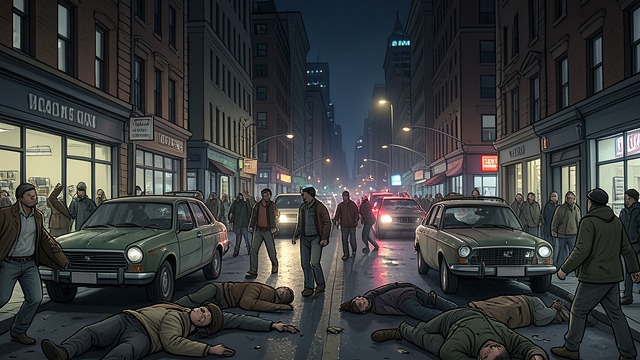
The New York vampire plague outbreak is the decisive catastrophe of the narrative: an invasion initially mistaken for poisoning, illness, or mass trauma that gradually reveals itself as a coordinated expansion of Vampires through New York City. Its significance lies in the way it joins ancient folklore to modern epidemiology. The outbreak travels through an airplane, morgues, homes, professional institutions, and urban streets, while grief and family attachment become mechanisms of transmission. By the time the first visible disorder spreads through the city, the crisis is no longer a medical anomaly but the beginning of social breakdown.
Causes and Hidden Background
The outbreak is presented by Abraham Setrakian as an act of war within the concealed history of the Vampires. He explains that seven originals, known as the Ancients or Masters, have existed for an open-ended span of time, nesting and feeding in secrecy. A schism divided them between the Old World and the New World: three remained in Europe, Asia, the Russian federation, the Arabian peninsula, and Africa, while three crossed into the American sphere. Both factions respected the other’s territory under an old truce. The seventh Ancient, however, became a rogue figure who turned away from both sides. Setrakian believes this renegade is responsible for the incursion into the New World and for breaking the balance that had governed the species.
The supernatural explanation is deliberately introduced through the language of disease. Setrakian describes the condition as a corruption of flesh and spirit, then names the feared category directly: Vampire. His account challenges Ephraim Goodweather’s medical assumptions without abandoning biological logic. The outbreak has transmission, symptoms, infected hosts, and recognizable wounds, but it also includes forces that conventional epidemiology cannot initially accommodate. The childhood legend told to Abraham Setrakian’s grandmother supplies an older cultural vocabulary for the same darkness. In that story, a giant abducts peasant children, leaves bodies white as snow, and is associated with the rhythmic “pick-pick-pick.” The warning to eat and grow strong or Sardu will come turns folk instruction into an inherited survival code.
Initial Medical Misrecognition
The first public sign of the plague is the Flight 753 disaster, which appears at first to be a mass medical emergency inside a sealed aircraft cabin. Ephraim Goodweather notes that viruses require transmission and that transmission takes time; passengers becoming ill or unconscious should have caused panic, regardless of the “FASTEN SEAT BELTS” sign. The absence of visible disturbance points instead toward a lethal poisoning agent introduced into the aircraft. Air samples, however, reveal nothing, leaving the investigators between a failed toxicology explanation and an event that does not fit any pathogen Eph has encountered during his work with the CDC.
The passengers’ symptoms seem ordinary enough to conceal the extraordinary event beneath them. Survivors report headaches, sometimes severe, muscle pain, ringing in the ears, disorientation, dry mouth, and impaired balance. Yet the deeper anomaly is that every passenger appears to have flat-lined. Eph and Nora Martinez were among the first people on the aircraft, and they find that the passengers may have been without breathing or oxygen for more than an hour. Four minutes without oxygen is generally understood as the threshold for permanent brain damage, but these people survive the interval. The medical data therefore becomes evidence not of recovery from a conventional emergency, but of a change in the meaning of life and death.
Doyle Redfern’s account gives the episode a further, older dimension. During his blackout, the pilot remembers a recurring childhood vision in his grandmother’s home: at midnight, when the nearby church bells chimed, a thing emerged from behind an old armoire. It had a black head, long arms, bony shoulders, and a jagged mouth with thin black lips; it stared at him and smiled. The memory does not explain the outbreak scientifically, but it links the contemporary disaster to ancestral images that surface across generations. The plague thus enters the story as something both newly arriving and eerily remembered.
Transmission Through the Dead and the Living
The outbreak’s most important reversal occurs when the dead cease to remain confined to institutional spaces. Setrakian explains that once turned, revenants seek out family and friends who remain uninfected. They return at night to their “Dear Ones,” driven by an instinct comparable to a lost dog’s homing impulse. As higher brain function recedes, feeding, hiding, and nesting replace human judgment. The person who returns is therefore recognizable enough to penetrate a household but altered enough to make emotional attachment dangerous.
Gary Gilbarton experiences this mechanism as a fulfillment of grief before he understands it as an attack. His daughter Emma appears barefoot at the door after midnight, and her return overwhelms his resistance. He kneels, touches her arm to make sure she is real, and embraces her. Later, she lies motionless beneath the pinkish night-light, does not acknowledge him, close her eyes, or wait for sleep, and then approaches his bedroom from the darkness. Gary waits for her without knowing what he expects. The scene converts parental longing into an opening through which the outbreak enters the home: the returned child is not simply an apparition, but an infected body using intimacy to reach its next victim.
Ann-Marie Barbour confronts the same transformation in a different register. She finds Ansel Barbour lying partly in soil, his face raised toward the doors, sunken eyes marked by pain. He is dying, and she understands that he must hurt someone else to revive himself and continue living. His return is bound to sacrifice: he had killed the family’s Saint Bernards and willingly taken their place in order to save Ann-Marie and the children, but the condition that now sustains him demands another person’s suffering. The household becomes both refuge and feeding ground, while the language of protection is twisted into the logic of infection.
Kelly Goodweather’s return makes the emotional danger explicit for Ephraim Goodweather and Zack Goodweather. Kelly stands before them without expression or blinking, a dead thing returned to her home. Eph immediately knows that she has been turned, and her eyes locate Zack as her Dear One. The plague reaches its most intimate threshold here: the infected do not merely enter a city or a building; they come back for the people whose love will make them hesitate.
Institutional Failure and Urban Expansion
The outbreak is also a crisis of recognition. Ephraim Goodweather warns Everett Barnes that the country is on the verge of a worldwide pandemic and an extinction event, while someone is making every effort to ensure that it succeeds. His declaration is not treated as an abstract professional concern; it is a decision to sound the alarm when an official public-health crisis warrants it. The response around him nevertheless shows how quickly a bureaucracy can become an obstacle when an event exceeds its categories.
Setrakian tells Eph and Nora that forces are coming after them to clear the way for infection. He argues that the strain will move faster through an orderly society than through one placed on high alert. This makes social calm itself part of the danger. Normal systems of trust, privacy, medical procedure, and family reunion provide the channels through which the infected move. The concealment of the threat is therefore not incidental to its spread; it is one of the conditions that accelerates it.
Setrakian’s knowledge also supplies a practical limitation. Vampires cannot cross moving water without human assistance, a prohibition preserved across cultures from Mesopotamians and the ancient Greeks and Egyptians to the Hebrews and Romans. New York City’s waterways consequently offer the defenders a strategic advantage. The ancient rule is not treated as decorative folklore but as a usable boundary in a modern battle. The outbreak’s mythology becomes operational knowledge precisely when scientific institutions remain unable to interpret the evidence.
The hunters’ understanding of the enemy expands through direct evidence. In Setrakian’s basement, Vasiliy Fet sees the remains of infected creatures reduced to cold cinder by sunlight. He also learns that the creatures attack with a stinger shooting from beneath the tongue, a grotesque biological weapon that makes the body itself an instrument of transmission. Setrakian’s compressed account connects the rogue Master’s concealment aboard Flight 753, the vanished coffin, the dead rising from morgues, the return to Dear Ones, household nests, Stoneheart Group, and the vulnerabilities of silver and sunlight. What first looked like disconnected incidents becomes a single ecology of invasion.
Consequences and the Beginning of Collapse
The outbreak’s immediate consequence is the destruction of the boundary between death and public order. A perforation wound through Doyle Redfern’s throat matches the wounds found on the Flight 753 victims, confirming that the pilot’s attack is part of the same phenomenon rather than an unrelated medical episode. The evidence turns a suspicious incident into a repeatable pattern: the infection has a physical signature, and the transformed can reproduce the violence that created them.
Its wider consequence is the corruption of ordinary spaces. Air travel becomes an entry point, morgues become reservoirs, homes become nests, and family reunions become predatory encounters. The plague does not advance only through anonymous crowds; it exploits recognition. The returned body is most dangerous where it is most loved, because grief delays resistance and familiarity disguises transformation.
The outbreak finally becomes visible as civic disorder. From a window in Morningside Heights, Eph, Zack, Setrakian, and the others see brake lights backed up for four or more blocks, people taking to the streets and fighting, and a building burning without fire trucks arriving. Setrakian identifies the scene as the beginning of the breakdown. The phrase marks a threshold rather than an ending: the city has not yet been described as wholly conquered, but its systems of response have begun to fail, and the outbreak has crossed from hidden infection into collective emergency. The legend of the giant, the medical mystery of Flight 753, and the first urban violence now belong to one continuous event—the New York vampire plague outbreak.
The Three New World Ancients Decide to Fight Back
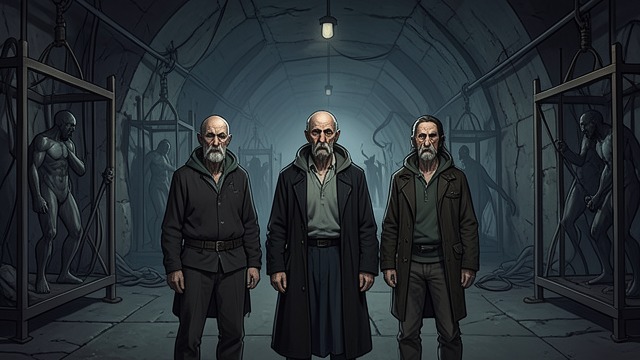
The New World Ancients’ decision to fight back is the concealed strategic reversal that transforms the outbreak from a one-sided invasion into a conflict among ancient powers. In an abandoned, unmapped asbestos mine beneath the woods of Nazareth, Pennsylvania, three Ancients determine that The Master has violated the old order by entering their territory, using a human ally, and pursuing a world war. Their answer is not immediate spectacle but a deliberate decision to abandon invisibility, recruit Gus Elizalde, and make him an instrument against the invader.
Setting and Participants
The decision takes place hundreds of feet below the Pennsylvania surface, in a pitch-black chamber within a mine that has become the New World Ancients’ dominion. Their underground world is organized around concealment and preservation: deep western tunnels contain cages in which they have begun storing human food for the coming winter, while the occasional scream of a captive travels through the mine. This is not merely a hiding place but a closed subterranean polity, insulated from ordinary human society and governed by the long habits of beings who have survived by remaining unseen.
The three Ancients themselves appear almost less like active rulers than like ancient biological mechanisms. Time has worn their bodies smooth, their movements have slowed nearly to imperceptibility, and their external physicality has become nearly irrelevant to them. Their bodies have evolved toward maximum efficiency, their mandibles function without flaw, and their night vision is extraordinary. Their deliberate stillness gives the council an immense temporal scale, yet the arrival of The Master forces even these creatures to act.
Recognition of the Threat
The council identifies the intruder as the seventh one, a recognition that gives the crisis its larger historical and supernatural dimension. One Ancient reaches across the sea with its mind toward the Old World and receives no corresponding sensation. From that absence, the Ancients infer that the seventh one has aligned himself with a human, standing against all other humans and against the Ancients themselves. The Master’s alliance with humanity is therefore not understood as ordinary cooperation; it is a breach of the division that had previously kept the ancient powers in equilibrium.
The Ancients conclude that The Master has been corrupted or emboldened by the violence of human history. He had been spoiled by the world war and had fed too long in the trenches and the camps. His experience of mass violence has not satisfied him; it has enlarged his appetite for domination. The council’s diagnosis is explicit: he has broken the truce, set foot on their soil, and wants the entire world for himself. What he wants, in their view, is another war.
The Decision to Resist
The value shift in the council is from guarded complacency to organized resistance. The Ancients acknowledge that they may have become too comfortable, treating their bodies as replaceable shells and assuming that their hidden existence would remain secure. The tallest Ancient’s talon twitches, an extraordinary movement precisely because it breaks the beings’ customary elemental stillness. The gesture registers a decision before the decision is spoken: the old posture of waiting has become untenable.
They resolve that they will oblige The Master by entering the conflict. Remaining invisible is no longer acceptable. The decision does not amount to a human-style declaration or a conventional mobilization; it is a change in the rules of their existence. A population that has preserved itself through secrecy now accepts exposure as the price of preventing one rival from converting the whole world into a single dominion. Their resistance is thus both military and constitutional: they are defending territory, but also the balance represented by the old truce.
Gus Elizalde as the Sun Hunter
The council’s first concrete act is to accept the headhunter into its chamber. He waits to be acknowledged, and the Ancients confirm that he has found the one they need. The headhunter explains that the quarry tried to return home, as all creatures do. The Ancients decide that he will suffice and name him their sun hunter, adding that he has no other choice. The language turns recruitment into coercion: Gus is not invited into a cause he can freely accept, but assigned a function by beings who possess the power to imprison him.
The chosen instrument is Gus Elizalde, who lies unconscious in a locked cage in the western tunnel, on a floor of cold dirt. He is dreaming of his mother and remains unaware of the danger awaiting him. The contrast is severe. Above and around him, the Ancients have made a strategic decision that may reshape the war; within the cage, Gus is reduced to an unconscious captive whose personal memory continues while his future is being appropriated. The sun hunter’s role connects the subterranean council to the vulnerability of The Master and suggests that the Ancients intend to oppose him through a weapon capable of confronting his darkness.
Consequences and Narrative Significance
The decision places the New World Ancients in a new relationship to the outbreak. Until this point, the spread has appeared to pit human investigators and improvised hunters against a rapidly expanding vampire ecology. Ephraim Goodweather has called the crisis a worldwide pandemic and an extinction event, while his proposed quarantine of New York City rests on the rule that vampires cannot cross bodies of moving water. The Ancients’ intervention reveals that the human struggle is unfolding within a larger contest: The Master’s incursion threatens not only people but the established order among the vampires themselves.
The council also clarifies why resistance must take forms beyond official authority. Eph’s warnings are dismissed by Everett Barnes, even as the doctor insists that the spread can still be contained in New York City. Elsewhere, ordinary institutions fail to understand what they face: a Port Authority officer’s trauma erupts during the removal of the dead from Flight 753’s aircraft, and Gus later witnesses vampires turning people in the street before being rescued by armed men in black hoodies using crossbows. These episodes show a world in which public systems are overwhelmed, fragmented, or blind to the true enemy. The Ancients’ decision creates a covert counterforce within that confusion.
The event also resonates with the book’s recurring opposition between human cruelty and human solidarity. Abraham Setrakian once escaped a Nazi execution line when a prisoner ran, anonymous hands lifted him over the barbed-wire fence, and the collapse of faith in God was accompanied by the discovery of Man as both scourge and blessing. The Ancients’ council reverses that pattern into a supernatural register: creatures who have remained outside human history are compelled to choose whether they will continue observing or intervene. Their choice does not restore innocence or promise an easy alliance. It produces another captive, another instrument, and another layer of danger. By deciding to fight back, the Ancients make the hidden war visible in principle, while leaving Gus Elizalde still imprisoned, unconscious, and unaware that he has become its appointed weapon.
Event 1
Event 2
Event 3
Event 4
