Chance and Fate
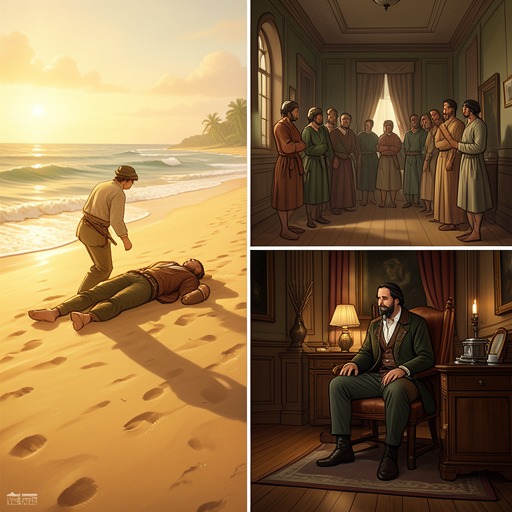
The Stranger (Albert Camus Edition)Chance and fate form one of the central tensions in Meursault’s story. Accidents repeatedly alter the course of events: his presence at the beach is described as coincidental, Raymond’s revolver comes into his hand at a moment of suspended danger, and the prosecutor later turns the very language of chance into proof that the killing was really premeditated. The novel does not simply choose between randomness and destiny. It shows how arbitrary moments acquire the appearance of necessity once they have produced irreversible consequences, while Meursault’s final reflections extend that predicament from one crime to the mortality shared by everyone.
Chance in the Beach Confrontation
The beach scene presents chance as a pressure operating through the body and the landscape rather than as a clear decision. When the two Arabs face Meursault and Raymond, nobody moves, yet Meursault recognizes that firing or not firing might lead to “absolutely the same thing.” The statement suspends ordinary moral causality: the revolver is available, danger is present, but the future seems indifferent to either possible action. The scene’s stillness makes choice feel both possible and powerless.
The Arabs then disappear beneath the rock, apparently ending the confrontation. Raymond returns toward Masson’s bungalow in a better mood and begins discussing the bus for the journey back. That apparent closure is itself accidental and fragile. Meursault stops at the steps because the light and heat make it impossible to go inside and behave pleasantly with the women, but remaining under the blinding sky is equally unbearable. His decision to return to the beach therefore arises from a chain of immediate physical circumstances rather than a stated plan to kill.
When Meursault encounters Raymond’s Arab alone, the earlier incident unexpectedly returns. The Arab’s hand moves toward his pocket, Meursault grips the revolver, and the distance between them becomes a temporary margin of safety. Meursault thinks that he could simply turn away, but the heat seems to press against his back. The landscape converts hesitation into movement: he takes several steps toward the stream, waits, and then advances once more even while knowing that doing so is foolish. The Arab draws the Knife, and the reflected sunlight overwhelms Meursault’s perception. Chance is thus not presented as a single random impulse; it is a succession of small conditions, each narrowing the next possibility.
From Contingency to Legal Premeditation
At the trial, Raymond insists that Meursault’s presence on the beach was a pure coincidence. He explains that the deceased man’s hostility was directed primarily at Raymond, who had beaten the man’s sister, and that the letter connected to the tragedy was also the result of mere chance. Raymond’s testimony tries to preserve the distinction between an accidental association and a criminal intention: Meursault was involved in the surrounding circumstances, but not because he had designed the outcome.
The Prosecutor immediately attacks that defense. He argues that “chance” and “mere coincidence” appear too frequently to be credible. In his account, chance cannot explain why Meursault failed to intervene when Raymond assaulted his mistress, why he gave Raymond unusually favorable support at the police station, or why he became entangled in the beach conflict. The prosecutor’s method is to gather separate contingencies into a single pattern. Once placed in sequence, each incidental act appears to confirm the others, and coincidence becomes the name for a hidden plan.
The same transformation governs the prosecutor’s reconstruction of the killing. He links Meursault’s letter written with Raymond, the attempted enticement of Raymond’s mistress, the brawl with Raymond’s enemies, Raymond’s wounding, the transfer of the revolver, and Meursault’s solitary return to the beach. He presents these episodes not as disconnected circumstances but as steps in a prepared design. The four additional shots are then treated as deliberate confirmation that the act was carried out “in cold blood,” allowing the prosecution to erase the uncertainty and bodily confusion surrounding the original encounter.
This retrospective ordering gives the court a reassuring narrative of causation. The prosecutor argues that the crime was not a sudden impulse but the expression of a criminal mentality, and he joins the beach killing to Meursault’s conduct after Madame Meursault’s death. His case depends on converting social irregularity into intention: Meursault’s failure to display expected grief, his relationship with Marie Cardona, and his association with Raymond become evidence of a coherent moral character. The accidental and the emotional are reorganized as stages in a destiny the court claims to have discovered.
The Individual Against Social Necessity
Meursault’s response reveals a conflict between personal contingency and the social demand for intelligible motives. The prosecutor’s explanation sounds plausible to him because it arranges scattered facts into a persuasive whole, even though that whole does not correspond to the way he experienced them. Meursault notices that the prosecutor calls Marie Cardona “the prisoner’s mistress,” whereas she was simply Marie to him. The changed label shows how institutional language turns an ordinary relation into a sign of guilt.
The court also treats the case as though Meursault’s actions must express a stable moral essence. His inability to state Madame Meursault’s age, his visit to the swimming pool immediately afterward, the film he saw with Marie, and his return with her to his rooms are placed beside the killing. These details are not causally necessary to the death, but the prosecutor makes them function as proof that Meursault was already the kind of person who could kill deliberately. Chance is therefore not only absorbed into legal fate; it is absorbed into a social story about what an acceptable son and citizen should feel.
Meursault’s predicament reflects a broader structure. Raymond’s violent history creates the original danger, Raymond’s letter helps bring the parties together, the beach provides the setting, and the heat intensifies the confrontation. Yet the legal system isolates Meursault as the single author of an intelligible chain. The result is a paradox: the killing emerges from a network of other people, objects, bodily sensations, and circumstances, but the court must compress that network into individual responsibility. What looks like fate in the courtroom is partly the consequence of institutional simplification.
Death as the Final Fate
In the prison, Meursault’s understanding of chance and fate becomes more radical. During his outburst against the chaplain, he rejects the possibility that religious certainty can give his life a privileged destination. He insists that he is certain of his present life and of the death approaching him, even though that certainty is limited to what can actually be grasped. His confidence does not arise from a belief in providence; it comes from accepting the immediate facts that others try to soften with explanations.
He then considers the different choices his life might have contained. He could have lived otherwise if he had wanted, but he did not; he acted in one way rather than another, and the completed sequence cannot be revised. The fact that alternatives once existed does not restore them after the event. In this sense, fate is not a supernatural force directing each action in advance. It is the irreversible shape that past choices and accidents acquire when viewed from the end.
Meursault’s final logic extends beyond his own trial. The “dark wind” blowing from his future levels the distinctions people use to rank lives, relationships, and moral identities. Death will come to the chaplain, to Raymond, to Marie, to Salamano, and to Meursault alike. The condemned man is not exceptional because he alone has a fate; he is exceptional because imprisonment and the death sentence force him to see the universal condition earlier and more sharply than those who remain temporarily free.
Significance of the Tension
The novel’s treatment of chance and fate does not absolve Meursault or replace responsibility with randomness. Instead, it exposes the difficulty of assigning a clean motive to an event produced by overlapping forces. At the beach, choice seems almost interchangeable with non-choice; at court, coincidence is rewritten as design; in prison, personal history becomes part of the common destiny of mortality.
This progression also explains why the legal narrative fails to contain Meursault’s experience. The Prosecutor wants a chain in which every preceding detail points inevitably toward murder. Meursault perceives something less orderly: an accidental world in which heat, light, fear, habit, other people’s actions, and isolated decisions converge without offering a final reason. His eventual recognition of universal death does not solve that contradiction, but it gives it a form. Chance governs the texture of lived experience, while fate names the certainty that every such experience ends.