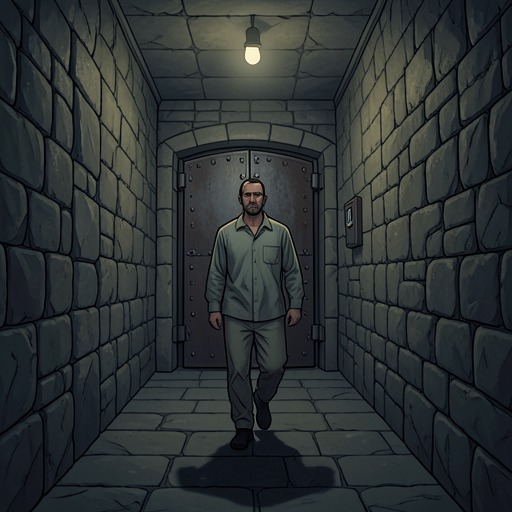
Death Penalty and Guillotine
The Stranger (Albert Camus Edition)Death penalty and the guillotine are the ultimate instruments of punishment in Meursault’s story, but they also become the central objects of his final thinking. The sentence transforms an abstract judgment into a bodily certainty: the court declares that he will be decapitated in public, and from that moment his life is organized around waiting, calculation, and the impossible hope of escape. The guillotine therefore represents both the state’s power to end a life and the disturbing gap between legal language and the concrete machinery that carries it out.
From Verdict to Physical Certainty
The sentence is announced after the jury has withdrawn and the courtroom has fallen into silence. When Meursault returns to the dock, the presiding judge declares, in the name of the French people, that he is to be decapitated in a public place. The formula gives the punishment a national authority, yet its grandeur is immediately reduced by Meursault’s sensory experience: the policemen handle him gently, his lawyer touches his wrist, and he answers that he has nothing more to say before being led away. The public language of justice thus ends in small bodily gestures, while the verdict itself acquires the hard reality of a wall against which he can press his back.
This transition is prepared by the earlier chain of punishment. After being sent to prison, Meursault initially remains only vaguely conscious of his confinement and retains a hope that some agreeable surprise may occur. The decisive change comes after Marie’s first and only visit, when he receives her letter explaining that she will no longer be allowed to see him because she is not his wife. The cell then becomes his last home, a dead end rather than a temporary inconvenience. The jailer explains the logic plainly: liberty is what prisoners have been deprived of, because without deprivation imprisonment would not be punishment. The death sentence extends that logic beyond space and time, converting confinement into the scheduled destruction of the prisoner himself.
The Guillotine as a Machine of No Escape
In the condemned cell, Meursault refuses repeated visits from the prison chaplain and says that his only concern is finding a loophole in the machine. He imagines condemned prisoners escaping at the last moment, breaking through the police cordon, disappearing just before the blade falls, or benefiting from a rare failure of chance. The possibility need not be probable. A single successful escape would be enough to satisfy him, because the emotion of that possibility could supply the hope that the legal system has eliminated.
His fantasy is deliberately practical as well as desperate. He imagines a mad dash for freedom, while recognizing that such an attempt would probably end with him being knocked down in the street or shot in the back. Even that would offer more freedom than the guillotine, because it would preserve a final moment in which events might still turn otherwise. The condemned man is trapped not merely because guards surround him but because the sentence has removed uncertainty from the future. The death penalty is therefore experienced as a rattrap: a sequence already closed, in which no action can alter the outcome.
Meursault’s reflections expose a paradox at the heart of execution. He proposes a system in which a condemned prisoner would have at least one chance in a thousand, perhaps through a drug that killed nine hundred and ninety times out of a thousand but failed in the remaining cases. The prisoner would have to know about the possibility, since hope depends on the existence of an alternative. Yet he also recognizes the absurd consequence of a machine that might fail: the condemned man would have to hope that the apparatus worked properly, because a failed blade would simply lead to another attempt. The system’s flaw and its efficiency become the same thing. Its purpose is not only to kill but to ensure that death is unavoidable.
Correcting the Image of Execution
Meursault discovers that his mental picture of the guillotine has been shaped by history, school lessons, and revolutionary images. He had assumed that the condemned man climbed steps onto a scaffold, leaving the ordinary world below. Then he recalls a newspaper photograph of the apparatus used for a famous criminal’s execution. It stands directly on the ground, is narrower and less impressive than he imagined, and has the clean, shining appearance of a laboratory instrument.
This correction makes the execution more disturbing rather than less. The machine is not monumental; it is simple, level with the man who approaches it. Meursault compares the final movement to stepping forward to meet someone known. The absence of a scaffold deprives imagination of distance and ceremony. There is no ascent into a dramatic public space, only an efficient meeting between a human body and an apparatus. The guillotine’s neatness gives state violence an administrative surface: death is carried out discreetly, with a hint of shame and much efficiency.
The physical design also challenges the distance created by legal vocabulary. Words such as judgment, debt, society, and the French people sound abstract, but the guillotine is narrow, polished, and placed on the same level as its victim. It makes the execution tangible. The state’s moral explanation can be questioned, but the machine’s operation cannot: from the moment the verdict is delivered, its consequences become as concrete as the wall of the cell.
Dawn, Waiting, and the Management of Time
The death penalty reorganizes Meursault’s daily rhythm around dawn. He knows that prisoners are always collected at daybreak, so he sleeps intermittently during the day and watches through the night for the first light in the dark sky. The most terrible interval is the vague hour when the execution party might arrive. The slightest rustle sends him to the door, where he presses his ear against the cold wood and listens to his own rapid breathing.
Each morning without footsteps becomes a temporary reprieve. When the sky brightens and light enters the cell, Meursault is grateful that his heart has not shattered and that another twenty-four hours remain. This repetition gives the punishment a distinctive temporal structure: the execution is not only a future event but a nightly possibility, renewed and then postponed. Waiting becomes a form of bodily discipline, and the state controls not merely where he is and what he may do but how he experiences every hour before death.
The earlier prison rules anticipate this total control. Cigarettes are taken from him with his belt, shoelaces, and pocket contents, and smoking is forbidden even after he receives a cell of his own. During the first days he suffers intensely, feeling faint and bilious and even sucking splinters from his plank bed. Later he understands that the deprivation is part of the punishment, but by then the craving has disappeared and the measure has ceased to punish him. This pattern clarifies the death sentence: punishment depends upon anticipated desire, while adaptation can weaken the authority of individual privations. The guillotine is different because it allows no adaptation and no second condition after the act.
Chance, Justice, and the Meaning of Death
Meursault attacks the apparent gravity of the verdict by noticing how contingent its circumstances are. The sentence is read at eight in the evening rather than five; it might have been different; it is pronounced by men who change their clothes; and it is attributed to the vague entity of the French people. These details seem to undermine the judgment’s metaphysical weight. Yet the verdict remains effective regardless of its contingencies. Once delivered, it governs reality with the force of an object against the body.
The prosecutor’s earlier treatment of chance helps explain this contradiction. He points to Meursault’s association with Raymond, his failure to intervene during Raymond’s assault on his mistress, and his favorable testimony at the police station, arguing that “chance” and “mere coincidence” cannot explain how these elements surround the crime. The court turns accidental connections into moral evidence. Later, Meursault turns the same problem back upon the death penalty: if chance can shape the path to conviction, why is there no place for chance after conviction? The legal process absorbs contingency while claiming an absolute result.
His thoughts about his father deepen the subject’s emotional and generational reach. Meursault remembers that his father once watched an execution and became violently sick afterward. He had previously found this reaction disgusting, but under sentence of death he understands it as natural. Execution becomes, in his altered perspective, the event that reveals what life and authority mean at their most concentrated. He even imagines attending every execution if he were released, then experiences a wild and absurd exultation at picturing himself on the observers’ side of the police line, before the fantasy turns into a shivering fit. The condemned man and the spectator are separated by the thinnest possible boundary: one stands inside the ritual, the other watches and returns home.
The guillotine finally brings Meursault to the general fact from which no one escapes. He tries to console himself with the thought that life is not worth living and that death at thirty or at seventy ultimately leaves the world continuing without the dead person. Yet the argument fails to erase the value of the years still in hand. The death penalty exposes the weakness of abstract equality before death: although everyone must die, the condemned person experiences the imposed timing, the enforced waiting, and the confiscation of every remaining alternative. Its decisive significance lies in this convergence of universal mortality and particular state violence. Death is inevitable, but the guillotine makes inevitability into an institution, a schedule, and a machine.