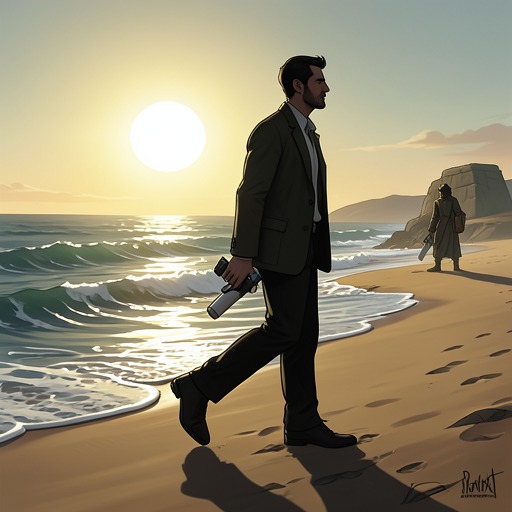
Knife
The Stranger (Albert Camus Edition)The Knife is the decisive object in the beach confrontation that leads to Meursault’s killing of the Arab. Initially carried by Raymond Sintès’s opponent, it wounds Raymond, forces the men into a defensive retreat, and later reappears when Meursault faces the same Arab alone. In that second encounter, the blade catches the sunlight, overwhelms Meursault’s perception, and stands at the threshold between withdrawal and irreversible violence. Its importance lies in this double function: it is both a concrete weapon in a chain of interpersonal retaliation and the material flash that helps precipitate the novel’s central rupture.
Appearance and First Use
The Knife enters the action after Raymond Sintès and Masson attack the two Arabs on the beach. Raymond has already been striking the man he identifies as his enemy, while Masson has knocked the other man into the water. The balance changes when Meursault sees the weapon and warns Raymond, “Look out!” The warning comes too late: the man cuts Raymond’s arm and mouth, making the object’s danger immediate and bodily rather than merely threatening.
The Knife also changes the physical arrangement of the scene. Masson moves forward, but the second Arab rises from the water and positions himself behind the man holding the weapon. The two Arabs then retreat slowly, using the Knife to keep the others at bay and never taking their eyes off them. Raymond, Masson, and Meursault do not dare move until the attackers reach a safe distance and run away. Blood continues dripping from Raymond’s wounded arm, while the weapon has converted an assault initiated by Raymond into a moment in which the injured men must submit to distance and caution.
The Standoff on the Beach
After the first encounter, Raymond returns to the bungalow, obtains his Revolver, and goes back toward the stream, where the Arab with the reed is lying in the heat. The Knife remains the condition of the confrontation even before Meursault handles the Revolver. Raymond wants to provoke the Arab into answering an insult so that he can fire, but Meursault tells him that he has no right to shoot unless the Arab draws the Knife. The weapon therefore becomes the stated boundary between an unlawful execution and a supposedly defensible act of self-protection.
This proposed boundary is unstable. Raymond is ready to manufacture the circumstance that would justify firing, while the Arab watches their movements. When Meursault approaches, the Arab raises himself slightly and puts his hand into his pocket. Meursault grips Raymond’s Revolver, but the Arab then sinks back without removing his hand. At a distance of roughly ten yards, the Knife is still unseen, yet its possible presence governs every gesture. The object has become a latent force: it does not need to be displayed to organize fear, attention, and readiness for violence.
Metal, Heat, and Perception
The Knife becomes fully visible when Meursault takes another step toward the Arab. The heat has begun scorching his cheeks, sweat gathers in his eyebrows, and he recognizes the sensation as resembling the physical distress he experienced at his mother’s funeral. He knows that moving only another yard will not take him out of the sun, yet he advances. The Arab then draws the Knife and holds it across the sunlight.
The blade’s reflection is described not as a neutral visual detail but as an assault on Meursault’s body. A shaft of light shoots upward from the steel, and Meursault feels as though a long, thin blade has pierced his forehead. Sweat spreads across his eyelids; salt and tears blur his sight; the sunlight seems to clash against his skull while the reflected edge scars his eyelashes and gouges into his eyes. The Knife is therefore both weapon and optical event. Its physical surface catches the surrounding glare and makes the environment itself appear to participate in the threat.
This moment gives the object an agency that exceeds its role as something held by the Arab. The blade does not speak, but its flash interrupts interpretation: Meursault’s attention narrows to heat, moisture, pain, light, and pressure. The scene’s value shifts from suspended possibility to mortal danger, although the danger is experienced through a confused fusion of the Arab’s action and the oppressive beach. The Knife’s material brightness helps turn an available choice—to step away or continue—into a crisis of sensation.
Relation to Violence and Responsibility
The Knife is tied to Raymond Sintès’s earlier revenge. The Arabs have followed the group from the city after the conflict connected with Raymond’s assault on his mistress; Raymond identifies one of them as the man who holds a grudge against him. On the beach, the Knife belongs to the retaliatory side of that conflict, but Meursault becomes physically and legally implicated even though his presence began as a coincidence. The object thus links separate acts: Raymond’s provocation, the assault on the beach, Raymond’s injury, the later standoff, and Meursault’s shooting.
Its role also exposes the difference between a weapon’s presence and the story told about that presence. Raymond insists that Meursault should help if another Arab appears, and later proposes insulting the Arab so that a reply can provide grounds for firing. Meursault accepts the practical logic of the plan but states a restriction: firing would be unjustified if the Arab did not draw the Knife. Yet when the blade is finally drawn, the resulting violence does not remain limited to a single defensive shot. Meursault fires once and then four more times into the inert body. The Knife may furnish the immediate trigger for the first shot, but it cannot explain the full sequence of shots or remove Meursault’s responsibility for them.
Narrative and Legal Consequences
The Knife’s importance continues after the beach because the court reconstructs the killing through relationships, motives, and chance. Raymond later testifies that the dead man’s grudge was directed at him because he had beaten the man’s sister, while Meursault’s presence at the beach was accidental. The prosecutor nevertheless connects the tragedy to the letter that Raymond had written and asks how that letter could have been the prisoner’s work. The weapon belongs to this chain of causation without settling it: it is the visible object in the confrontation, while the legal narrative searches for a larger account of intention, responsibility, and motive.
The Knife also marks the failure of Meursault’s detached perception to remain harmless. Earlier, the Arabs across the street are described as silently watching the group, and on the beach two men in blue dungarees approach after apparently tracking them. Their faces and motives remain only partially available to Meursault, whereas the Knife becomes sharply legible at the instant of danger. The object gives the encounter a hard physical focus, but the surrounding colonial and legal order does not grant the Arab an equally developed voice or interior presence. The blade is therefore central to the action while also revealing how the narrative’s attention is distributed between the weapon, Meursault’s sensations, and the institutions that later judge him.