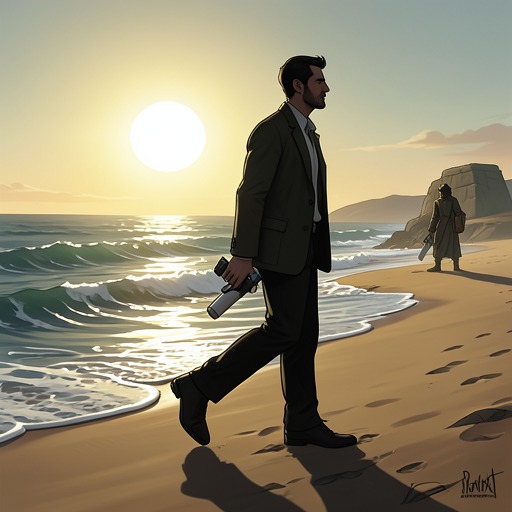
Sun and heat imagery
The Stranger (Albert Camus Edition)The sun and heat imagery gives the novel’s most decisive scenes their oppressive physical logic. It is not merely atmospheric description: heat alters Meursault’s perception, exhausts his body, repeats the sensations of the funeral, and reaches its most destructive intensity immediately before he fires the Revolver. Through this recurrence, the landscape becomes a force that exposes the gap between abstract intention and embodied action.
Heat at the Funeral
The imagery first governs Madame Meursault’s funeral procession. The sky is already blazing, the air is rapidly stoking up, and waves of heat lap against Meursault’s back while his dark suit intensifies his discomfort. The delay before the procession begins becomes physically unbearable, and his attention is drawn less to conventional mourning than to sweat, clothing, movement, and the rising sun. The heat therefore places the ceremony in tension with its social purpose: a public ritual meant to express grief is experienced through bodily irritation and fatigue.
The setting briefly permits a different understanding of Madame Meursault. Looking across the cypresses, hills, red soil, green vegetation, and isolated houses, Meursault can understand her feelings; the evening landscape might have offered a mournful solace. Yet the same countryside appears in the morning glare as inhuman and discouraging. The contrast makes heat a changing filter of perception. The land itself has not changed, but the merciless light changes its emotional and moral appearance, replacing possible consolation with hostility.
As the hearse moves, the procession becomes a composition of heat, blackness, and sensory confusion. Fresh tar shimmers beneath their feet, leaving bright black gashes; the hearse and the mourners’ clothes merge with the sticky road; hot leather, horse dung, and incense mingle in the air. Meursault’s eyes and thoughts grow blurred, while Thomas Pérez repeatedly falls behind, vanishes into the heat haze, and takes shortcuts to rejoin the group. The funeral’s human relationships are thus rendered through unstable distance and bodily depletion rather than through spoken sentiment.
The Beach as Repetition
The beach scene repeats the funeral’s physical pattern while changing its stakes from burial to killing. After Raymond’s Arab companions disappear, Meursault returns from the bungalow toward the boulders, unable to remain comfortably either with the women or under the exposed sky. The beach carries the same red glare as far as he can see, and even the small waves seem to gasp against the hot sand. Heat presses on his temples and threatens to stop his progress, making movement itself a struggle against the environment.
Meursault responds to the sun with increasingly deliberate bodily resistance. He clenches his fists in his trouser pockets, grits his teeth against each blast of heat, and hardens his jaws whenever light flashes from shell or broken glass. His stated aim is not yet an articulated plan of violence; he is trying to escape glare, tears, strain, and the absence of cool shadow. The cold stream behind the rock becomes a promise of relief, while the rock’s shadow represents silence and shelter from the entire burden of the scene.
The return of Raymond’s Arab interrupts that hoped-for retreat. The Arab lies partly in shadow while the sun beats on his body, and the heat makes his dungarees appear to steam. From a distance, his figure wavers in the haze, sometimes reduced to a blurred dark shape and sometimes sharpened by the glimpse of his eyes. Meursault recognizes that he could turn away, yet the heat-filled beach seems to press against his back and prevent detachment. The conflict is therefore staged as both a human encounter and an ordeal of perception.
From Sensation to Violence
The decisive transition comes when the Arab draws the Knife. Meursault explicitly recognizes the heat as the same kind experienced at Madame Meursault’s funeral, including the disagreeable pressure in his forehead and the sensation that his veins are bursting through the skin. This repeated bodily memory binds the two scenes together. The funeral has not simply been recalled intellectually; its sensations return as a physical pattern, and the repetition precedes the fatal act.
The knife turns sunlight into a weapon-like flash. Sweat runs into Meursault’s eyes, covering his vision with a warm film, while the reflected light seems to pierce his forehead and scar his eyelashes. The world then loses stable form: everything reels, a fiery gust rises from the sea, and the sky appears to split open as flame pours through it. The language enlarges a small movement of steel into an assault by the whole atmosphere. The sun does not literally command Meursault, but the scene presents his body as caught within forces that overwhelm ordinary distance, judgment, and proportion.
The first shot follows the collapse of perceptual balance. Meursault’s grip closes on the Revolver, the trigger gives, and the shot marks the beginning of his undoing. He understands that he has shattered the beach’s spacious calm, yet the act does not end with that single discharge: he fires four more shots into the inert body. Each successive shot becomes another fateful interruption, so the imagery converts one moment of confused reaction into a sequence of irreversible choices. Heat provides the pressure and disorientation, but the repeated shots establish the consequence that cannot be reduced to atmosphere alone.
Bodily Perception and Meaning
The sun imagery makes the body the primary medium through which Meursault encounters the world. Sweat, throbbing temples, blurred sight, burning cheeks, clenched hands, and strained walking appear before any stable moral explanation. The scenes consequently resist a simple division between deliberate motive and external compulsion. Meursault’s experience is intensely physical, but the narrative also preserves his awareness that he could have turned away and that firing again changed the meaning of what had happened.
The recurring heat produces a structural value shift. At the funeral, light and heat transform a potentially consoling landscape into an inhuman one; at the beach, the same elements turn the desire for shade and silence into a confrontation with death. A natural force associated with summer brightness becomes an engine of exhaustion, blindness, and irreversible action. The contrast between the sun’s apparent permanence and the human catastrophe beneath it reinforces the impression of an indifferent universe: the light continues to pound the sand while a life is destroyed and another is set on the path toward punishment.
The imagery also defamiliarizes both mourning and violence. Instead of allowing the funeral to be organized primarily by grief or the shooting primarily by motive, the narrative delays interpretation through tar, incense, horse dung, heat haze, salt, metal, and the rhythm of waves. Familiar events become strange because they are filtered through a consciousness registering surfaces and bodily shocks. The result is not an absence of meaning, but a meaning produced by recurrence: the same forehead pressure returns, the same oppressive sun reappears, and the funeral’s physical discomfort is carried forward into the beach until it becomes inseparable from the act that changes Meursault’s life.
Narrative Significance
The sun and heat imagery connects the novel’s two major thresholds: the burial of Madame Meursault and the killing of the Arab. At the first threshold, heat exposes Meursault’s distance from expected mourning; at the second, it accompanies the passage from possibility to irreversible violence. The repeated physical sensations create a bridge between scenes that social language would normally keep separate, showing how an apparently minor bodily experience can become a recurrent pattern governing perception and action.
Yet the imagery does not absolve Meursault or provide a complete causal explanation. The beach sequence records hesitation, recognition, movement toward danger, the grip on Raymond’s Revolver, and four further shots after the first. Heat makes the world dazzling, painful, and difficult to interpret, but the narrative preserves the moral weight of the decisions made within that confusion. Its deepest significance lies in this tension: the sun seems both impersonal and overpowering, while the human consequences of responding to it are exact, cumulative, and final.