The prison
The Stranger (Albert Camus Edition)The prison is the decisive environment of Meursault’s second life: the place where legal punishment becomes daily existence, where freedom is reduced to memory and expectation, and where the certainty of death gradually strips away the social meanings imposed on him. It first appears as a temporary interruption that he expects might end through some agreeable surprise; it becomes, after Marie’s visit is forbidden, his last home and a dead end. Within its walls, confinement does not merely restrain his body. It reorganizes his desires, his sense of time, his relationships, and finally his understanding of himself.
Definition and Place in the Narrative
The prison receives Meursault after his arrest for killing an Arab and holds him through the long legal process that follows. At first, he is hardly conscious of being imprisoned. He retains the vague hope that something may happen to release him from the situation, so the prison initially seems less like a permanent institution than a pause in ordinary life. That interpretation changes when Marie writes that she will no longer be allowed to visit because she is not his wife. From that moment, Meursault understands the cell as his final home: not simply a room in which he is held, but a dead end that has closed off his former social world.
The institution also stands within a larger network of official places. The Home for Aged Persons lies near Marengo, where Meursault goes after his mother’s death; the police station is where he previously gives evidence for Raymond; the law courts later convert those earlier associations into evidence against him. The prison is therefore not isolated from the society outside it. It is the enclosed endpoint of the same administrative and judicial order that records his mother’s dependence, accepts his testimony for Raymond, summons witnesses, and interprets his conduct before the Assize Court.
Physical Structure and Daily Conditions
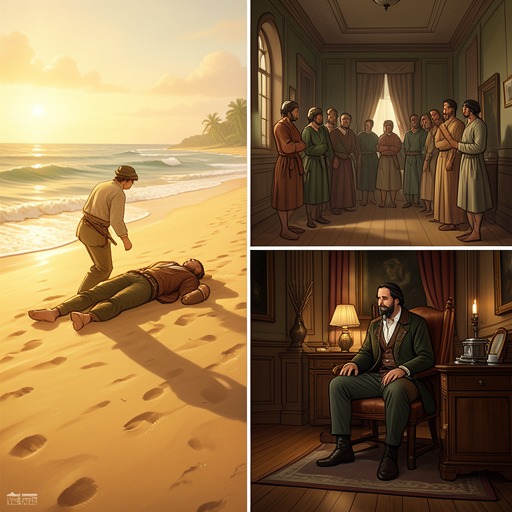
On the day of his arrest, Meursault is placed in a large room with several other prisoners, mostly Arabs. They ask what he has done, and when he says that he killed an Arab, they fall silent. One prisoner nevertheless teaches him how to arrange his sleeping mat by rolling one end into a bolster. That small practical gesture contrasts with the impersonal force that has brought him there. The night is marked by bugs crawling over his face, making imprisonment immediately physical rather than merely juridical.
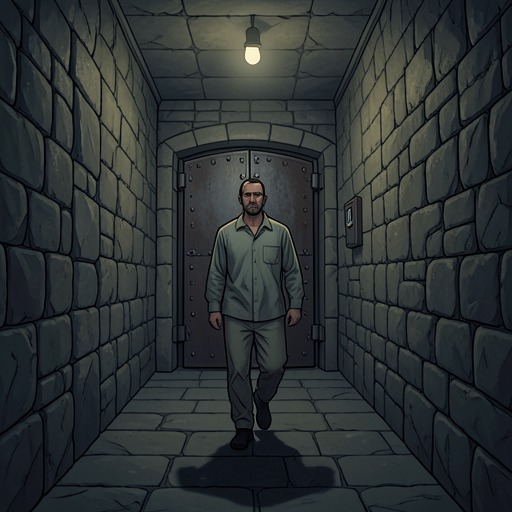
After some days, Meursault is moved alone into a cell. Its furniture is limited to a plank bed hinged to the wall, a latrine bucket, and a tin basin. The cell’s one significant opening is a little window through which he can glimpse the sea. This view preserves a fragment of the outside world while intensifying his awareness of separation: sunlight plays on waves that his body can see but cannot reach. Later, he is moved to another cell from which he can see the sky while lying on his back, with nothing else in view. The change does not restore freedom; it reduces the world to a slowly changing field of color.
The route to the Visitors’ Room reveals the prison as a carefully engineered system of separation. Meursault is taken along one corridor, up a flight of steps, and along another corridor into a large room lit by a bow window. High iron grilles divide the room into three compartments, while a gap of about thirty feet creates a no man’s land between prisoners and visitors. Officials sit at either end of this space. Prisoners and their families occupy opposite sides, forced to raise their voices across the distance, while native prisoners and their relations converse in low murmurs beneath the larger babel. The architecture turns intimacy into supervised, physically measured communication.
Confinement, Desire, and Adaptation
Meursault’s first months in the prison are difficult because he continues to think like a free man. A sudden desire to swim can summon the sound of ripples, the feel of water against his body, and the relief of moving through it; the imagined pleasure then makes the cell’s narrowness more painful. His confinement is therefore experienced through contrast. The sea glimpsed from the window is not simply scenery, and the beach is not merely a remembered location: both become evidence of a bodily freedom that the prison has removed.
His desires also fill the cell with memories of women. He does not think only of Marie, but of various women and the circumstances in which he had loved them. Their faces become ghosts of former passions, crowding the confined space and helping to kill time. Even the possibility of Sunday love-making with Marie is transformed into a scheduled mental horizon. The prison absorbs ordinary life and returns it as timetable, recollection, or anticipation.
Over a few months, Meursault changes from a free man trapped in a cell into a prisoner who has learned how to inhabit confinement. He waits for the daily walk in the courtyard or for a visit from his lawyer, and he discovers that almost any condition can become bearable through repetition. He imagines that he could have grown accustomed even to living in the trunk of a dead tree while watching a small patch of sky, just as he has learned to watch for birds, clouds, his lawyer’s odd neckties, or the arrival of Sunday. His mother’s repeated idea that one eventually gets used to anything becomes a practical law of prison existence.
The institution also governs communication with Marie. During their first and only visit, she stands on the opposite side of the grilles in her striped dress, pressed among other visitors. Meursault sees her brown, sun-tanned face against the bars and notices her strained smile, but cannot bring himself to tell her that she looks pretty. Their contact is reduced to shouted words, gestures, and finally a kiss thrown across a supervised space. When Meursault walks away, Marie remains facing the rails, her face still pressed against them. Soon afterward, her letter confirms that the prison has ended their visits, making institutional restriction the immediate cause of his recognition that his old life has become inaccessible.
Time, Isolation, and the Justice System
Prison time does not pass in ordinary units. Sleep, memories, a scrap of newspaper, and the alternation of light and darkness cause days to overlap until “yesterday” and “tomorrow” are among the few words retaining meaning. When a jailer tells Meursault that he has been imprisoned for six months, he believes the statement but cannot attach any substantial feeling to it. His experience is of one continuous day in which the same actions have been repeated.
This distorted duration is reinforced by the prison’s objects. Meursault polishes his tin pannikin and studies his reflection, trying different angles but finding the same mournful, tense expression. At the evening hour he calls “the nameless hour,” sounds rise stealthily through the prison. Hearing a voice, he realizes it is his own and understands that he has been talking to himself for many days. Isolation has made the prison both an external building and an interior echo chamber.
The remembered remark from his mother’s funeral returns with particular force: there is no way out, and no one can imagine what evenings are like in prison. This recurrence links the institutional confinement of the present to the funeral that first made his mother’s death official. The prison thus becomes the place where an earlier emotional absence is reinterpreted. The ceremony that was supposed to make death real has become a prophecy of irreversible enclosure.
The courtroom is the prison’s public extension. At the Assize Court, people connected with Meursault’s earlier life—Raymond, Masson, Salamano, the doorkeeper from the Home, Thomas Pérez, Marie, and Céleste—appear as witnesses. The Prosecutor uses Meursault’s association with Raymond, his testimony at the police station, and the sordid background of Raymond’s conduct to construct a moral portrait of the prisoner as an inhuman monster without moral sense. The court therefore judges not only the killing but also Meursault’s relation to society, his mother’s funeral, and his failure to perform expected feeling. The prison is the material consequence of that expanded judgment.
Death Row and Final Transformation
After the verdict, Meursault is moved to a cell where he can see the sky and spends his time watching its colors change from day to night. He refuses the prison chaplain three times, not because the prison has removed the question of death, but because death has become the only question that matters. He studies the possibility of a loophole in the “implacable machinery of justice,” imagining a condemned prisoner escaping at the last moment, breaking through the police cordon, or benefiting from a single interruption of the inevitable sequence.
The prison’s machinery makes the verdict tangible even when Meursault doubts its ultimate authority. He finds it difficult to accept that the difference between life and death should depend on the hour at which the verdict is read, on men who change their underclothes, or on an abstract entity such as the French people. Yet once pronounced, the judgment has the solidity of the wall against which he lies. The institution exposes a contradiction at the center of his confinement: the verdict may appear contingent and humanly constructed, but its consequences are absolute.
Each dawn becomes a possible moment of removal from the prison. Meursault knows that condemned prisoners are collected at dawn, so he sleeps intermittently during the day and watches through the night for footsteps. The faintest rustle sends him to the door, where he listens to his own quick breathing; when morning arrives without the expected sound, he experiences another twenty-four hours of respite. During the day, he disciplines himself by considering his appeal in two stages. He first assumes that it has failed and reasons toward death, then permits himself to imagine success, a possibility that brings such sudden joy that tears rise to his eyes. The prison turns hope into a controlled exercise and postponement into a daily ritual.
The final confrontation with the chaplain breaks the remaining religious and social framework around him. Meursault rejects the chaplain’s claim to stand on his side and seizes him by the neckband of his cassock, shouting that the priest’s certainties are worth less than a woman’s hair. His outburst asserts certainty about his present life and the death approaching him, even as the jailers rush in and try to release the chaplain. Afterward, exhausted, Meursault sleeps on the plank while stars appear above him and the cool air carries the smells of earth and salt into the cell.
At the edge of dawn, a steamer’s siren reminds him that other people are beginning journeys into a world that will no longer concern him. He thinks of his mother and understands her late-life attachment in the Home as a movement toward a fresh beginning at the edge of death. In the prison, death no longer appears only as a sentence imposed from outside. It becomes the common condition shared by Meursault, the chaplain, his mother, and every living person. Gazing at the dark sky, Meursault feels ready to begin again and opens his heart to the universe’s benign indifference. The prison has not freed his body, but it has brought him to a final recognition: acceptance of mortality can become a form of inward release, even when the physical walls remain and execution awaits.