dawn
The Stranger (Albert Camus Edition)Dawn is the decisive temporal threshold in Meursault’s imprisonment: the hour he fears as the possible arrival of the executioners, yet also the hour whose arrival confirms that he has survived another night. Repeated through sleepless waiting, minute attention to sound, and the changing sky above his cell, dawn converts time from an ordinary sequence into a pressure system organized around death. By the end, it becomes more than a reprieve. In the light approaching after his confrontation with the chaplain, dawn accompanies Meursault’s recognition that he has been happy and remains happy despite the certainty of execution.
Dawn as the Hour of Execution
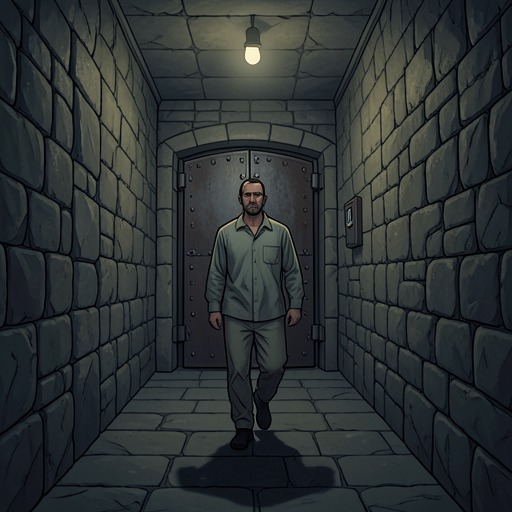
Meursault knows that the condemned are always collected at dawn, and this knowledge governs his nights. He does not merely dread an unspecified future; he watches for a particular temporal signal, the first hint of daybreak in the dark dome above him. Because he dislikes being taken by surprise, he sleeps intermittently during the day and remains awake through the night, preparing himself for the hour when footsteps might announce the end.
The most terrible part of the night is the vague hour in which the executioners usually come. At the slightest rustle, Meursault rushes to the door and presses his ear against its rough, cold wood, listening so intently that he can hear his own breathing, quick and hoarse. Dawn therefore carries an unstable value: it may bring death, but its arrival without footsteps also proves that death has not yet come. The approach of light is simultaneously an anticipated catastrophe and evidence of another twenty-four hours of life.
Reprieve, Vigil, and Repetition
The recurring dawn imposes a mechanical rhythm on Meursault’s existence. Each night is spent waiting, and each morning divides one period of danger from the next. When the sky brightens and light floods the cell without the sound of approaching footsteps, he experiences a limited but unmistakable reprieve: his heart has not shattered, and another day has been granted.
This repetition does not resolve his fear. Instead, it sharpens his hearing and makes ordinary noises newly significant. The absence of footsteps becomes as meaningful as any event, while the expected arrival of dawn prevents him from escaping into vague thoughts about the future. He tries to divert himself by studying the sky and listening to his heart, imagining the moment when its faint throbbing will no longer echo in his head, but neither exercise can dislodge dawn or the appeal from the natural course of his thoughts.
Dawn and the Appeal
During the day, Meursault turns to his appeal, while dawn remains the boundary toward which the prison nights move. His legal hope and the coming light are linked because both keep the future open, though neither offers security. He repeatedly imagines that the appeal has been dismissed and that he will die sooner than other people, then attempts to console himself with the thought that everyone must eventually confront death.
The reasoning provides only imperfect comfort. It is possible to say that dying at thirty or at seventy makes little difference because the world continues and other people go on living, but the years still apparently available to him make early death painful. Dawn exposes the weakness of abstract consolation: each morning does not merely demonstrate the inevitability of death but returns Meursault to the concrete fact that he may still have another day to lose. His eventual willingness to face the appeal’s dismissal is therefore formed through repeated dawns rather than achieved by a single argument.
The Final Dawn and Recognition
After his violent confrontation with the chaplain, Meursault falls into an exhausted sleep. He wakes beneath the stars, hears faint countryside sounds, and feels the cool night air carrying the smells of earth and salt. At the edge of daybreak, a steamer’s siren announces that other people are beginning voyages toward a world that, for him, has ceased to matter. Dawn here opens not onto ordinary participation but onto separation: the living world is moving forward while Meursault stands outside its future.
Yet this final approach to dawn also brings his first sustained thought of his mother in many months. He understands why she had accepted a fiance and played at beginning again near the end of her life. In the Home for Aged Persons, where lives were fading, the coming dusk could offer consolation; near death, she may have felt like someone on the brink of freedom, ready to start life anew. The temporal cycle that has imprisoned Meursault thus connects him to his mother: both discover, at the edge of death, that an ending can strip away the demands of ordinary life and make a new beginning imaginable.
Significance of the Threshold
Dawn changes from an external schedule imposed by the prison into a measure of Meursault’s inward transformation. At first it is the hour of surveillance, bodily panic, and possible execution. Then it becomes the proof of continued existence, even when that existence is reduced to listening, waiting, and counting another twenty-four hours. Finally, after his anger has exhausted him and sleep has carried him toward morning, dawn forms part of a larger acceptance.
Looking into the dark sky marked by stars, Meursault feels ready to start life all over again. He recognizes that he has been happy and is still happy, not because death has been removed but because he has opened himself to the universe’s indifference. Dawn consequently does not promise rescue or religious redemption. Its power lies in its repetition and neutrality: it arrives whether or not the executioners come, and it gives the condemned man one more encounter with the world before death. The threshold that once threatened to close his life becomes the setting in which he accepts its irreducible finitude.