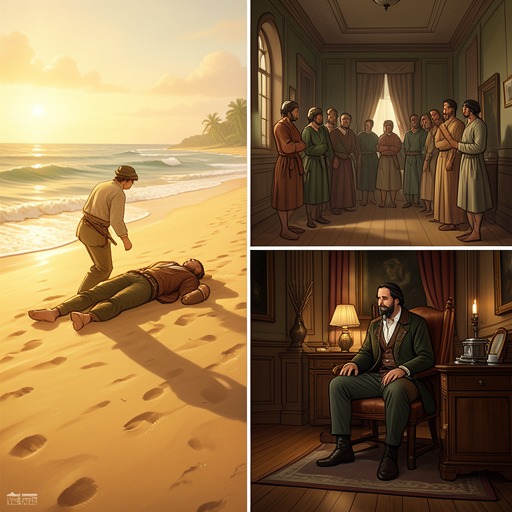
opening day
Mother’s Death
[Meursault](entity:character-recall-character-meursault-bdf3ec5b996c) receives a telegram saying that [Madame Meursault](entity:character-recall-character-madame-meursault-4019f35451e1) has died at [The Home for Aged Persons](entity:location-recall-location-the-home-for-aged-pe-a2e564dd4d5a) in [Marengo](entity:location-recall-location-marengo-4822d3da8edb), though he cannot determine whether the death occurred today or yesterday. He arranges two days’ leave, borrows mourning clothes, and takes the bus from [Algiers](entity:location-recall-location-algiers-badef4fe514b) to Marengo.
His uncertainty immediately establishes his emotional detachment and the novel’s tension between private sensation and social expectation. The death is presented less as a sentimental rupture than as an administrative fact whose exact timing remains unclear.
same afternoon
Arrival at the Home
[Meursault](entity:character-recall-character-meursault-bdf3ec5b996c) walks from the village to [The Home for Aged Persons](entity:location-recall-location-the-home-for-aged-pe-a2e564dd4d5a) and meets its warden. The warden explains that [Madame Meursault](entity:character-recall-character-madame-meursault-4019f35451e1) had entered the institution three years earlier because she had no private means and depended on her son, while also insisting that she had been happier among people of her own generation.
Meursault admits that he rarely visited because the journey consumed his Sundays and because mother and son had little to say to one another. Their relationship emerges as one shaped by habit, distance, and practical accommodation rather than conventional tenderness.
late afternoon of the opening day
Refusal to View the Body
The keeper tells [Meursault](entity:character-recall-character-meursault-bdf3ec5b996c) that the [Coffin](entity:object-recall-object-coffin-783640ffa007) lid has been loosened so he can see his mother, but Meursault refuses. He sits beside the Coffin while the nurse remains nearby, and the keeper explains that [Madame Meursault](entity:character-recall-character-madame-meursault-4019f35451e1) died of a tumor.
Meursault accepts [Café au lait](entity:object-recall-object-caf-au-lait-4399f0060ed0) and a [Cigarette](entity:object-recall-object-cigarette-98ea3ed9565f), deciding that smoking in the presence of the body does not matter. This small choice becomes central evidence against him because others interpret ordinary physical acts as proof of moral callousness.
night before the funeral
The Vigil
Friends of [Madame Meursault](entity:character-recall-character-madame-meursault-4019f35451e1) arrive for the Home’s customary vigil. They sit silently around the [Coffin](entity:object-recall-object-coffin-783640ffa007) while one woman sobs repeatedly, and [Meursault](entity:character-recall-character-meursault-bdf3ec5b996c) observes their aged bodies, their fixed expressions, and their exhausted gestures with intense physical clarity.
He spends the night drinking coffee, smoking, dozing, and noticing the light, insects, and bodily discomfort around him. The vigil creates a communal ritual of grief that Meursault witnesses without fully entering, reinforcing his isolation from socially expected mourning.
dawn after the vigil
Funeral Arrangements
The warden tells [Meursault](entity:character-recall-character-meursault-bdf3ec5b996c) that the Home’s inmates are normally barred from attending funerals, though an old friend, [Thomas Pérez](entity:character-recall-character-thomas-p-rez-d3780261e37f), has been permitted to accompany the procession. The priest, acolytes, nursing sister, undertakers, and hearse arrive, and the [Coffin](entity:object-recall-object-coffin-783640ffa007) is screwed shut.
The Home’s funeral attendance rule separates institutional routine from personal grief. Pérez’s presence offers the only visible bond between [Madame Meursault](entity:character-recall-character-madame-meursault-4019f35451e1) and another mourner, while Meursault remains largely an observer of the ceremony.
morning after the vigil
The Funeral Procession
The procession leaves the Home under an increasingly fierce sun. [Thomas Pérez](entity:character-recall-character-thomas-p-rez-d3780261e37f) struggles to keep pace, repeatedly taking shortcuts, while [Meursault](entity:character-recall-character-meursault-bdf3ec5b996c) suffers from heat, thirst, glare, exhaustion, and the oppressive smell of leather, horse dung, and incense.
The landscape appears mournful in the cool [evening](entity:time-recall-time-evening-96766d6ccf32) but inhuman beneath the morning blaze. Physical sensation dominates Meursault’s consciousness, and the funeral becomes associated with the same solar violence that will later surround the killing.
late morning after the vigil
Burial at Marengo
The funeral reaches the village church and cemetery. [Thomas Pérez](entity:character-recall-character-thomas-p-rez-d3780261e37f) faints from exhaustion and grief, while [Meursault](entity:character-recall-character-meursault-bdf3ec5b996c) remembers the red earth, geraniums, white roots, the [Coffin](entity:object-recall-object-coffin-783640ffa007) being covered, and the wait for the bus back to [Algiers](entity:location-recall-location-algiers-badef4fe514b).
Once the burial is complete, Meursault’s strongest feeling is relief at returning to the city and sleeping. The event fixes the public narrative that he did not mourn properly, a judgment that will later overwhelm the actual circumstances of the killing.
Saturday after the funeral
Saturday Swim with Marie
[Meursault](entity:character-recall-character-meursault-bdf3ec5b996c) wakes and realizes that the funeral occurred on Friday, giving him four consecutive days away from work because [Saturday](entity:time-recall-time-saturday-26079b8bc97c) and [Sunday](entity:time-recall-time-sunday-073632221971) were already free. He goes to [The swimming pool](entity:location-recall-location-the-swimming-pool-26b283ab710b) and encounters [Marie Cardona](entity:character-recall-character-marie-cardona-81c6beec157a), a former office typist, with whom he swims, flirts, and begins a sexual relationship.
Marie notices his black mourning tie and learns that his mother died the day before. Although she briefly recoils, the two spend the [evening](entity:time-recall-time-evening-96766d6ccf32) at a comic film and return to Meursault’s room, making the contrast between his physical pleasure and conventional mourning immediately conspicuous.
Sunday after the funeral
A Sunday of Observation
Marie leaves in the morning, and [Meursault](entity:character-recall-character-meursault-bdf3ec5b996c) spends [Sunday](entity:time-recall-time-sunday-073632221971) sleeping, smoking, eating simply, and watching the street from his balcony. He observes families, young men, football crowds, cinema audiences, streetcars, and the gradual emptying of the neighborhood.
At night he reflects that [Madame Meursault](entity:character-recall-character-madame-meursault-4019f35451e1) is buried and that he will return to work tomorrow, yet nothing in his life has changed. His detached conclusion embodies [“One life was as good as another.”](entity:expression-recall-expression-one-life-was-as-go-5d68872562ec)
Monday after the funeral
Meeting Salamano
After work, [Meursault](entity:character-recall-character-meursault-bdf3ec5b996c) encounters [Salamano](entity:character-recall-character-salamano-b41b05b39b83) and his diseased spaniel in the building. Salamano repeatedly beats and curses the dog during their customary walks along [Rue de Lyon](entity:location-recall-location-rue-de-lyon-0000e64be232), even though the two have been inseparable for eight years.
The pair’s mutual hatred conceals a dependence that becomes visible only when the dog later disappears. Their relationship provides a distorted parallel to human attachments, showing affection and cruelty coexisting within habitual bonds.
later that week
Raymond’s Invitation
[Raymond Sintès](entity:character-recall-character-raymond-sint-s-fe484236aa78) invites [Meursault](entity:character-recall-character-meursault-bdf3ec5b996c) to spend the coming [Sunday](entity:time-recall-time-sunday-073632221971) at [Masson’s bungalow](entity:location-recall-location-masson-s-bungalow-7e1b6c77119c) outside [Algiers](entity:location-recall-location-algiers-badef4fe514b). He also warns that Arabs connected to the woman he has been keeping are following him, including her brother.
At work, Meursault’s employer offers him a position in [Paris](entity:location-recall-location-paris-c02b439ce220), but Meursault says he does not care much either way and rejects the idea that changing his life matters. His indifference toward career, place, and ambition clarifies the pattern of passive acceptance that draws him into Raymond’s affairs.
same week
Marriage Proposal from Marie
Marie asks [Meursault](entity:character-recall-character-meursault-bdf3ec5b996c) whether he loves her and whether he will marry her. He says that love and marriage have little importance to him, but he will marry her if she wants, since one life is as good as another.
Marie is fascinated by his strangeness and worries that the same quality may eventually make her hate him. Their relationship remains genuine at the level of desire and companionship, but it cannot supply the emotional declarations society expects.
same week
Salamano Loses His Dog
[Salamano](entity:character-recall-character-salamano-b41b05b39b83) discovers that his spaniel has disappeared and searches the pound and police station without success. He insists that he does not care about the animal, yet his trembling hands and repeated questions reveal his fear of being left alone.
He tells [Meursault](entity:character-recall-character-meursault-bdf3ec5b996c) that he acquired the dog after his wife’s death and that they had grown old together. His grief briefly makes Meursault think of [Madame Meursault](entity:character-recall-character-madame-meursault-4019f35451e1), linking the dog’s disappearance to the loneliness that follows bereavement.
later that week
Raymond’s Violent Story
Raymond tells [Meursault](entity:character-recall-character-meursault-bdf3ec5b996c) that he has beaten the woman he kept after suspecting her of infidelity. He claims she had betrayed him, describes the money he gave her, and asks Meursault for advice about punishing her further.
Meursault does not condemn Raymond and agrees that the woman may deserve punishment. His passive neutrality becomes practical complicity, allowing Raymond’s violent grievance to pull him toward the later confrontation.
same evening
Raymond’s Revenge Letter
Raymond asks [Meursault](entity:character-recall-character-meursault-bdf3ec5b996c) to write a vicious letter to his mistress, designed to lure her back so Raymond can sleep with her, humiliate her, and throw her out. Meursault writes it without much effort because he sees no reason not to satisfy Raymond.
The letter turns Meursault from a bystander into an instrument of Raymond’s revenge. Its consequences extend beyond the apartment and help create the chain of coincidence that culminates at the beach.
following Saturday
Raymond Assaults His Mistress
Marie is visiting [Meursault](entity:character-recall-character-meursault-bdf3ec5b996c) when a violent quarrel erupts in Raymond’s room. They hear the woman screaming while Raymond beats her, and a policeman arrives, strikes Raymond, and orders the woman away.
Marie asks Meursault to fetch a policeman, but he refuses because he dislikes them. Raymond later explains that the woman slapped him and that he lost control, then asks Meursault to serve as a witness that she had betrayed him.
same Saturday afternoon
Meursault Becomes Raymond’s Witness
[Meursault](entity:character-recall-character-meursault-bdf3ec5b996c) agrees to support Raymond’s version of the assault and accompanies him to a café and billiards hall. Raymond proposes visiting a brothel, but Meursault declines, and the two return home as friends.
Meursault’s testimony is not motivated by conviction; he simply sees no reason to refuse. This moral passivity strengthens Raymond’s position and makes Meursault increasingly entangled in the conflict with the woman’s family.
Saturday evening
Raymond’s Police-Station Release
Raymond and [Meursault](entity:character-recall-character-meursault-bdf3ec5b996c) visit [The police station](entity:location-recall-location-the-police-station-c4a5b824ec5f), where Meursault gives evidence favorable to Raymond regarding the woman’s alleged infidelity. The police release Raymond with a warning and do not investigate Meursault’s statement.
The encounter confirms Meursault’s role as Raymond’s associate. It also demonstrates how an apparently minor act of testimony can become part of the prosecution’s later portrait of Meursault as morally connected to Raymond’s violent underworld.
Sunday morning
Arabs Follow Raymond
[Meursault](entity:character-recall-character-meursault-bdf3ec5b996c), Marie, and Raymond leave for [Masson’s bungalow](entity:location-recall-location-masson-s-bungalow-7e1b6c77119c). Raymond points out several Arabs watching them, identifying one as the brother of the woman he assaulted. The group takes the bus toward the beach despite the apparent threat.
Raymond’s fear is partly concealed by jokes and bravado, while Meursault responds with practical observation rather than alarm. The journey transforms a domestic dispute into an open confrontation under the heat of the coast.
Sunday morning
Arrival at Masson’s Bungalow
The group reaches [Masson’s bungalow](entity:location-recall-location-masson-s-bungalow-7e1b6c77119c), where [Masson](entity:character-recall-character-masson-ce477ec3ced6) and his wife welcome them and announce that fried fish will be served. [Meursault](entity:character-recall-character-meursault-bdf3ec5b996c) swims with Marie and Masson, enjoys the sea, and begins seriously considering marriage to Marie.
The bungalow offers a brief vision of uncomplicated pleasure: bathing, food, sunlight, and companionship. Its apparent refuge is unstable, however, because Raymond’s enemies have followed them to the shore.
Sunday around midday
Beach Fight
After lunch, Raymond, [Masson](entity:character-recall-character-masson-ce477ec3ced6), and [Meursault](entity:character-recall-character-meursault-bdf3ec5b996c) walk along the beach and encounter two Arabs. Raymond attacks the man connected to his mistress, Masson strikes the other, and the fight turns when one Arab draws a [Knife](entity:object-recall-object-knife-9c4df9a6663d) and slashes Raymond’s arm and mouth.
The Arabs withdraw, leaving Raymond wounded and enraged. The violence is the direct consequence of Raymond’s earlier assault and Meursault’s participation in the surrounding chain of events.
shortly after the beach fight
Raymond Takes the Revolver
After receiving medical treatment, Raymond insists on walking alone along the beach. [Meursault](entity:character-recall-character-meursault-bdf3ec5b996c) follows him, and they find the two Arabs resting near a stream. Raymond reaches for his [Revolver](entity:object-recall-object-revolver-93b4d7db5019) and asks whether he should shoot.
Meursault advises against firing without provocation and suggests that Raymond hand him the weapon. When the Arabs disappear behind the rock, Meursault and Raymond return toward the bungalow, but Meursault remains overwhelmed by heat and glare.
early Sunday afternoon
Meursault Returns Alone
At the bungalow steps, [Meursault](entity:character-recall-character-meursault-bdf3ec5b996c) stops because the light pounds in his head and he cannot face the effort of returning to the women. He turns back toward the beach, drawn by the imagined coolness of the stream and the shade beneath the rock.
His movement seems both voluntary and compelled. The physical world—heat, salt, glare, and bodily pressure—narrows his consciousness until the distinction between decision and accident begins to collapse.
moments before the shooting
The Knife in Sunlight
[Meursault](entity:character-recall-character-meursault-bdf3ec5b996c) discovers that the Arab has returned alone and is lying near the rock. As Meursault approaches, the Arab raises his [Knife](entity:object-recall-object-knife-9c4df9a6663d), and sunlight flashes from the steel into Meursault’s blinded eyes.
The heat recalls [Madame Meursault](entity:character-recall-character-madame-meursault-4019f35451e1)’s funeral, while sweat and glare overwhelm Meursault’s perception. The Knife becomes fused with the “cymbals of the sun,” turning the approaching confrontation into a crisis of physical sensation rather than articulated intention.
Sunday afternoon
Meursault Shoots the Arab
[Meursault](entity:character-recall-character-meursault-bdf3ec5b996c) fires the [Revolver](entity:object-recall-object-revolver-93b4d7db5019) once, striking the Arab. After a pause, he fires four additional shots into the inert body. He recognizes that the first shot has broken the day’s balance, yet he cannot explain why he continues.
The killing becomes the novel’s irreversible turning point. Meursault later describes the sun as the immediate force pressing through him, but the five shots also create the legal and moral ambiguity that the court will attempt to convert into a coherent motive.
immediately after the shooting
Initial Arrest
[Meursault](entity:character-recall-character-meursault-bdf3ec5b996c) is arrested and subjected first to routine questioning about his identity and circumstances. He regards the administrative process as straightforward and assumes the authorities will handle necessary details.
His calmness contrasts with the gravity of the crime and foreshadows the court’s later fixation on his personality. The legal system begins treating not only the shooting but also Meursault’s entire manner of living as evidence.
about one week after arrest
The Lawyer Investigates His Character
An appointed lawyer tells [Meursault](entity:character-recall-character-meursault-bdf3ec5b996c) that investigators have emphasized his conduct at [Madame Meursault](entity:character-recall-character-madame-meursault-4019f35451e1)’s funeral. The lawyer asks whether Meursault felt grief, but Meursault answers that he has lost the habit of identifying his feelings and cannot honestly claim to have displayed control or remorse.
The lawyer urges him not to mention atheism or the ordinary possibility that people may sometimes wish loved ones dead. Meursault understands that the defense requires an emotional performance he cannot sincerely provide.
first formal examination
The Magistrate’s Religious Interrogation
The examining magistrate questions [Meursault](entity:character-recall-character-meursault-bdf3ec5b996c) about the shooting, especially why he waited before firing the remaining four shots. When Meursault cannot provide a satisfying explanation, the magistrate produces a [Crucifix](entity:object-recall-object-crucifix-6b88d47ea1bd) and urges him to repent and believe in God.
Meursault rejects the magistrate’s faith and says he does not believe in God. The interrogation reveals that the authorities want an intelligible moral soul behind the act, while Meursault offers only physical memory, uncertainty, and refusal to pretend.
the following eleven months
Long Pretrial Examinations
[Meursault](entity:character-recall-character-meursault-bdf3ec5b996c) appears repeatedly before the magistrate, usually with his lawyer. The questioning becomes technical and cordial, and the magistrate gradually loses his initial religious fervor, eventually jokingly calling Meursault “Mr. Antichrist.”
The case proceeds without Meursault’s active participation. His growing familiarity with the officials produces an absurd sense of belonging even while he remains under [Imprisonment](entity:state-recall-state-imprisonment-19f85c061f7f) and moves steadily toward trial.
early imprisonment
Marie’s Visit Ends
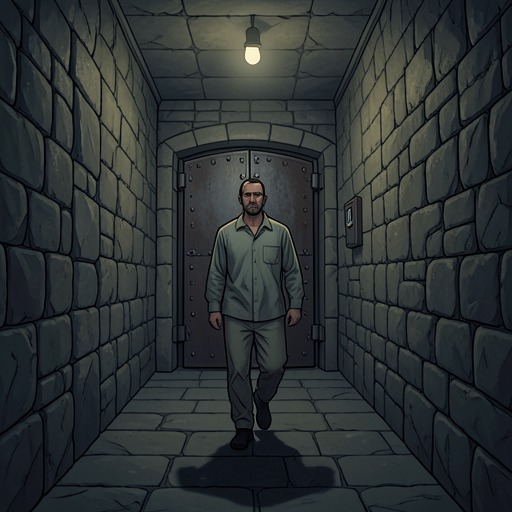
Marie visits [Meursault](entity:character-recall-character-meursault-bdf3ec5b996c) in prison, but afterward he receives a letter saying she can no longer visit because she is not his wife. He realizes that the cell has become his last home and a dead end.
The restriction converts his relationship with Marie from a continuing possibility into a memory. Institutional rules now control even the most intimate bonds, sharpening the tension between freedom and confinement.
first months of imprisonment
Life in the Prison
[Meursault](entity:character-recall-character-meursault-bdf3ec5b996c) initially struggles with the loss of the sea, women, [Cigarette](entity:object-recall-object-cigarette-98ea3ed9565f), and unrestricted movement. He gradually adapts by waiting for walks, visits, meals, and sleep, accepting that a person can become accustomed to almost anything.
[The prison](entity:location-recall-location-the-prison-9745412da591) deprives him of liberty, and a jailer explains that this is precisely the punishment. Meursault learns to kill time through memory, reconstructing his room in exhaustive detail until a single day’s experience can sustain years of confinement.
during the first months in prison
The Czech Crime Story
[Meursault](entity:character-recall-character-meursault-bdf3ec5b996c) finds a fragment of newspaper about a man from Czechoslovakia who returns home wealthy but is not recognized by his mother and sister. They murder him for his money, discover his identity afterward, and respond by suicide.
He reads the account repeatedly, finding it both implausible and believable. The story becomes a prison companion and a warning against elaborate tricks, while also echoing the novel’s concern with failed recognition, family, death, and chance.
after six months of imprisonment
Time Loses Its Shape
A jailer tells [Meursault](entity:character-recall-character-meursault-bdf3ec5b996c) that six months have passed, but the statement carries little meaning because prison time feels like one continuous day. Meursault studies his reflection in a tin cup and realizes that he has been speaking aloud to himself.
The collapse of temporal distinctions marks his full adaptation to confinement. The outside world survives only as remembered sensations, while the prison turns consciousness inward and makes repetition its governing reality.
June of the following year
Trial Begins
[Meursault](entity:character-recall-character-meursault-bdf3ec5b996c)’s trial begins in the [Assize Court](entity:organization-recall-organization-assize-court-cd66497a3ea5) on a brilliant, stifling day. The courtroom is crowded because newspapers have featured his case, though many journalists are primarily waiting for a forthcoming parricide trial.
[The law courts](entity:location-recall-location-the-law-courts-dafc6a5dc1d5) immediately feel like a social club from which Meursault is excluded. He becomes an object of public curiosity, and the trial’s atmosphere suggests that the court will judge his place in society as much as the killing itself.
first day of the trial
Witnesses Are Called
The court calls Raymond, [Masson](entity:character-recall-character-masson-ce477ec3ced6), [Salamano](entity:character-recall-character-salamano-b41b05b39b83), the Home’s warden, [Thomas Pérez](entity:character-recall-character-thomas-p-rez-d3780261e37f), Marie, and [Céleste](entity:character-recall-character-c-leste-34355bf95c76) as witnesses. Their presence links the shooting to every earlier stage of [Meursault](entity:character-recall-character-meursault-bdf3ec5b996c)’s life, from the funeral to Raymond’s violence and the beach trip.
Meursault is startled that these familiar people were present in the courtroom without his noticing them. The legal process gathers scattered incidents into a single narrative that he himself does not recognize.
first afternoon of the trial
Funeral Evidence
The warden testifies that [Meursault](entity:character-recall-character-meursault-bdf3ec5b996c) refused to view [Madame Meursault](entity:character-recall-character-madame-meursault-4019f35451e1)’s body, did not cry, and left promptly after the burial. The doorkeeper adds that Meursault smoked, slept, and drank [Café au lait](entity:object-recall-object-caf-au-lait-4399f0060ed0) beside the [Coffin](entity:object-recall-object-coffin-783640ffa007).
These details provoke indignation in the courtroom and make Meursault feel guilty for the first time in this public sense. The prosecution treats private conduct at the funeral as evidence of a criminal disposition.
same afternoon
Pérez Cannot Confirm Tears
[Thomas Pérez](entity:character-recall-character-thomas-p-rez-d3780261e37f) testifies that grief and exhaustion prevented him from observing [Meursault](entity:character-recall-character-meursault-bdf3ec5b996c) closely during the funeral. When asked whether he saw Meursault weep, Pérez answers that he cannot swear that Meursault did not shed a tear.
The defense tries to use this uncertainty, but the testimony cannot dislodge the courtroom’s settled impression. The scene shows how a vague absence of evidence is overwhelmed by the demand for a recognizable performance of mourning.
same afternoon
Céleste Defends Meursault
[Céleste](entity:character-recall-character-c-leste-34355bf95c76) describes [Meursault](entity:character-recall-character-meursault-bdf3ec5b996c) as an honest customer and friend and insists that the killing was an accident or bad luck. He wants to continue defending Meursault, but the Judge cuts him short because the court is concerned with legal responsibility rather than accident.
Céleste’s helpless emotion is the first testimony to affect Meursault deeply. Meursault feels an unprecedented desire to kiss a man, recognizing genuine loyalty even though the court dismisses it.
same afternoon
Marie’s Damaging Testimony
Marie confirms that she and [Meursault](entity:character-recall-character-meursault-bdf3ec5b996c) began their relationship the day after [Madame Meursault](entity:character-recall-character-madame-meursault-4019f35451e1)’s funeral. Under pressure, she describes their swim, their visit to a comic film starring Fernandel, and their return to Meursault’s room.
The Prosecutor presents the outing as proof that Meursault was morally corrupt immediately after his mother’s death. Marie protests that the court has distorted the truth, but she breaks down and is led away.
same afternoon
Raymond’s Testimony Turns
Raymond says that [Meursault](entity:character-recall-character-meursault-bdf3ec5b996c) is innocent and that their meeting at the beach was coincidental. The Prosecutor exposes Raymond’s violent reputation, his relationship with women, and Meursault’s assistance in the revenge letter and police testimony.
The testimony transforms Raymond from a supporting witness into evidence of Meursault’s supposed moral depravity. The Prosecutor argues that Meursault’s friendship with Raymond reveals the squalid background and intention behind the killing.
second day of the trial
The Prosecutor’s Moral Case
The Prosecutor argues that [Meursault](entity:character-recall-character-meursault-bdf3ec5b996c)’s funeral conduct, relationship with Marie, association with Raymond, and five shots prove premeditated criminality. He describes Meursault as intelligent, soulless, and devoid of normal human feeling.
He claims that Meursault is morally guilty of [Madame Meursault](entity:character-recall-character-madame-meursault-4019f35451e1)’s death and even symbolically connected to the parricide case scheduled for the next day. The prosecution’s central strategy is to convert emotional nonconformity into evidence of murder.
during the prosecution and defense arguments
Meursault Blames the Sun
When the Judge asks [Meursault](entity:character-recall-character-meursault-bdf3ec5b996c) to explain the crime, Meursault says that it happened because of the sun. He knows the explanation sounds absurd, and the courtroom responds with laughter and disbelief.
His statement is truthful to his experience but unusable within legal language. The sun functions as a physical pressure and recurring image, while the court demands a stable motive such as malice, revenge, or premeditation.
final day of the trial
Defense Plea Fails
[Meursault](entity:character-recall-character-meursault-bdf3ec5b996c)’s lawyer presents him as a decent, hardworking young man whose actions resulted from provocation and extenuating circumstances. He emphasizes Meursault’s support for [Madame Meursault](entity:character-recall-character-madame-meursault-4019f35451e1) and avoids the funeral evidence that has dominated the case.
Meursault feels that the lawyer’s speech substitutes the lawyer for himself and excludes him from his own trial. The courtroom’s elaborate argument about his soul becomes increasingly unreal to him as heat, exhaustion, and memories blur his attention.
evening of the final trial day
Death Sentence
The jury returns, and the presiding Judge announces that, in the name of the French people, [Meursault](entity:character-recall-character-meursault-bdf3ec5b996c) is to be decapitated in public. Meursault answers “No” when asked whether he has anything more to say, and the police lead him away.
The sentence crystallizes the court’s judgment that his failure to mourn makes him a monster. The legal machinery turns an uncertain chain of physical events into irreversible punishment.
after the death sentence
Death Row Relocation
[Meursault](entity:character-recall-character-meursault-bdf3ec5b996c) is moved to another cell where he can see the sky and begins obsessively imagining ways a condemned prisoner might escape the execution process. He considers historical accounts, drugs, luck, and the possibility that the [Guillotine](entity:object-recall-object-guillotine-cc94009e513a) might fail.
His reflections reveal that what torments him is not only death but the absence of any chance. The condemned man must hope for the machine’s efficiency while longing for the smallest possibility of accidental escape.
during the weeks on death row
The Inevitability of Death
[Meursault](entity:character-recall-character-meursault-bdf3ec5b996c) reasons that all people are destined to die, whether at thirty or seventy, and recalls that his father once watched an execution and became violently ill. He recognizes that his own death gives execution a significance he had previously refused to see.
The thought offers no stable comfort because the years he might have lived remain painfully imaginable. Yet it establishes death as the common condition linking Meursault to every other person.
later on death row
Marie Fades from Memory
[Meursault](entity:character-recall-character-meursault-bdf3ec5b996c) wonders whether Marie is tired of being associated with a condemned man, ill, or dead. He concludes that even if she has died, her memory would eventually mean nothing to him, just as people would soon forget him after his own death.
The thought illustrates his radical detachment from future remembrance and conventional grief. Death dissolves not only bodies but the social bonds that once seemed to define identity.
near the ending
The Chaplain Arrives
After [Meursault](entity:character-recall-character-meursault-bdf3ec5b996c) refuses several visits, the prison chaplain enters his cell for a final attempt to discuss God. Meursault explains that he does not believe in God and has no interest in troubling himself over a question that does not matter to him.
The chaplain insists that all condemned men turn toward faith and that God can help him. Their conversation becomes a confrontation between religious consolation and Meursault’s insistence on the certainty of physical life and death.
same final evening
Meursault Rejects Afterlife
The chaplain argues that every person is under sentence of death and urges [Meursault](entity:character-recall-character-meursault-bdf3ec5b996c) to imagine a divine face in the prison walls. Meursault rejects the promise of an afterlife, saying that if anything remained after death, he would want only the memory of earthly life.
He refuses to call the chaplain “Father” and insists that man’s justice has already condemned him, while he has no consciousness of religious sin. The dispute exposes the incompatibility between institutional faith and Meursault’s direct, embodied certainty.
just before dawn near the ending
The Outburst Against Faith
When the chaplain declares that [Meursault](entity:character-recall-character-meursault-bdf3ec5b996c) must hope for an afterlife, Meursault erupts in rage. He seizes the chaplain’s cassock and denounces religious certainty, insisting that every person shares the same fate of death and that no belief can make one life intrinsically more meaningful than another.
The outburst breaks through his habitual passivity. He recognizes that he is sure of his present life and approaching death, while the chaplain’s certainties are not provable. His revolt becomes an affirmation of lucid existence rather than an appeal for escape.
final dawn
Acceptance of Cosmic Indifference
After the chaplain leaves, [Meursault](entity:character-recall-character-meursault-bdf3ec5b996c) sleeps and wakes to the sounds of the countryside, the sea, and a steamer beginning its voyage. He thinks about [Madame Meursault](entity:character-recall-character-madame-meursault-4019f35451e1)’s final attempt to begin life again at [The Home for Aged Persons](entity:location-recall-location-the-home-for-aged-pe-a2e564dd4d5a) and understands her as someone who faced death with a sense of renewed freedom.
Looking into the night sky, Meursault opens himself to “the benign indifference of the universe.” He realizes that he has been happy and remains happy, and hopes that a large crowd will greet his execution with cries of hatred so that he will feel less alone.