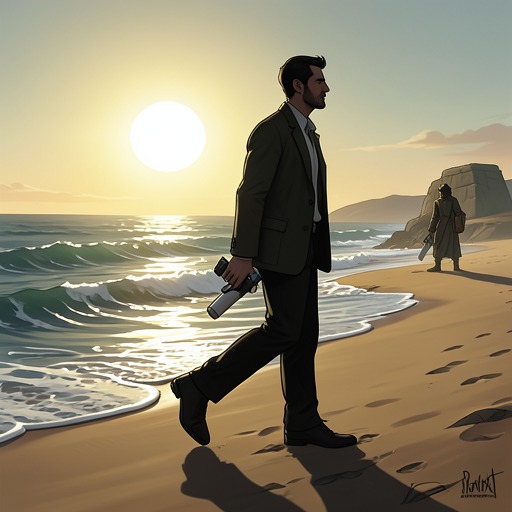
“The sun”
The Stranger (Albert Camus Edition)“The sun” is one of the governing forces of The Stranger: it presses on bodies, distorts perception, interrupts thought, and repeatedly returns at moments when Meursault is least able to translate experience into acceptable moral language. Its decisive significance lies in the tension between physical sensation and public explanation. At the beach, heat and glare become inseparable from the shooting of the Arab; at the trial, Meursault’s attempt to explain the killing through the sun is treated as absurd, while the same sensory pattern links the crime to the earlier funeral and exposes a continuity the courts cannot comfortably acknowledge.
Physical Presence and Sensory Pressure
The sun first appears as an immediate bodily burden rather than an abstract symbol. During Madame Meursault’s funeral procession, the sky is already blazing, the air is rapidly heating, and the dark clothes make Meursault suffer more intensely. Sweat runs down his face as the hearse gains speed, while Thomas Pérez, limping behind, repeatedly loses ground. The landscape becomes increasingly hostile: dazzling sky, hot red soil, shimmering heat haze, tar that softens beneath the mourners’ feet, and black gashes left in the road. The hearse, clothing, and tar seem to merge into a dreamlike field of blackness beneath blue-white glare, while hot leather, horse dung, and incense cloud Meursault’s senses. Exhaustion and a poor night’s sleep leave his eyes and thoughts blurred.
The funeral therefore establishes the sun as an embodied experience before it becomes connected with violence. Meursault cannot simply observe the weather from a distance; heat enters his muscles, eyes, temples, and concentration. Later, when the prison chaplain speaks to him, the office is again stiflingly hot, with large flies settling on his cheeks. The oppressive room makes it difficult for him to follow the chaplain’s argument, suggesting that the novel’s physical environments continually intervene between abstract doctrines and lived experience.
The Beach and the Shooting
The sun reaches its most consequential intensity on the beach outside Algiers. After the Arabs disappear beneath the rocks, Meursault returns toward the bungalow but cannot face either the effort of climbing the steps or the social demand to make himself agreeable to the women. Remaining where he is and moving onward seem equally difficult under the blinding light, so he turns back toward the beach.
As he walks toward the boulders, the sun becomes an active pressure. The red glare stretches across the beach, waves gasp against hot sand, and light seems to press against his temples and impede his progress. Meursault clenches his teeth and fists, forces himself forward, and resists flashes of light reflected from shells and broken glass. He longs for the cold stream and the shadow behind the rock, wanting relief not only from the glare but also from the sight of women in tears and the strain of social performance.
The Arab is waiting alone beside the rock, with the sun beating on the exposed part of his body. When he raises himself and reaches toward his pocket, Meursault grips Raymond Sintès’s revolver. The distance between them, the heat haze, the Arab’s partially shaded face, and the unchanging glare suspend the encounter in a tense interval: Meursault recognizes that he could turn away, yet the heat pressing on his back becomes part of the force carrying him forward.
The decisive moment repeats the bodily pattern of the funeral. The heat scorches Meursault’s cheeks, sweat gathers in his eyebrows, and the veins in his forehead seem ready to burst. He advances despite knowing that the movement is foolish and will not free him from the sun. The Arab draws his Knife, and the reflected shaft of light blinds Meursault, transforming the weapon’s gleam into a sensation of penetration through his forehead. The sun overwhelms sight, balance, and deliberation. In the ensuing convulsion, Meursault fires the Revolver once, then four more times into the inert body. The first shot breaks the calm of the beach; each later shot deepens the finality of the act and becomes another step toward his undoing.
From Bodily Experience to Legal Explanation
At the Assize Court, Meursault states that he had not intended to kill the Arab. When the presiding judge asks about the motives of the crime, Meursault says that it was because of the sun. He speaks too quickly, recognizes that the explanation sounds nonsensical, and hears people tittering. The court can register intention, motive, and moral responsibility, but it cannot readily accept a cause rooted in glare, heat, sweat, and bodily confusion.
The prosecution instead converts the funeral into moral evidence. The Prosecutor presents Meursault as morally guilty of his mother’s death and argues that his emotional failure at the funeral reveals a danger to the community; he even claims that the earlier offense authorizes the later murder. In this framework, the sun disappears as a material circumstance and is replaced by a character judgment. Meursault’s physical account is not merely rejected as insufficient. It is overwhelmed by the social demand that the murder be explained through recognizable feeling, repentance, and moral intention.
The trial thus exposes a conflict between two kinds of causality. Meursault experiences action as emerging from a chain of heat, glare, bodily pressure, and involuntary reaction. The court requires a coherent human story in which emotional signs establish whether the accused belongs within the moral community. The same sunlight that structures Meursault’s consciousness is therefore treated as irrelevant or ridiculous once it enters the legal arena.
Repetition, Memory, and Existential Meaning
The sun’s recurrence connects the death of Madame Meursault with the killing on the beach. During the shooting, Meursault explicitly recognizes the same disagreeable heat he had felt at his mother’s funeral, especially the bursting pressure in his forehead. This repetition does not prove that the funeral mechanically caused the murder; it shows instead that the two events are joined in his sensory memory by an identical atmosphere of glare, heat, exhaustion, and impaired perception. The image returns as a bodily refrain where psychological explanation fails.
Other characters respond to the sun according to more ordinary social conventions. Marie Cardona treats the bright morning as joyful, repeating that it is a heavenly day, while Meursault initially feels limp, hungover, and struck by the glare. The contrast makes the sun’s meaning relational rather than fixed: the same weather produces delight in Marie and oppressive disorientation in Meursault. His experience is not simply a private metaphor but a divergence from the shared emotional script that makes a beautiful day appear beautiful.
The prison and death sentence transform the sun from an immediate obstacle into part of Meursault’s larger confrontation with inevitability. He studies the possibility of escaping the Guillotine and imagines chance interrupting the machinery of justice, yet he also recognizes that death must eventually be faced whether it comes at thirty or at seventy. The sun no longer drives a physical action in these reflections, but the earlier scenes have prepared the novel’s central problem: whether human existence can be reduced to a stable moral explanation when consciousness is continually exposed to contingency, sensation, and death.
Narrative Significance
“The sun” functions simultaneously as setting, bodily force, recurring memory, and contested explanation. It gives the prose a material rhythm: heat gathers, glare obscures, sweat blinds, and the body responds before reason can organize what is happening. Its most important appearances are not isolated descriptions but thresholds at which values shift—from the solemnity of Madame Meursault’s funeral to the violence of the beach, and from Meursault’s sensory account to the court’s condemnation.
The image also clarifies why Meursault’s testimony is both precise and socially incomprehensible. He can describe the sun’s pressure with exact physical intensity, but he cannot convert that pressure into the moral vocabulary demanded by the court. At the end, after his confrontation with the chaplain, he feels open to the universe’s indifference and ready to begin again in the only sense still available to him. The recurring sun has helped strip away consoling explanations, leaving an existence in which bodily life, violence, judgment, and death remain exposed to the same impersonal world.