Absurdist
The Stranger (Albert Camus Edition)The absurd names the collision between the human demand for meaning and a world that offers no reliable answer. In Meursault’s experience, it is not an abstract doctrine but a pressure felt in ordinary scenes: a tense standoff on a beach, a neighbor’s grief over a dog, the mechanical force of a verdict, the expectation of dawn in a prison cell, and the final confrontation with the chaplain. The condition becomes decisive when Meursault discovers that the same fate levels every distinction people treat as sacred, and that freedom begins only when he stops pretending that the universe will justify them.
Definition Through Stalemate
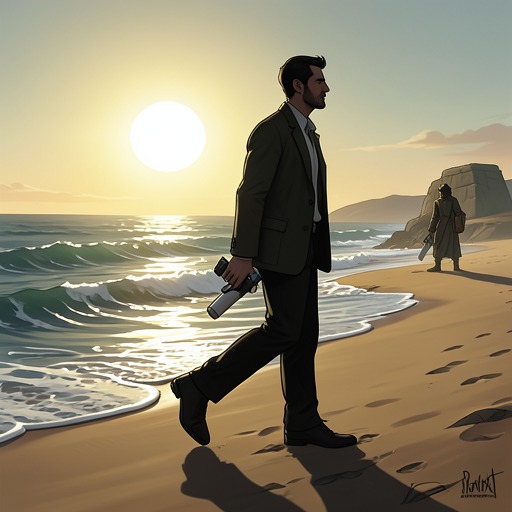
The beach confrontation gives the absurd a physical form before Meursault explains it philosophically. Raymond hands him a revolver while two Arabs watch their movements, yet nobody acts. The sun flashes on the weapon; the sea, the reed, and the stream seem to hold the world motionless. Meursault realizes that firing or not firing might “come to absolutely the same thing.” The thought does not erase danger, but it exposes the terrifying lack of a necessary script: action appears both momentous and arbitrary, while the surrounding world supplies no moral sign telling him what the moment must mean.
The scene also turns decision into paralysis. The men watch one another without lowering their eyes, trapped on a narrow strip of sand between sunlight and sea. When the Arabs suddenly disappear under the rocks, the immediate crisis dissolves without resolution. Raymond becomes cheerful and resumes talking about the bus, as though the suspended violence had been merely an interruption in an ordinary afternoon. Meursault, however, remains caught between moving toward the bungalow and remaining beneath the heat. For him, staying or moving seems to amount to the same thing, a repetition of the same indifferent equivalence that governs the confrontation.
Absurdity in Grief and Social Meaning
The absurd also appears in the gap between genuine suffering and the social explanations imposed upon it. Salamano comes to Meursault trembling, staring at his shoes, and asks whether the authorities will really take his dog away. Meursault answers with the practical information that stray dogs are kept in the pound for three days before being disposed of. The answer is factually useful but emotionally incapable of meeting Salamano’s fear. Afterward, the old man paces, and the wheezing sound from his room suggests that he is crying. Meursault then thinks of Mother, linking two apparently different losses through the same helplessness before removal and death.
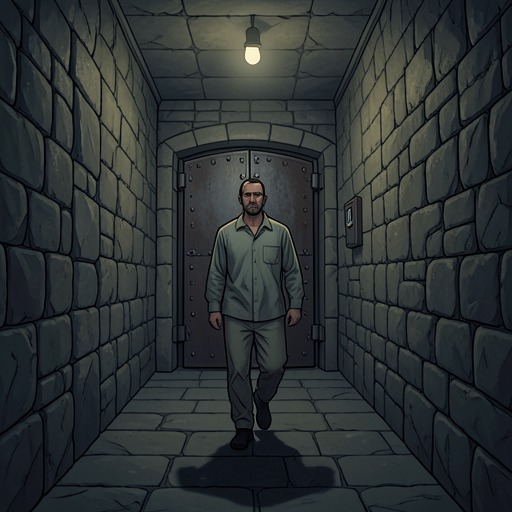
In prison, Meursault recalls a remark made by the nurse at Mother’s funeral: there is no way out. The memory returns while he studies his reflection in a tin pannikin and hears his own voice, realizing that he has been talking to himself. The prison therefore becomes more than a location of physical confinement. Its walls separate him from others, while his own voice reveals an interior solitude that cannot be repaired by ordinary conversation. The absurd is presented formally through repetition and failed communication: a remembered saying, a reflected face, and an inner voice circling the same closed reality.
The Verdict and the Search for a Loophole
The death sentence makes the absurd conflict with the machinery of social judgment. Meursault cannot accept the disproportion between a verdict and the irreversible sequence of events that follows it. The decision was announced at eight in the evening rather than five; it might have been different; it was delivered by men who change their underclothes and attributed to the vague authority of the “French people.” These contingencies seem to rob the judgment of metaphysical gravity. Yet once pronounced, the verdict becomes tangible and coercive, as solid as the wall against which he lies.
His mind therefore searches obsessively for an escape that would restore chance to a process presented as inevitable. He wonders whether a condemned prisoner has ever broken through the police cordon just before the Guillotine falls, and regrets never having studied technical accounts of public executions. A single story in which luck interrupted the machinery would satisfy him—not because it would establish justice, but because it would prove that the sequence was not absolutely closed. The imagined escape is itself modest and desperate: he might be knocked down in the street or shot in the back, yet even that would offer the gambler’s last throw and a moment of hope. The law’s claim to necessity is opposed by the smallest imaginable possibility of chance.
Death, Time, and the Equality of Fate
Meursault’s nights in prison are organized around the expectation that officials come for a prisoner at dawn. He sleeps intermittently during the day and listens through the night for footsteps. The faintest rustle sends him to the door, ear pressed against the cold wood, until the morning light proves that another twenty-four hours has been granted. This rhythm makes death both abstract and bodily immediate: he can reason about its inevitability, but he also feels his heart nearly shatter at the thought of hearing the approaching steps.
During the day, he tests two alternatives concerning his appeal. He first assumes that it has failed and that he will die sooner than other people. He reminds himself that life is not worth living and that, whether a person dies at thirty or seventy, the world continues as before. Yet the argument does not fully console him, because the years still available to him remain painfully imaginable. Only after mastering this first line of reasoning does he permit himself to imagine that the appeal might succeed, and the sudden rush of joy brings tears to his eyes. His thought repeatedly builds and dismantles hope, showing that abstract acceptance of death does not abolish fear or desire.
The same logic expands beyond his own case. Meursault reflects that every living person is privileged only in the temporary sense of still being alive, while all belong to the same condemned class because each will eventually die. The distinction between the condemned man and the supposedly secure spectator collapses. The fate of the chaplain, Salamano, Marie, Raymond, Céleste, and others differs in circumstance but not in final structure. Even the court’s accusation that Meursault failed to weep at his mother’s funeral is absorbed into this leveling vision: moral judgments, social roles, love, and blame all occur inside a mortality that ultimately overtakes everyone.
Revolt and Final Recognition
The chaplain represents the promise that death can be given a religious meaning, but Meursault refuses that promise. After repeatedly declining to see him, Meursault becomes enraged when the priest presents himself as an ally and speaks of his hardened heart. Meursault seizes the chaplain by the neckband of his cassock and shouts that the priest’s certainties are worthless. His outburst is not a conversion to another system of belief. It is a violent rejection of the demand that he accept a meaning he does not experience as true.
In the outburst, Meursault declares certainty about the only things he can possess: his present life and the death approaching him. His past actions could have been different, but they were not; his life has led to this moment, and no external explanation can undo that fact. The future appears as a dark wind that has been blowing toward him all his life, flattening the ideas others tried to impose upon him. This image gathers the novel’s central tension: time does not disclose a providential plan, but carries every person toward the same end.
After the chaplain leaves, Meursault sleeps, wakes beneath the stars, and hears a steamer’s siren near daybreak. The cool air and the sounds of the countryside bring him back to Mother. He now understands her late-life decision to take on a fiancé and begin again: with death near, she may have felt poised for a new beginning rather than merely awaiting extinction. Meursault’s anger has emptied him of hope in the ordinary sense, but it has also freed him from the demand to find a consoling order. Looking at the night sky, he opens himself to the universe’s benign indifference and recognizes that he has been happy and remains happy. The absurd therefore ends neither in despair nor in reconciliation with religious authority, but in an acceptance of shared mortality that makes his final solitude feel, paradoxically, less lonely.