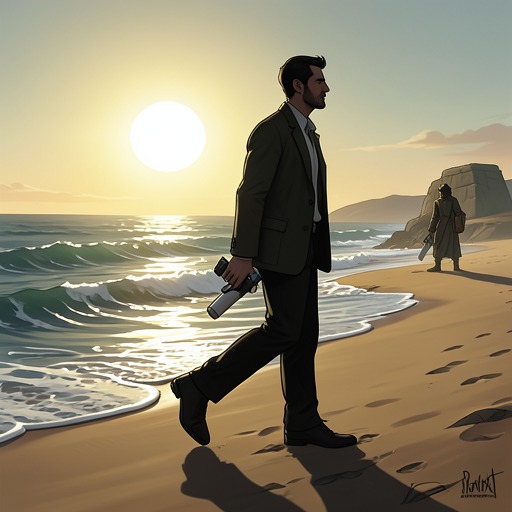
Arab conflict on the beach
The Stranger (Albert Camus Edition)The beach fight is the central escalation of Raymond Sintès’s quarrel with the Arabs: a previously personal grudge follows Raymond’s group from Algiers to the beach, turns into an arranged confrontation, and ends with Raymond wounded by a knife. The encounter changes the apparent stakes from intimidation and retaliation to an armed cycle of violence, while Meursault’s presence as observer, helper, and participant binds him more closely to Raymond’s conflict and to the later legal interpretation of the killing.
Causes and Background
The immediate background is Raymond Sintès’s assault on his mistress and the resulting hostility from her relatives. On the previous evening, Meursault had given evidence for Raymond at the police station, supporting Raymond’s account that the girl had been unfaithful; the police released Raymond with a warning and did not check Meursault’s statement. The next day, as Raymond, Meursault, Marie Cardona, and Masson prepared to take a bus to the beach, Raymond identified a group of Arabs across the street. He said that the second Arab from the left was “his man,” while Meursault noticed that Raymond seemed worried despite insisting that the matter belonged to the past.
The group’s departure therefore carries an unresolved threat. Marie wanted to leave immediately after Meursault explained that the Arabs held a grudge against Raymond, but Raymond laughed, squared his shoulders, and said there was no point in waiting around. During the bus journey he appeared relaxed enough to joke with Marie, yet the Arabs had apparently seen the group board and noticed Marie’s oilcloth bathing bag. The conflict is thus presented as both deliberate and oddly contingent: Raymond has brought his history with him, but the movement from street to bus to beach depends on observation, recognition, and chance.
The Confrontation
At the beach, Raymond and Masson walked with Meursault along the water’s edge while the two Arabs approached from a distance in blue dungarees. Raymond recognized one of them, and Masson wondered how they had tracked the group there. As the distance narrowed, Raymond assigned each man a role: Masson was to take the second Arab, Raymond would tackle the man pursuing him, and Meursault was to stand by and strike down anyone else who came forward. Meursault agreed, accepting a place inside the planned violence even though Raymond’s feud was not originally his own.
The fight begins when the Arabs halt only a few steps away. Raymond goes directly toward his opponent, who lowers his head as though preparing to butt him in the chest. Raymond strikes first and calls Masson forward. Masson hits the man he has marked twice with all his strength; the man falls into the water and remains there for several seconds, bubbles rising around his head. At the same time, Raymond beats the other man, whose face is running with blood, and declares, “Just you watch! I ain’t finished with him yet!” The scene’s physical sequence makes the violence unmistakably reciprocal in its immediate mechanics but also unmistakably initiated by Raymond and Masson’s attack.
The balance changes when Meursault sees that Raymond’s opponent has a knife. His warning, “Look out!” comes too late. The Arab cuts Raymond’s arm and mouth, and the wound in his mouth makes it difficult for Raymond to speak. Masson moves forward, but the second Arab rises from the water and positions himself behind the man with the knife. The two Arabs then retreat slowly, using the knife to keep the others at bay, before turning and running once they have reached a safe distance. Raymond’s group is left motionless under the sun, with blood dripping from Raymond’s arm as he presses it hard above the elbow.
Immediate Aftermath
The injured Raymond is no longer the triumphant aggressor of the opening exchange. Masson points out that a doctor spends Sundays at the beach, and Raymond agrees to go at once, barely able to get the words out because blood from his mouth forms bubbles as he speaks. Meursault and Masson each support him by an arm and help him back to the bungalow. Raymond minimizes the severity of the wounds, saying they are not very deep and that he can walk to the doctor, but Marie has gone pale and Madame Masson is in tears.
Masson and Raymond leave for the doctor while Meursault remains at the bungalow to explain what has happened to the women. He dislikes the task, soon runs out of words, and starts smoking while staring at the sea. That withdrawal is characteristic of the event’s narrative treatment: the fight produces intense bodily consequences for Raymond and visible distress for Marie and Madame Masson, whereas Meursault responds through discomfort, silence, smoking, and attention to the surrounding landscape rather than through an overt moral declaration.
Meursault’s Position and the Legal Reframing
The fight establishes Meursault’s practical involvement before the later killing. He has already helped Raymond at the police station by giving unverified testimony, has travelled with him despite knowing of the grudge, has accepted Raymond’s battle plan, and has stood ready to use violence. During the confrontation, however, Meursault does not deliver the decisive blows or wield the knife. His role remains intermediate: he observes the approach, warns Raymond, and then helps carry the wounded man away.
The court later treats this earlier episode as essential to understanding the dead man’s relation to Raymond. When Raymond testifies, he says that the deceased man, rather than Meursault, was the person who held a grudge against Raymond because Raymond had beaten his sister. He describes Meursault’s presence on the beach that morning as a pure coincidence. The prosecutor nevertheless connects the fight’s background to the letter that led to the tragedy, and Raymond calls that connection another matter of chance. The legal account therefore transforms the beach fight from a private brawl into evidence about motive, association, and responsibility.
Significance
The beach fight is the plot’s hinge because it converts Raymond’s revenge story into a broader chain of consequences. Before the encounter, the Arabs are distant watchers across a street and a threat that Raymond claims is finished. At the beach, they become armed opponents; Raymond’s confident posture becomes injury; and Meursault’s passive companionship becomes physical complicity. The event’s movement from silent surveillance to assigned roles, sudden assault, knife attack, retreat, and medical aftermath gives the later killing a concrete history without making its outcome mechanically inevitable.
The scene also exposes the unequal visibility of its participants. Meursault, Raymond, Masson, and the police are named and granted explanatory speech, while the opposing men are repeatedly reduced to the collective designation “Arabs.” Their actions are visible—their approach, resistance, knife, retreat, and flight—but their motives and voices remain inaccessible within Meursault’s account. That imbalance is not incidental to the event’s meaning: the confrontation is narrated through a colonial social vocabulary in which one group possesses individual names and institutional credibility, while the other is rendered as a threatening collective. The later court scene preserves this asymmetry by allowing Raymond to explain the deceased man’s hostility and by placing the dispute within the testimony of the named European participants.
Finally, the fight intensifies the novel’s recurring relation between heat, bodily sensation, and violence. The beach is deserted, the glare from the water sears the eyes, heat rises from the rocks, and the sand seems to glow red. Those physical conditions do not excuse the assault, but they shape the event as an experience in which perception, fatigue, fear, and aggression become difficult to separate. The fight ends not in resolution but in displacement: Raymond seeks medical attention, the Arabs escape, and the unresolved conflict remains available for a further encounter whose consequences fall most heavily on Meursault.