Death row
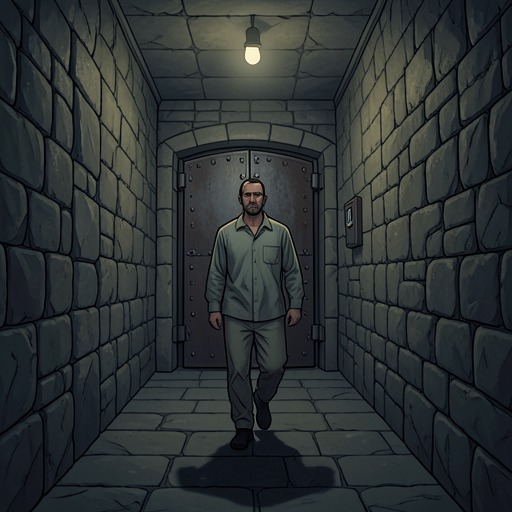
The Stranger (Albert Camus Edition)Death row is the final condition imposed on Meursault after the court sentences him to public decapitation. More than a place within the prison, it is a regime of waiting that turns legal judgment into an everyday physical reality: liberty is removed, ordinary comforts are stripped away, dawn becomes a possible hour of execution, and the condemned prisoner is forced to measure hope against the certainty of death. In this state, Meursault’s attention moves from escape and appeal toward an acceptance of mortality that ultimately leaves him feeling less lonely and newly reconciled to the universe.
From Imprisonment to Condemnation
Death row grows out of Meursault’s earlier imprisonment, which at first seems strangely provisional to him. During the first days after his arrest, he is barely conscious of being in prison and retains a vague hope that some agreeable surprise might occur. The decisive change comes when Marie’s letter informs him that she will no longer be allowed to visit because she is not his wife. From that moment, the cell becomes his “last home,” a dead end rather than a temporary interruption of ordinary life.
The prison’s logic is explained to Meursault in explicitly punitive terms. When a jailer tells him that liberty means being deprived of liberty, Meursault recognizes that confinement is not merely physical custody but the very mechanism by which punishment acquires meaning. The institution controls space, movement, communication, and expectation. Even the smallest personal possessions are absorbed into this system. On arrival, Meursault loses his belt, shoelaces, pocket contents, and cigarettes; once he receives a cell of his own, his request to have the cigarettes returned is refused because smoking is forbidden. The prohibition initially produces faintness, nausea, and desperate craving, but when he finally understands that the deprivation itself is part of the punishment, the craving has already disappeared and the punishment has lost that particular force.
The legal process gives this confinement its terminal direction. After the Assize Court pronounces, in the name of the French people, that Meursault is to be decapitated in a public place, the courtroom’s attitudes toward him change. The journalist avoids his eyes, the policemen handle him gently, and the lawyer places a hand on his wrist. Meursault stops thinking and answers “No” when the Judge asks whether he has anything more to say. The sentence is therefore both ceremonious and brutally concrete: an impersonal public formula becomes the condition governing every subsequent hour of his life.
The Machinery of Waiting
Once condemned, Meursault’s principal problem is no longer how to occupy a cell but how to live inside an interval whose end has been fixed. He refuses, for the third time, to see the prison chaplain, explaining that he has nothing to say and will be seeing him soon enough. His attention is concentrated on the possibility of finding a loophole in what he calls the “implacable machinery of justice.” The phrase gives the death sentence a mechanical character: the institution is not presented as a single official decision but as an inexorable process whose parts continue to move after judgment has been delivered.
Meursault imagines condemned prisoners escaping at the last moment, breaking through the police cordon, or disappearing just before the Guillotine falls. He wishes he had paid closer attention to accounts of public executions and wonders whether technical books might contain a story in which chance interrupted the expected sequence. Even a doomed attempt at flight would offer a final instant of hope. Yet he recognizes that this possibility is denied to him; he is caught irrevocably in the trap. His imagination repeatedly tests the boundary between inevitability and accident, but the death sentence leaves almost no practical space in which freedom can operate.
The verdict also troubles him because of the arbitrary details surrounding it. Whether it is delivered at eight in the evening rather than five, whether it might have been different, and whether it is attributed to the vague entity of the French people all seem to diminish its moral grandeur. Nevertheless, once pronounced, the judgment becomes as tangible as the prison wall against which he lies. Death row thus joins abstraction to matter: a legal phrase, spoken at a particular hour, produces an unalterable bodily future.
Meursault’s understanding of execution is also corrected by concrete knowledge. He had imagined that a condemned man climbed steps onto a scaffold, an idea associated with the French Revolution and schoolbook pictures. Remembering a newspaper photograph, he instead sees the Guillotine as a ground-level apparatus, narrow, polished, and almost laboratory-like. Its neat efficiency disappoints the imagination. There is no elevated scaffold separating the condemned person from the world; the machine stands on the same level, and the man moves toward it as though approaching someone familiar. The execution becomes discreet, efficient, and faintly shameful, precisely because the apparatus removes the theatrical grandeur Meursault had expected.
Time, Dawn, and Bodily Discipline
Death row reorganizes Meursault’s sense of time around two objects of thought: dawn and his appeal. He watches the sky from his cell as its colors change from day toward night, while the possibility of legal reversal remains present even when he tries to suppress it. The heartbeat that has accompanied him for years becomes another instrument of measurement. He tries to imagine the moment when it will no longer echo in his head, but the attempt fails; the heart’s persistence keeps life audibly present within the imagined future of death.
Because Meursault knows that condemned prisoners are taken at dawn, every night becomes a vigil. He sleeps intermittently during the day and watches through the darkness for the first light. The worst period is the vague hour when the jailers might come. Tiny sounds become magnified: a faint rustle sends him to the door, where he presses his ear against the cold wood and listens to his own breathing, quick and hoarse. When no footsteps arrive and morning light enters the cell, he experiences the day as another twenty-four-hour reprieve. The absence of an event becomes a recurring event in itself, and survival is registered not as freedom but as postponed execution.
This waiting produces a severe form of mental discipline. Meursault begins by assuming that his appeal has been dismissed and therefore that he will die sooner than other people. He argues that death at thirty or at seventy makes little difference to the continuation of the world, since other men and women will go on living. Yet the argument fails to console him completely, because the years still ahead remain painfully imaginable. He then rehearses the alternative: an appeal that succeeds. The possibility brings a rush of joy through his body and tears to his eyes, but he must restrain himself and restore order to his thoughts. Even hope must be rationed and methodically arranged, because uncontrolled hope would make the first alternative harder to endure.
The cell also becomes a laboratory for adapting to duration. Earlier, Meursault learned to kill time by reconstructing his room from memory, listing every object in order and then every detail of each object, down to dents, chipped edges, and the grain and color of the wood. On death row, this capacity for exact recollection becomes part of his survival. Time is no longer empty when it can be divided into remembered surfaces, changing skies, heartbeats, possible footsteps, and carefully controlled arguments about the appeal.
Isolation, Memory, and the Return of Mother
Death row intensifies isolation, but it does not produce silence. Looking at his face in a polished tin pannikin, Meursault discovers a serious, mournful expression that remains unchanged even when he tries to smile. At the prison’s “nameless hour,” while evening sounds rise from the different floors, he hears his own voice and realizes that he has been talking to himself for many days. The discovery makes the cell a psychological enclosure as well as a physical one: the absent world returns as an internal voice, while the prisoner becomes both speaker and listener.
This moment recalls a remark made by a nurse at Madame Meursault’s funeral. The memory does not arrive as a detached recollection; it enters the prison evening as an explanation of the prisoner’s condition. There is no way out, and no one outside can imagine what the evenings are like in prison. The past funeral and the impending execution become structurally connected, with the earlier encounter with death returning in altered form inside Meursault’s cell.
The memory of Madame Meursault becomes most significant after the confrontation with the chaplain. Following the exhausted sleep that comes after their argument, Meursault hears a steamer’s siren near daybreak and thinks of people beginning voyages toward a world that no longer concerns him. He then imagines why his mother had taken on a fiancé and played at beginning again near the end of her life. With death close, she may have felt like someone on the brink of freedom, ready to start life over. Meursault recognizes a similar possibility in his own condition: the approach of death has stripped away hope and, paradoxically, made a new beginning imaginable.
Final Transformation and Narrative Significance
The condemned state reaches its emotional and philosophical climax when Meursault opens himself to what he calls “the benign indifference of the universe.” His anger has washed him clean by emptying him of hope, and the night sky, marked by its stars, appears not hostile but brotherly because its indifference resembles his own relation to the world. This is not an escape from death row in the physical sense. The sentence remains, the execution remains possible, and the future remains bounded by the court’s decision. The transformation lies in the change of Meursault’s relation to that fact.
Earlier, death row is defined by resistance: he searches for an escape story, studies the imagined mechanism of execution, waits for footsteps, and alternates between the dismissal and success of his appeal. By the end, he no longer requires the universe to justify his life or rescue him from death. He understands that the living world will continue without him, just as it continued after Madame Meursault’s death, but this recognition no longer functions only as a bleak argument. It allows him to acknowledge that he has been happy and is still happy.
The final wish associated with death row is therefore deliberately paradoxical. Meursault hopes that a huge crowd will attend his execution and greet him with howls of execration. The desire does not cancel the sentence; it completes his separation from the social order that has judged him while giving him a final form of recognition. Public condemnation would confirm that he and the crowd stand opposed, yet it would also prevent his death from disappearing into anonymity. Death row ends not with restored liberty or a successful appeal, but with Meursault’s acceptance of mortality, his renewed understanding of Madame Meursault, and his sense of kinship with a universe that offers neither consolation nor deception.