Babbitty’s escape and the end of the kingdom’s persecution
The Tales of Beedle the BardBabbitty’s escape and the end of the kingdom’s persecution is the decisive reversal in “Babbitty Rabbitty and her Cackling Stump”: the witch-hunters’ effort to capture Babbitty instead exposes their charlatan, compels the king to protect witches and wizards, and leaves a golden statue to commemorate the washerwoman he had wronged. The ending makes a persecuted witch’s escape the means by which persecution itself is brought to an end.
The Pursuit and the Charlatan’s Accusation
When the king’s attempt to revive a dead dog failed, the crowd began to suspect that his earlier magical feats had been tricks. The charlatan, fearing the exposure of his own deception, redirected suspicion toward Babbitty, who was concealed in a bush. He claimed she was blocking the king’s magic and urged the crowd to seize her. The accusation makes Babbitty a convenient scapegoat: rather than face the failure of his supposed magic, the charlatan presents the actual witch as its cause.
Babbitty fled, and the Brigade of Witch-Hunters pursued her with its hounds. At a low hedge she vanished from their sight. When the king, the charlatan, and the courtiers crossed after her, they found the dogs gathered around a bent, aged tree. The charlatan asserted that Babbitty had transformed into the tree and persuaded the king to have it cut down. The crowd’s apparent victory was another mistake: it had accepted the charlatan’s explanation without understanding either the witch’s escape or the limits of its own power.
The Stump Turns the Threat Back
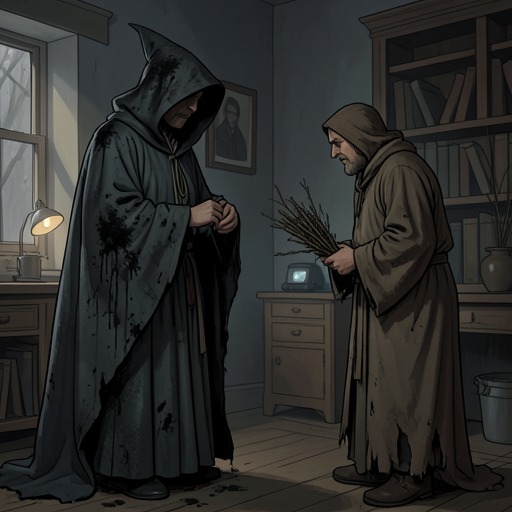
After the tree was felled, Babbitty’s cackling voice came from the stump. She declared that cutting a witch in half could not kill her and challenged the crowd to test the same method on the supposed Grand Sorcerer. The Captain of the Brigade of Witch-Hunters moved to do so. Faced with the danger of being subjected to the test, the charlatan fell to his knees, begged for mercy, and confessed his wrongdoing; he was taken away to the dungeons.
Babbitty then told the petrified king that the act of cutting down the witch had unleashed a curse: every harm he inflicted on witches and wizards would feel like an axe stroke in his own side, until he wished for death. The threat reverses the relationship between ruler and persecuted. The king had allowed the pursuit and destruction of those he feared; now he is made to understand that continuing such harm would carry a cost to himself. In the story’s action, the curse is the pressure that turns his fear into a public promise of protection.
The King’s Promises and Babbitty’s Memorial
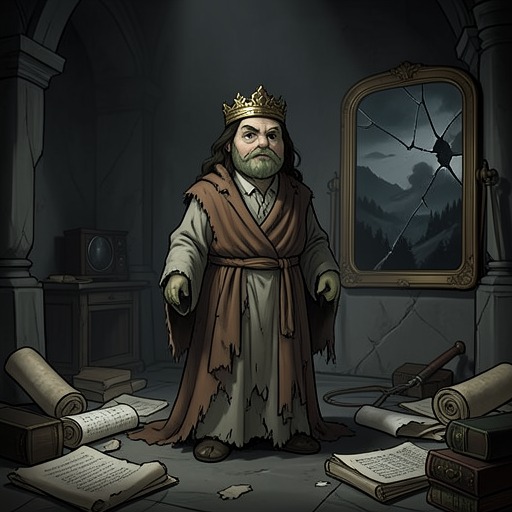
The king fell to his knees and promised to issue a proclamation protecting all the witches and wizards in the kingdom and allowing them to practise magic in peace. Babbitty did not treat the general promise as sufficient amends. She demanded a statue of the washerwoman placed upon the stump, both to commemorate her and to remind the king of his foolishness. He agreed to have the statue made of pure gold by the foremost sculptor in the land.
The required memorial binds the king’s change of policy to a visible reminder of the person he had persecuted. The king and his nobles returned to the palace, leaving the stump behind. Once the grounds were deserted, a stout, whiskery old rabbit emerged from a hole among the roots, with a wand held between her teeth. Babbitty hopped away. The rabbit’s appearance reveals how she escaped the pursuit: rather than having become the tree, as the charlatan claimed, she had been concealed beneath it in her animal form.
A golden statue of the washerwoman was thereafter placed on the stump, and the story states that no witch or wizard was persecuted in the kingdom again. Babbitty therefore wins more than her own escape. Her deception of the persecutors exposes the false accusation, her curse secures the king’s proclamation, and the statue ensures that the settlement retains the memory of what his foolishness had done.
The Fable’s Wider Context
The episode belongs to a collection of bedtime stories familiar to generations of young witches and wizards. In Beedle’s tales, characters who can perform magic still face problems magic cannot simply solve; the framing commentary describes this as the lesson that magic causes as much trouble as it cures. Babbitty’s escape exemplifies that distinction: magic enables her concealment and helps her turn the pursuit against its instigators, but the ending also depends on the king’s promised change in law and conduct.
The story’s resolution sits within a broader history of persecution. In the early fifteenth century, witch-hunts were gathering pace across Europe, and many wizards considered helping Muggles dangerous. That climate helps explain the force of a fable in which the king’s hostility toward witches becomes the subject of public correction. It also contrasts with a later retelling of “The Wizard and the Hopping Pot,” in which a pot protects a wizard from hostile, torch-bearing neighbours by driving them away. The two tales imagine opposing outcomes for magical persecution: one entrenches separation through force, while Babbitty’s story ends with protection and the right to practise magic in peace.
The framing notes place the fable’s magical details beside rules and institutions beyond its plot. Animagi are a small fraction of the wizarding population; achieving spontaneous human-to-animal transformation requires study and practice, and the Ministry of Magic requires them to register because such a talent can aid concealment or covert activity. The story also predates the 1717 classification of the Cruciatus, Imperius, and Avada Kedavra curses as Unforgivable. These details do not alter Babbitty’s escape, but they set it within a wider account of magic shaped by regulation, risk, and disputes over its use. At the heart of the episode, however, is a more direct political reversal: the witch-hunters lose their prey, the deceiver is exposed, and the king’s persecution gives way to protection.