Cloak of Invisibility
The Tales of Beedle the BardThe Cloak of Invisibility is the youngest brother’s gift from Death in “The Tale of the Three Brothers.” It enables him to leave without being followed, not to conquer mortality: the youngest brother survives Death’s search for many years, passes the Cloak to his son in old age, and then willingly departs with Death as an equal. In Albus Dumbledore’s commentary, the Cloak also stands at the center of a persistent legend that reverses the tale’s moral, turning a story about accepting death into a supposed promise of mastery over it.
The Gift and Its Purpose
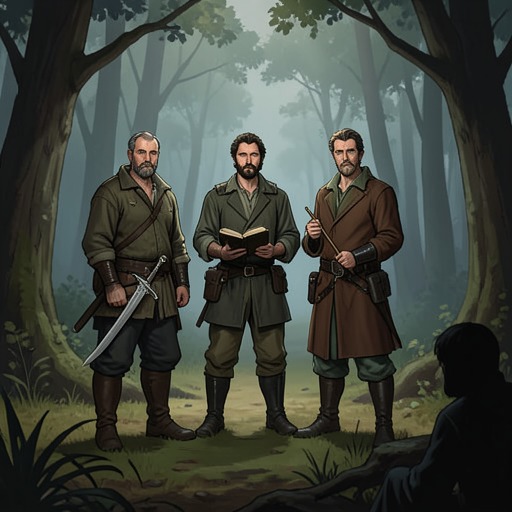
When Death asks what each brother desires, the youngest is described as both the humblest and the wisest. Distrusting Death, he asks for something that will let him go from that place without being followed. Death reluctantly hands over his own Cloak of Invisibility. Unlike his brothers, who ask for power to defeat opponents or summon the dead, the youngest asks for a means of escape. The request defines the Cloak’s role from the outset: it can postpone an encounter with Death, but it does not promise to abolish that encounter.
After receiving the three gifts, the brothers continue on their way, talking with wonder about their adventure and admiring what Death has given them. In due course they separate for their own destinations. The Cloak thus enters the story as one of three extraordinary objects, but its significance develops through a different relationship to time and mortality from that of the wand and stone.
The Cloak in the Youngest Brother’s Life
Death searches for the youngest brother for many years and cannot find him. The tale offers no account of the brother using the Cloak to pursue power or to bring anyone back from the dead; its stated purpose is to keep Death from following him. The contrast with his brothers’ fates makes that restraint consequential. The Cloak protects the youngest brother from an immediate pursuit, while the story presents his eventual death not as a failure of the object but as the limit he understood from the beginning.
Only after attaining a great age does the youngest brother take off the Cloak and give it to his son. He then greets Death as an old friend and goes with him gladly; the two depart this life as equals. The passing of the Cloak marks the end of its protection for its first owner, while the brother’s willing acceptance completes the tale’s distinction between evasion and victory. Its final scene does not show the Cloak overpowering Death. It shows a man who has used it to postpone their meeting and is now prepared to meet him.
Legend and the Three Gifts
Dumbledore identifies an irony in the legend that grows around the story: it contradicts the meaning of Beedle’s original tale. According to that legend, the gifts are real objects—the unbeatable wand, a stone that can bring back the dead, and an Invisibility Cloak that endures for ever—and whoever becomes the rightful owner of all three will become master of Death, commonly understood to mean invulnerable or immortal. The Cloak’s association with endless durability and the other gifts therefore transforms it, in popular belief, from a means of postponement into part of a claim to triumph over death.
Dumbledore says that only a tiny minority of the wizarding community persists in treating the tale as a coded message with the reverse of its plain meaning. The belief has little evidence behind it. True Invisibility Cloaks exist, but they are rare, and Dumbledore distinguishes ordinary examples from Death’s supposedly unique Cloak: no one has claimed to find Death’s Cloak in the centuries since Beedle’s time. Believers explain its absence by supposing that the youngest brother’s descendants either do not know its origin or keep that knowledge private to imitate his wisdom. Those explanations preserve the legend, but do not establish the object’s identity.
Durability and the Story’s Moral
Dumbledore’s commentary also makes clear why the legend cannot simply be inferred from the existence of ordinary Invisibility Cloaks. Such cloaks are not generally infallible: they can rip, grow opaque with age, lose the effects of their charms, or be countered by charms of revealment. Witches and wizards therefore usually rely first on Disillusionment Charms for concealment. Albus Dumbledore himself was known to perform a Disillusionment Charm powerful enough to render him invisible without a Cloak. Against this ordinary range of limitations, the tale’s description of Death’s Cloak as enduring for ever is distinctive, but the special object has never been claimed or verified in the intervening centuries.
For Dumbledore, the object’s importance rests less on a proven history in the wider wizarding world than on the ethical contrast built into the tale. The youngest brother does not try to make himself immortal; he asks only to be left unpursued, and he accepts Death when their meeting finally comes. The later legend treats the Cloak as evidence that death can be mastered, precisely the conclusion the story warns against. Its meaning therefore depends on which account surrounds it: in the tale, it serves a wise man’s limited hope of delay; in the legend, it becomes one piece of a fantasy of invulnerability.