The quest for the Fountain of Fair Fortune
The Tales of Beedle the BardThe quest for the Fountain of Fair Fortune is a journey undertaken by three witches and a knight, driven by the hope that the Fountain can relieve suffering. Its trials progressively displace the idea of a solitary reward: the travelers advance through mutual assistance, and at the final barrier Amata sacrifices cherished memories so that the group can reach the summit together. The Fountain comes into view at sunset, but Asha’s collapse leaves the promised choice of who will bathe unresolved at this point in the story.
Causes and Companions
The journey begins in shared vulnerability. Asha seeks relief from an illness that has left her frail; Altheda has lost her home, gold, and wand to an evil sorcerer and hopes the Fountain can free her from powerlessness and poverty; Amata has been deserted by a man she dearly loved and believes her heart will never mend. Their desired cures are different, but each woman looks to the same place for relief.
Pitying one another, the three agree that if an opportunity arises, they will unite and try to reach the Fountain together. That promise establishes the quest’s central form: not a contest among isolated petitioners, but a shared undertaking among people whose troubles have made them vulnerable in different ways.
The opportunity arrives with the first ray of sun, when a chink opens in the wall. The crowd surges forward, shrieking its claims for the Fountain’s blessing. Creepers from the garden snake through the press and coil around Asha; she catches Altheda by the wrist, Altheda seizes Amata’s robes, and Amata in turn becomes caught on the armour of a dismal-looking knight seated on a bone-thin horse. The plants drag the three women through the opening, pulling the knight from his steed after them. Their entry is less a chosen march than a sudden chain of physical connections, making the earlier agreement real by carrying the women into the garden together.
The Garden and Its Tests
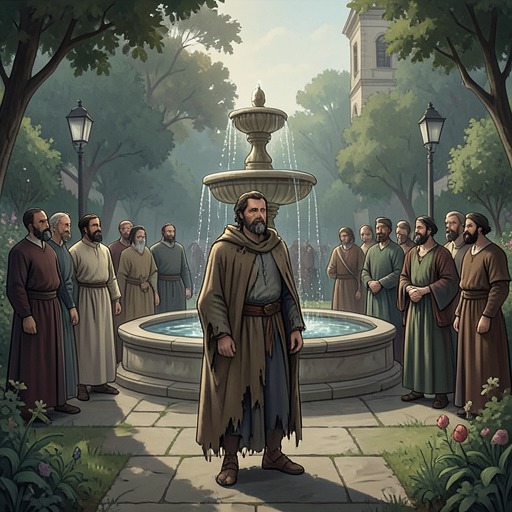
Once inside, the three witches and the forlorn knight venture through an enchanted garden. Rare herbs, fruit, and flowers grow in abundance beside the sunlit paths, and the travelers meet no obstacle until they reach the foot of the hill where the Fountain stands. The garden’s beauty gives way to a direct test at the ascent: a monstrous white Worm, bloated and blind, is wrapped around the hill’s base. It turns its foul face toward them and demands proof of their pain.
The first responses are attempts at force, and each fails. Sir Luckless draws his sword, but the blade snaps against the Worm. Altheda throws rocks, while Asha and Amata try spells to subdue or entrance the creature. Neither wand-magic, stone, nor steel can make it let them pass. The group’s inability to overcome the guardian by attacking it marks a limit on the kinds of power the quest will reward.
After the travelers clear the Worm’s obstacle, they hurry uphill and glimpse the Fountain glittering like crystal in a bower of flowers and trees. The sight does not end the journey. A stream runs around the hilltop and bars the way, with a smooth stone in its clear depths bearing the next demand: the treasure of the travelers’ past. Sir Luckless attempts to float across on his shield, but it sinks. The witches then pull him out of the water; their own attempts to leap the brook fail as the sun sinks lower. The repeated failures make time as well as distance part of the trial, and leave the companions to interpret the message rather than overcome the stream by strength.
Amata’s Sacrifice and the Summit
Amata understands what the stream requires. Taking her wand, she draws from her mind the happy memories of the time she spent with her vanished lover and drops them into the rushing water. The current carries the memories away; stepping stones appear in their place, allowing the three witches and the knight to cross and reach the hilltop. The obstacle is answered not with a weapon or a spell against the stream, but with a loss Amata chooses to bear.
The sacrifice also transforms the meaning of the quest’s promise of relief. Amata began the journey hoping to be freed from grief and longing, yet at the point when the Fountain is nearest, the memory she relinquishes is not simply an impediment: it is a treasured part of her past. Her act makes passage possible for everyone, joining personal cost to collective progress. The stones that appear after the memories are swept away are the concrete consequence of that choice.
The Fountain shimmers on the summit amid herbs and flowers more beautiful and rare than those the travelers have seen along the paths. The sky burns ruby, and the time has come to decide which companion will bathe. Before they can make that decision, however, Asha falls to the ground. Exhausted by the struggle to climb the hill, she is close to death and in mortal agony; her friends would carry her to the Fountain, but she begs them not to touch her. The quest has brought the group to its goal, yet arrival does not immediately deliver its hoped-for remedy: the decision over the Fountain is interrupted by the urgent presence of Asha’s suffering.
The Quest’s Structure and Significance
The episode’s obstacles form a progression from pain, to the past, to the choice of a beneficiary. At the Worm, the travelers are asked to prove pain, but violence and conventional magic achieve nothing. At the stream, the demand becomes more intimate: passage requires a treasure from one’s past, and Amata gives up memories rather than attempting to defeat the barrier. At the summit, the question of who will bathe remains open just as Asha’s failing strength makes the group confront need in its most immediate form.
This sequence gives the quest its communal force. The witches’ initial agreement precedes the chance to enter; the creepers physically link them and draw the knight into their company; the travelers rescue Sir Luckless from the stream; and Amata’s choice opens a crossing for all four. Progress depends on cooperation, while the most decisive advance comes from surrender rather than domination. The Fountain’s beauty remains visible at the end of this part of the journey, but it is not yet the answer: the travelers have reached the place where they must decide what their shared undertaking means in the face of another person’s need.