Wizarding secrecy
The Tales of Beedle the BardWizarding secrecy is the separation of magical society from Muggles, shaped first by the danger of persecution and later reinforced by law and social prejudice. In the commentary to The Tales of Beedle the Bard, it is not presented as a simple boundary: the same retreat that protected witches and wizards also discouraged aid to Muggles, stigmatized those who befriended them, and could be invoked to suppress uncomfortable truths about shared ancestry.
Origins in Persecution
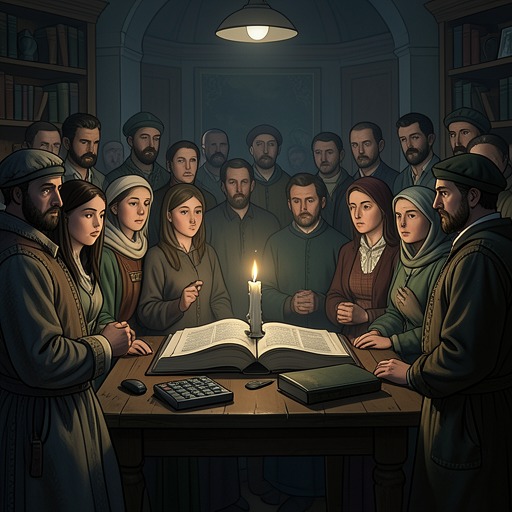
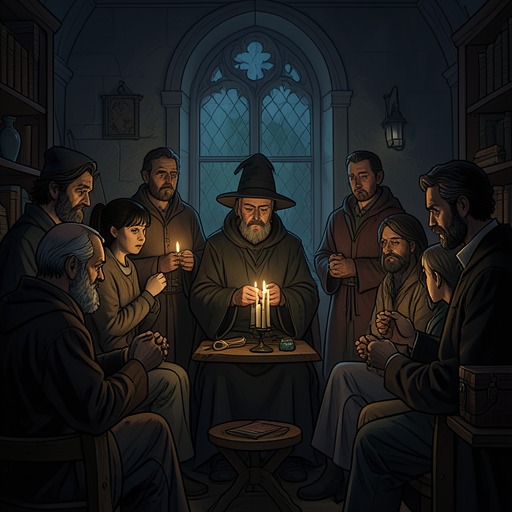
In the early fifteenth century, as persecution of witches and wizards gathered pace across Europe, many in the magical community had reason to fear contact with Muggles. Even offering a spell to help a neighbour’s sick pig could seem tantamount to volunteering for the funeral pyre. The cry “Let the Muggles manage without us!” captured a growing withdrawal from non-magical people, culminating in 1689 with the International Statute of Wizarding Secrecy, when wizardkind voluntarily went underground.
That history supplies the danger behind secrecy without making separation morally uncomplicated. Beedle the Bard, who lived in the fifteenth century, preached brotherly love for Muggles at a time when many wizards regarded such contact as perilous. His tale of a father who helps local Muggles, in contrast to his hardhearted son, became controversial precisely because its pro-Muggle lesson challenged the retreat taking hold around it.
Social Enforcement and Prejudice
Secrecy became a lived social discipline as well as a formal arrangement. During the witch-hunts, magical families used concealment charms to protect themselves and their relatives. By the seventeenth century, a witch or wizard who fraternized with Muggles could be treated as suspect or even as an outcast within the magical community. Derogatory labels such as “Mudwallower,” “Dunglicker” and “Scumsucker” gave that exclusion a vocabulary, while the accusation of weak magic framed contact with Muggles as evidence of inferiority.
Brutus Malfoy, editor of the anti-Muggle periodical Warlock at War, helped promote that stereotype. In 1675 he claimed that wizards who enjoyed Muggle company were unintelligent and magically feeble; the maxim “Nothing is a surer sign of weak magic than a weakness for non-magical company” condensed the prejudice into a rule of social judgment. The commentary notes that this bias eventually met evidence that some of the world’s most brilliant wizards were commonly called “Muggle-lovers.” Secrecy had thus become entangled with a hierarchy that policed not only what magical people disclosed, but whom they were permitted to value.
Law, Risk, and Magical Practice
The boundary between magical and non-magical society also appears in later rules directed at particular risks. The Ministry of Magic requires Animagi to register, because human-to-animal transformation can serve disguise or concealment and may be useful in covert or criminal activity. The requirement illustrates a wider tension: concealment can protect a vulnerable community, yet the same capacity can enable secret action that authorities seek to monitor.
The commentary also distinguishes secrecy from the regulation of magic itself. In Beedle’s time, the Cruciatus Curse had not yet been made illegal; the Cruciatus, Imperius and Avada Kedavra Curses were first classified as Unforgivable in 1717, with the strictest penalties attached to their use. This chronology shows that the legal order governing magical conduct continued to develop after the 1689 Statute, addressing dangerous practices as well as the separation of wizardkind from Muggles.
Secrecy and the Politics of Blood
The commentary’s later dispute over The Fountain of Fair Fortune exposes how separation could serve blood-purity ideology as well as protection. Lucius Malfoy, a descendant of Brutus Malfoy and a member of the Hogwarts Board of Governors, demanded that the tale be removed from the Hogwarts library because it depicted wizard–Muggle marriage. His stated concern was that the story might encourage his son to sully the purity of his bloodline.
Albus Dumbledore refused to remove the book, with the Board’s majority supporting his decision. He argued that families claiming pure-blood status maintained that appearance by disowning, banishing or lying about Muggles and Muggle-borns in their family trees. Since no witch or wizard had blood untouched by Muggles, he regarded banning works on the subject as both illogical and immoral. The exchange began Malfoy’s campaign to remove Dumbledore as Headmaster and Dumbledore’s counter-campaign to remove Malfoy from his position as Lord Voldemort’s Favourite Death Eater. The episode reveals secrecy’s ideological afterlife: a policy of separation could be made to reinforce claims of purity, while open discussion threatened those claims.
Narrative Significance
Across these examples, secrecy changes from a response to external persecution into a norm enforced within wizarding society and, at times, a shield for exclusion. The contrast between the original, pro-Muggle lesson of The Wizard and the Hopping Pot and a later retelling in which the pot attacks the villagers makes that shift especially clear: some families preserved the frightening cauldron while discarding the story’s appeal for mutual aid. Beatrix Bloxam’s sanitizing rewrite further shows that stories themselves became sites of dispute over what children should be taught.
The collection’s broader moral framework resists the idea that magical power removes ordinary responsibilities. Its stories present witches and wizards as capable of hardship and error despite their abilities, and identify kindness, common sense and ingenuity—not superior force—as the qualities that enable triumph. In that light, secrecy may answer real danger, but it cannot by itself justify indifference to Muggles or the prejudice directed at those who refuse to treat them as strangers.