Arthur Huntingdon's fatal illness
The Tenant of Wildfell HallArthur Huntingdon's fatal illness is the bodily culmination of his dependence on alcohol and the crisis that draws Helen Huntingdon back to Grassdale to care for the husband from whom she has separated. His decline unfolds through episodes of apparent improvement and renewed danger; at the deathbed, physical suffering, dependence, and Helen's religious fear converge without producing an easy reconciliation.
Causes and Bodily Decline
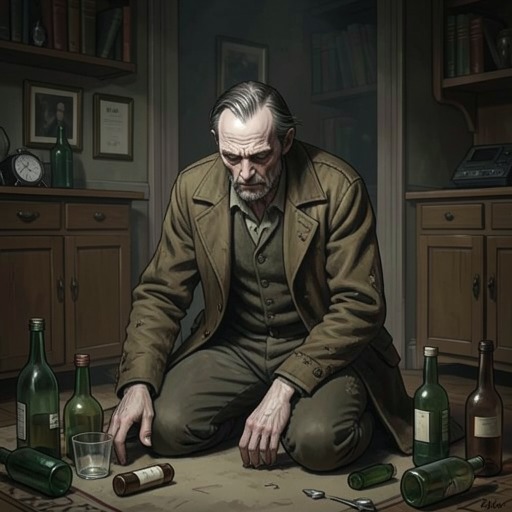
The novel links Huntingdon's illness to a history of excess rather than presenting it as an isolated accident. Before the terminal crisis, Helen had watched his appetite for wine change from an adjunct to sociability into a source of pleasure in itself. During a period of weakness, she feared that he would make alcohol his medicine, support, comfort, recreation, and friend, deepening the dependence she had tried to resist. His body is therefore already vulnerable when the later illness begins.
That vulnerability is made concrete after an accident. In a letter from Grassdale dated November 4, Helen reports that Huntingdon is very ill but not then dying or in immediate danger. The injuries themselves, the doctor says, would have been trifling for a temperate man; in Huntingdon's case, his habits make the consequences far more serious. When Helen first enters his room, he is in a half-delirious state and mistakes her for Alice, asking why she had left him. His confusion places the sickroom in a history of broken attachments, but the immediate evidence is bodily: injury, delirium, and a condition worsened by intemperance.
The account gives the illness a longer prehistory in Huntingdon's own domestic life. After a journey, he returns in poor condition; Helen waits to raise her objections, first because he is tired and then because he remains weary the following day. At dinner, his routine includes breakfast at noon with a bottle of soda-water and strong coffee, followed at two by soda-water mixed with brandy. He complains about the meal and demands a change of cook, though she is the same cook he had previously praised. Helen's decision to confront him arises from this ordinary scene: his irritability and drinking have become too evident to excuse or postpone.
The novel distinguishes the illness's visible effects from Huntingdon's underlying character. His fretfulness and nervous irritability are described as foreign to his natural disposition, almost ludicrous in their incongruity, yet painful because they signal a disordered body. As his health improves, his temper improves too. Helen believes her efforts hasten that recovery, but she also sees that the apparent progress does not remove the deeper danger: wine has become a sustaining pleasure in its own right, and weakness threatens to make the dependence still more binding.
Care, Dependence, and Relapse
Helen's return places her in a difficult position: she attends to a man whose conduct has caused her suffering, yet she refuses to treat his condition as beyond help. During his earlier weakness, she nurses their ailing infant while enduring the reproaches and complaints of Huntingdon, whose demands on her are unreasonable. Her care is thus not a sudden sentiment prompted by the final crisis; it belongs to a sustained effort to protect both child and husband, even when that effort is costly and the prospect of reform uncertain.
The last illness makes that care visible in the arrangements at Grassdale. By the time Helen arrives, Mrs. Greaves, Benson, and the other decent servants have left; those who replace them are negligent and disorderly. A professional nurse, described by Helen as grim and hard, has been engaged for the invalid. Helen finds a household in disarray around a man whose injuries are not severe in themselves but whose intemperate habits have made recovery precarious. The contrast between the deficient household and Helen's return gives nursing a practical as well as moral dimension: the sick man needs competent attention, not merely expressions of concern.
The course of treatment offers only temporary calm. After the doctor orders Huntingdon to be bled the next morning, he becomes more subdued and tranquil. Helen spends half the day in his room in intervals; he accepts her services without the bitter remarks that had marked their earlier encounters and says little beyond making his needs known. This quiet is not a cure or a conversion. It marks a brief change in their immediate relationship, with the former conflict receding while bodily dependence limits his ability to resume it.
The pattern of relapse is sharpened by his resistance to restraint. At a later point in the illness, Huntingdon seizes a glass and a bottle and drinks until the bottle is empty, against Helen's efforts to keep him weak enough to control the danger. Alarming symptoms follow and increase rather than subside. The external wound, which had been half-healed, breaks open again, and internal inflammation develops; the doctor warns that it may prove fatal if not promptly removed. The episode makes the illness more than a passive decline: alcohol remains an active threat, and Huntingdon's decision to drink turns a precarious recovery into a renewed emergency.
Terminal Crisis and Death
After the relapse, the symptoms that had seemed to ease return with greater force. Helen's letters record a decisive change: the doctor tells her that mortification has begun and that there is no hope. Huntingdon's suffering is now inseparable from the knowledge that he is dying. Helen cannot write at length after receiving the prognosis; the abruptness of her report makes the limit of her language part of the scene, as the medical judgment closes off the possibility of recovery.
A subsequent letter, dated December 5, confirms that Huntingdon has died. Helen has sat beside him through the night with her hand locked in his. Believing him unconscious, and herself nearly fainting from exhaustion, she gently disengages her hand to steal away for air. A convulsive movement and his faint plea, “Don’t leave me!” bring her back to him; she takes his hand again and holds it until he is dead. She then faints. Helen explicitly distinguishes her collapse from grief alone: exhaustion, held at bay until that moment, overwhelms her after the vigil.
The final exchange between them is therefore not a restored marriage but a last dependence. Huntingdon, who had caused the separation and resisted Helen's efforts to restrain his drinking, dies asking her not to leave him. Helen answers the plea with physical presence, staying at his bedside until the end. The scene neither cancels the history of harm nor makes his death a simple punishment; it shows the estranged couple brought together by illness in a relation reduced to care, need, and the last holding of a hand.
Narrative and Moral Significance
The reader encounters much of the terminal illness through Helen's letters to Frederick Lawrence, incorporated into Gilbert Markham's account to Halford. That documentary structure gives the deathbed its intimate immediacy while also preserving the fact that the account reaches the reader through successive narrators and selected written testimony. Helen's dated reports convey changes in Huntingdon's condition as they happen to her: at first he is seriously ill but not immediately dying, then temporarily calmer, then endangered again by drinking, and finally beyond medical hope.
The illness also tests the difference between medical observation and moral interpretation. The doctor connects the severity of the accident's consequences to Huntingdon's intemperate habits, and the physical progression is described through injury, inflammation, mortification, and the loss of sensation. Helen, meanwhile, interprets the deathbed through Christian concern for the soul. After the doctor declares there is no hope, she fears that Huntingdon's suffering may end in everlasting torment; the bodily crisis therefore does not exhaust what she believes is at stake. Care for the body and anxiety for the soul coexist, without the letters claiming that either can undo the damage already done.
Huntingdon's illness brings the novel's recurring conflict between dependence and self-command to its starkest conclusion. Earlier efforts at nursing and restraint produce temporary improvement, but the return to alcohol reopens the wound and intensifies the danger. His death follows not a smooth upward arc toward reform but a sequence of brief easings, renewed excess, and irreversible bodily collapse. Helen's vigilance cannot save him, yet her presence at the end gives the final scene its moral force: she remains beside him even when there is no cure, and answers his last fear of abandonment with the care he had repeatedly made difficult.