Gilbert Markham’s mistaken discovery of Helen Graham and Frederick Lawrence
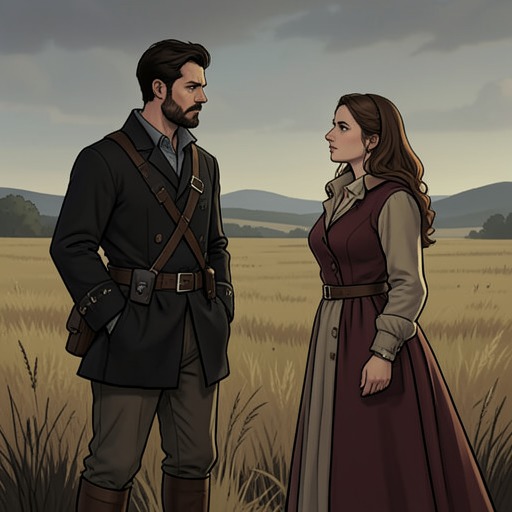
The Tenant of Wildfell HallGilbert Markham’s mistaken discovery of Helen Graham and Frederick Lawrence is a pivotal scene of misinterpretation: watching them together in the moonlit garden, Gilbert takes their closeness as evidence of a love affair and flees in anger before he can know what Helen’s words mean. The scene makes his restricted viewpoint consequential, turning an incomplete glimpse into a breach that Helen’s manuscript will later help explain.
Causes and Circumstances
Gilbert is already distressed by Helen’s unhappiness and regrets that his earlier impetuosity may have aggravated it. He sees her chair empty and the room vacant, then hears her return with a companion. Helen says she wants to walk in the garden, see the moon, and breathe the evening air, hoping that these may ease her distress. Gilbert hides in the shadow of a tall holly bush between the window and porch, watching without being seen.
The companion is not Rachel, as Gilbert might have expected, but Frederick Lawrence. Helen calls him Frederick and says she must leave the place because she cannot be happy there or rest there. Lawrence answers that the sources of annoyance would follow her elsewhere and that he cannot consent to lose her; he would go with her or come to her. Their conversation concerns Helen’s distress and departure, but Gilbert hears only fragments, and his jealousy supplies a romantic meaning before he has enough information to judge what he witnesses.
The Moonlit Encounter and Gilbert’s Reaction
As the pair walk slowly down the garden path, Gilbert sees Lawrence put an arm around Helen’s waist and Helen rest her hand lovingly on his shoulder. The gestures appear intimate, and the tenderness in Lawrence’s voice has already heightened Gilbert’s anxiety. He does not stay to ask Helen what the exchange means. Instead, horror roots him to the spot; then darkness obscures his sight, his heart sickens, and his head burns.
Gilbert half rushes and half staggers away, leaping or tumbling over the wall. Outside, he throws himself to the ground in a paroxysm of anger and despair. His abrupt flight is the immediate consequence of treating a partial observation as a settled truth. The scene establishes the emotional force of his error, but not the correctness of his inference: the reader, like Gilbert, has seen the gestures while lacking the history that would explain them.
Consequences and Later Disclosure
The misunderstanding belongs to Gilbert’s retrospective account, addressed to Halford as an instalment of his story. That frame matters: Gilbert recounts not just what he saw, but the violent response produced by his own limited perspective. His letter promises Halford the rest of the narrative at his leisure, making the garden scene one episode in a larger act of disclosure rather than an independent, fully explained encounter.
Helen later gives Gilbert a thick manuscript, first tearing away a few leaves from its end. She tells him he need not read it all, but asks him to return it and not breathe a word of its contents to anyone, trusting his honour. The manuscript changes the terms of the earlier scene: instead of relying on the glimpse that provoked him, Gilbert can read Helen’s account of her life. He begins by turning through it hastily, then settles down to read it in full. The nested narrative therefore makes correction possible through Helen’s own record, while preserving the gap between Gilbert’s first, mistaken conclusion and the fuller explanation he subsequently receives.
Narrative Significance
The episode’s drama depends on a narrow visual and aural field. Gilbert sees an embrace-like gesture and hears language of separation and attachment, but misses the rest of the conversation; his intense response turns that fragment into apparent proof. The reader is made to experience how quickly an observer’s fear and desire can harden uncertainty into conviction.
The delayed manuscript does not merely add background. It shifts narrative authority from Gilbert’s jealous interpretation toward Helen’s testimony, while remaining embedded within Gilbert’s letter to Halford. The scene thus links emotional conflict to the novel’s layered form: first comes a vivid but incomplete observation, then a written account that permits the past to be reconsidered. The decisive event is not that Gilbert discovers a romance, but that he believes he has discovered one—and acts on that belief before he knows the truth.