Grimsby
The Tenant of Wildfell HallGrimsby is a companion of Arthur Huntingdon whose apparent quietness masks a taste for gambling, drink, and treachery. Though often present at the edge of a scene, he helps shape its danger: he exploits Lord Lowborough’s gambling weakness, assists Huntingdon in arranging a secret meeting with Annabella, and participates in humiliating Helen. His eventual death in a drunken brawl gives his downward course a blunt conclusion, linking the private corruption he facilitates to the violent company he chooses.
Identity and Introduction
Grimsby enters the account as one of Huntingdon’s friends, but Gilbert Markham’s first impression is distinctly hostile. At a dinner, Grimsby is assigned to escort Helen’s party, while Gilbert is placed with him; Gilbert describes a sinister cast to his face and a combination of lurking ferocity and fulsome insincerity in his manner. This early judgment establishes the dissonance between Grimsby’s outward civility and the malice that later becomes visible in his actions.
He is also a familiar presence in the social circle that gathers around Huntingdon. Huntingdon proposes him as a guest on a shooting outing, describing him as a decent, quiet fellow, despite Helen’s immediate admission that she hates him. The disagreement exposes how different the men’s standards are: Huntingdon presents Grimsby’s manner as a recommendation, while Helen recognizes a person she cannot trust. Grimsby’s quietness is not evidence of decency; in the episodes that follow, it makes his manipulations easier to conduct without attracting attention.
Gambling and Complicity
Grimsby’s most consequential early appearance comes during Lord Lowborough’s gambling relapse. Lowborough has just sworn solemnly that this trial will be his last, invoking curses on himself if he ever again shuffles cards or rattles a dice-box. Instead of allowing the vow to stand, he doubles his stake and challenges those present. Grimsby steps forward at once. He is known for luck nearly as much as Lowborough is known for misfortune, and he has, in the narrator’s judgment, considerable skill and little scruple. Lowborough loses again and is left physically sick.
The account does not claim to prove that Grimsby cheats. It leaves open whether he takes advantage of Lowborough’s trembling eagerness to deal unfairly, while making clear that the possibility suits his character and reputation. The distinction matters: Grimsby’s role is not merely that of a lucky opponent. He knowingly enters a contest in which Lowborough’s resolve is already failing, and the episode places him beside the forces that convert temptation into renewed ruin.
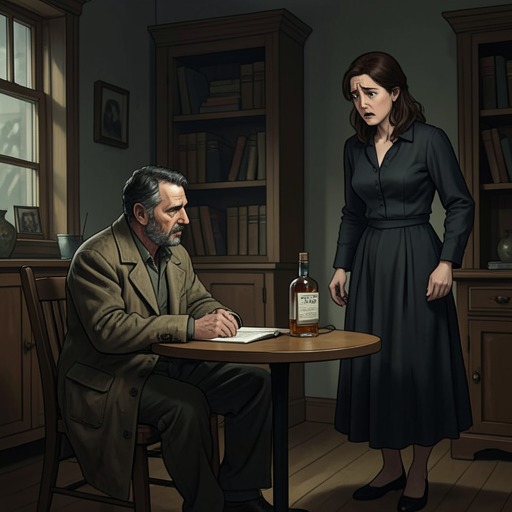
His conduct around Lowborough later reveals the same appetite for exploiting weakness. When Lowborough visits because he cannot bear his own thoughts, Grimsby notices that the glass beside him has been drained and signals that it should be refilled. He pushes the bottle forward while another companion complies. Lowborough catches the covert exchange, angered by the knowing grins, and snatches the glass. The episode gives Grimsby no grand speech or open confrontation; instead, a wink and a bottle show how he encourages relapse while keeping his own role superficially small.
Huntingdon’s Accomplice
Grimsby’s quietness becomes especially dangerous when Huntingdon uses it to conceal his meeting with Annabella. Helen learns that Huntingdon has gone out with Grimsby, and that Grimsby has proposed a plan: he will meet them near the water, draw Huntingdon into a private conversation about matters supposedly unsuitable for Helen, and keep him occupied while Annabella is directed toward the shrubbery. The plan depends on a feigned ordinary separation and an apology that will disguise the arrangement.
Helen later overhears Grimsby’s words as he watches Huntingdon leave. He urges Annabella to run, celebrates that Huntingdon has not seen her, and tells Grimsby to keep him back. The overheard exchange confirms that this is no innocent errand or accidental encounter. Grimsby has served as lookout and decoy, helping the lovers evade Helen while maintaining the appearance of friendship with her husband. The scene turns his earlier reputation for insincerity into specific evidence of collusion.
Grimsby also belongs to the group whose presence makes Huntingdon’s household life degrading and unsafe. Helen recalls a night when Huntingdon is brought upstairs slowly, stumbling and sick, supported by Grimsby and Hattersley, who are themselves unsteady and laughing and joking loudly enough for the servants to hear. The scene has been repeated in similar form. Grimsby is not simply an observer of Huntingdon’s drinking: he participates in the company that surrounds and sustains it, even as the spectacle exposes the disorder to the household.
Treatment of Helen and the Household
Grimsby’s contempt for Helen is expressed through social exclusion and private humiliation. After Huntingdon’s deception is exposed, Helen returns to the drawing room, where she finds Hattersley railing against Lord Lowborough’s supposed cowardice before an audience that includes Huntingdon, who is exulting in his treachery, and Grimsby, who stands quietly rubbing his hands and chuckling with fiendish satisfaction. His small, almost passive gesture makes his allegiance unmistakable: he takes pleasure in the harm done to Lowborough and in the spectacle of a man being mocked for refusing to answer betrayal with a duel.
His presence remains part of the pressure surrounding Helen’s effort to protect herself and her child. When she asks Huntingdon to let her take their child and what remains of her fortune and leave, the request comes within a household where Grimsby has already helped Huntingdon conceal adultery and where the men’s companionship repeatedly turns cruelty into amusement. Helen’s attempt to secure an exit is therefore set against a social world in which Grimsby’s loyalties lie with her husband and his circle, not with the welfare of the family.
Grimsby’s conduct also bears on the restricted household economy Helen describes. She relies on Rachel, who has nursed her and wishes to nurse her child, and on a young nursery-maid under Rachel’s direction; this arrangement is trustworthy and saves money. Helen explains that she has learned to regard economy as important after discovering the state of Huntingdon’s affairs, and that nearly all her income is committed for years ahead. The contrast is sharp: Helen’s careful management addresses the practical consequences of her husband’s financial affairs, while Grimsby belongs to the circle of male companions whose drinking and gambling deepen the disorder around him.
Narrative Role and Ending
The novel presents Grimsby largely through other people’s testimony and through visible acts rather than through an account of his private thoughts. Gilbert’s early dislike, Helen’s reports of the gambling and drinking scenes, and the overheard plan with Annabella accumulate into a consistent portrait. The changing narrative access matters: the reader first encounters a suspicious face and an unpleasant manner, then sees the conduct that gives those impressions substance. Grimsby’s apparently minor gestures—a wink toward Lowborough’s glass, a quiet chuckle, the instruction to keep Huntingdon back—become evidence of how corruption operates through accomplices as well as through its central figure.
In the closing account, Grimsby goes from bad to worse, consorting with the worst members of his club and the lowest levels of society. He eventually dies in a drunken brawl, reportedly at the hands of a fellow rogue whom he had cheated at play. The report is qualified as hearsay, but its shape is fitting: the man who had helped exploit another gambler’s vulnerability is himself brought to his end amid gambling’s disreputable company and the violence of drink. His fate does not redeem or reform him; it completes a trajectory of vice in which the quiet accomplice becomes increasingly isolated among people like himself.