Helen Graham's secluded and concealed life
The Tenant of Wildfell HallHelen Graham’s secluded and concealed life is at once a refuge, a maternal safeguard, and a carefully managed silence. At Wildfell Hall, she makes a few rooms habitable in a largely ruined house, avoids extensive acquaintance, and keeps her young son close; later, her manuscript reveals that concealment also protects her from an oppressive marriage and serves her plan to remove her child from his father’s influence. The novel makes readers approach this life indirectly, through Gilbert Markham’s letters and the manuscript Helen entrusts to him, so that secrecy shapes both her survival and the telling of her history.
Refuge at Wildfell Hall
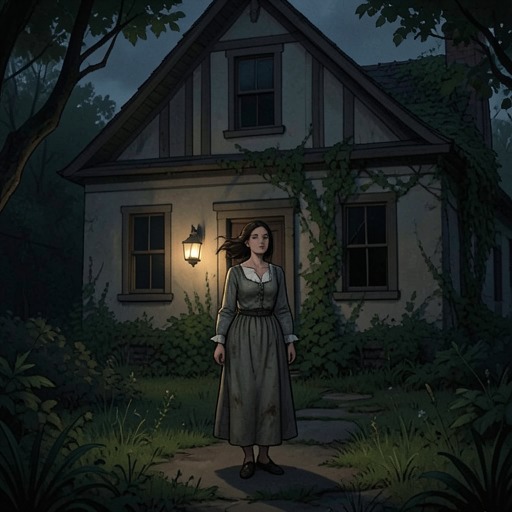
When Helen arrives at Wildfell Hall, the house’s dilapidated state and her restricted domestic arrangements distinguish her from the surrounding community. She has only two or three rooms made habitable and lives there with an old woman as her servant. The arrangement is sparse and conspicuous enough to encourage speculation, but it also gives her a space apart from the social world that would demand explanations she is unwilling to offer.
Helen does not describe solitude as an accidental hardship. She tells Fergus that the house’s loneliness was among its chief recommendations: she takes no pleasure in watching people pass her windows and likes quiet. Yet she does not claim to want permanent isolation. She dislikes an extensive acquaintance, she explains, but welcomes occasional visits from a few friends, because no one can be happy in eternal solitude. Her privacy therefore has limits of her own choosing: the distinction is between intimacy she permits and social scrutiny she refuses.
Her reserve coexists with artistic work. When Gilbert observes a nearly completed painting, he notices that she has signed it with the name Fernley Manor, Cumberland, rather than Wildfell Hall. The substituted place-name makes concealment visible within the image itself: even the work produced in her secluded home carries a guarded identity. The detail anticipates the wider gap between the woman her neighbours think they know and the history she has not disclosed.
Privacy as maternal practice
Helen’s withdrawal is inseparable from her care for her son, Arthur Graham. When Mrs. Markham expresses surprise that the child could walk so far, Helen explains that she had either to bring him or abandon the visit altogether, because she never leaves him alone. She also asks that apologies be conveyed to the Millwards and Mrs. Wilson, whose calls she cannot return until Arthur is able to accompany her. Her limited social life is thus not simply a refusal of company: it is organized around keeping her child within her own care.
The maternal vigilance that first appears as an everyday rule becomes a response to a more serious danger. In her manuscript, Helen recounts that the men around her husband treated a child’s early vices as material to cultivate, taking it as an amusement to teach him bad habits and, in their phrase, to make a man of him. She tries to keep Arthur with her or in the nursery and instructs Rachel not to let him come down to dessert while the men are present. The instructions fail, and the episode clarifies why proximity and control over the child’s upbringing matter so much to her.
Helen later describes herself as a prisoner, distressed not only by her own confinement but by being forbidden to rescue her son from the corrupting influence around him. The contrast gives her seclusion its sharper meaning: privacy can shelter a child only so long as a mother retains the power to keep him near. Her guarded life is therefore also a struggle over who may shape Arthur’s character and future.
Marriage, money, and the limits of concealment
Helen’s manuscript also reframes her isolation as a response to her marriage. When she asks Arthur Huntingdon whether he will let her take their child and what remains of her fortune and go, the request exposes the practical stakes beneath her private resolve. She is not merely seeking distance from an unhappy household; she is asking for the means to leave with her child and some portion of her resources. The evidence presents the request, but not a general legal ruling, so the pressure is most clearly seen in the terms she must negotiate with her husband.
The material limits are visible in Helen’s arrangements for care. She prefers to entrust an important charge to Rachel, who had nursed her and wished to nurse her child, with a young nursery-maid under Rachel’s direction. She values Rachel’s trustworthiness and also notes that the arrangement saves money. Since learning the state of Arthur’s affairs, Helen says, she has come to regard economy as no trifling recommendation; by her own desire, nearly the whole income from her fortune is devoted for years to come. Her quiet household is therefore not detached from financial strain: its staffing and her choices are shaped by resources she cannot treat as freely available for herself.
When Arthur discovers her writing, he dismisses it as too long to read immediately and demands the keys to her cabinet, desk, drawers, and other possessions. His demand turns private space into a point of conflict. Helen’s papers and locked belongings are not incidental household objects; they are where a woman’s account, plans, and property can be kept, and where a controlling husband can attempt to reach them. The scene makes the precariousness of her privacy concrete without implying that concealment alone can secure her freedom.
Manuscript, escape, and narrative disclosure
Gilbert receives Helen’s manuscript only after he pleads for anything that might restore his former opinion of her and relieve his regret. Helen says nothing at first: she goes to her desk, tears away a few leaves from the end of what appears to be a thick album or manuscript volume, and thrusts the remainder into his hands. After he has left the house, she calls him back to require that he return it after reading and tell no living person what it contains. The gesture grants access while preserving a boundary; she selects what can be read, withholds the ending’s pages, and explicitly entrusts him with its secrecy.
Gilbert reads the manuscript first rapidly, then steadily, and later presents its contents to Halford as part of his own account. That layered form means Helen’s history does not arrive as unrestricted confession. It is a written record entrusted to a particular reader, excerpted within Gilbert’s retrospective narrative and shaped by what has been torn away. When the surviving text breaks off just as Helen is about to mention the parish’s self-appointed fine gentleman, Gilbert believes she was about to refer to him. The interruption leaves the reader with his inference rather than Helen’s completed account, underscoring how the frame can expose her story while still filtering it through his perspective.
Helen’s departure from Grassdale completes the movement from hidden refuge to active escape. She decides that her duty to her son requires her to submit no longer and resolves that he must be delivered from his father’s corrupting influence. She deliberately withholds the location of her refuge even from her brother, so that he and her uncle can truthfully deny knowing where she is; communications sent under cover to her brother, she expects, will still reach her. Concealment here is practical protection, carefully arranged to limit the danger of discovery while preserving a channel for correspondence.
Later, a letter dated Grassdale, November 4, tells Frederick that Helen has found the household in confusion and that decent servants, including Mrs. Greaves and Benson, have left. The letter places her once more within the world she had escaped, but now as a visitor caring for the seriously ill Arthur Huntingdon rather than as a wife confined there. Across these changes, her privacy is neither a fixed temperament nor a complete solution: it begins as chosen quiet, becomes protection for a child and a hidden history, and finally gives way when duty requires her to act openly. By making the reader encounter that arc through guarded papers, missing pages, and a letter, the novel presents secrecy not as an absence of agency but as one of the means through which Helen exercises it.