Helen Huntingdon's secret exile at Wildfell Hall
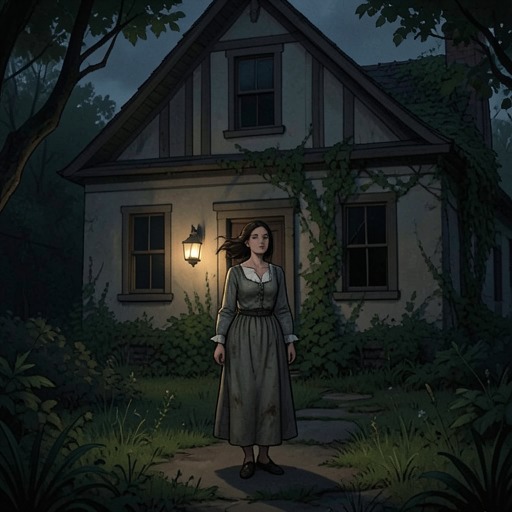
The Tenant of Wildfell HallHelen Huntingdon’s secret exile at Wildfell Hall is a deliberate escape from a marriage that has made her a prisoner while placing her son at risk. Leaving Grassdale with her child and Rachel, she adopts her mother’s maiden name, Mrs. Graham, and settles at Wildfell Hall in concealment. The refuge offers safety and the possibility of independent work, but not security: Helen fears discovery, while Arthur Huntingdon pursues the child he wants to reclaim. Her exile makes maternal protection a practical struggle over money, movement, information, and control of her son’s upbringing.
Causes and Constraints
Helen’s departure follows her recognition that remaining at Grassdale means allowing her son to be shaped by his father’s household. Arthur’s companions treat a child’s emerging vices as material for amusement and instruction; their ideal of making a man of him intensifies Helen’s determination to remove him from their influence. She had first tried to keep the boy beside her or in the nursery, instructing Rachel not to let him join the men at dessert, but those precautions could not secure him. Her fear is not abstract: she feels herself unable to teach or accompany him as she wishes, and describes herself as a prisoner because she cannot rescue him from the corruption around him.
The limits on Helen’s choices are also financial and domestic. She asks Arthur to let her take their child and what remains of her fortune and go, a request that exposes how much her departure depends on his response and on the resources she can access. She has already learned to regard money as consequential: nearly all the income from her fortune is committed for years ahead, and she economizes by relying on Rachel, who has nursed her and wishes to care for her child, with a young nursery-maid under Rachel’s direction. The refuge is therefore not a simple return to freedom. It must be made possible through careful use of limited funds, trusted service, and concealment.
Escape and Assumed Identity
Helen organizes the escape in secret. Before leaving, she arranges for Benson to cord the boxes and send them down the back stairs after dusk to a coach office, while she and the sleeping child remain inside the house. The travelling cards bear the name Mrs. Graham. Helen explains that Graham was her mother’s maiden name and that she claims it as her own, preferring it to any other name except the one she dares not resume. The alias provides a usable identity while recording, in its choice, the identity she cannot safely reclaim.
On October 24, Helen writes that she is free and safe at last. She and the child rise early, dress swiftly and quietly, and descend stealthily to the hall, where Benson waits with a light to open the door. At the little wicket closing behind them as they leave the park, Helen pauses for one breath of cool air and looks back at the dark house. She is glad she did not leave earlier: now she feels no doubt about the propriety of her decision and no remorse for the husband she has left. The fear of detection remains the one disturbance to her joy, and she has barely enough money for the likely cost of the journey.
Life in Refuge and the Threat of Discovery
Helen’s new home is at first a place of cautious settlement rather than complete security. Nearly a fortnight after arriving, she reports that Frederick has supplied the necessary furniture and painting materials. Rachel has sold most of her clothes in a distant town and obtained a wardrobe more suitable to Helen’s present position; Helen also has a second-hand piano. These details show the refuge being assembled through practical assistance and adaptation. She fears that a landlord’s visit to a stranger tenant might excite suspicion, whether suspicion of the truth or of a slanderous falsehood, so ordinary contact with the surrounding community carries risk.
The danger is sharpened by Arthur’s attempts to locate her. He goes in person to Staningley seeking redress, expecting to find his victims there if he cannot find them, and spreads accounts to Helen’s friends. Helen believes that he does not want her back so much as he wants their child. He tells her friends that he will tolerate her living apart from him and even settle a reasonable provision, presenting separation as a whim he can indulge while retaining a claim over the boy. Helen, meanwhile, keeps her refuge from her aunt and uncle so that they can truthfully deny knowledge of it; correspondence addressed to her under cover to her brother can still reach her. Secrecy protects those who might otherwise be drawn into the conflict, but it also isolates Helen and leaves discovery as a continuing threat.
Documents, Narrative, and Significance
The refuge reaches the reader through a layered telling rather than direct access alone. In the outer narrative, Gilbert Markham recalls receiving a thick album or manuscript volume from Helen, who hastily tears away some leaves and gives him the rest. She asks him to return it after reading and to tell no living person what it contains, placing her confidence explicitly in his honour. Gilbert reads the manuscript and then presents its contents to Halford as part of his letter, while acknowledging that a portion is missing. Helen’s written history thus emerges through acts of selection, withholding, and transmission; Wildfell Hall’s secrecy is not only a condition of her life but also a principle shaping how the reader learns it.
That frame also marks the difference between what Helen can establish about her refuge and what remains beyond the surviving account. In Gilbert’s reading, a passage breaks off just as Helen is about to mention a young parish gentleman; the torn ending frustrates his curiosity and leaves the disclosure incomplete. Elsewhere, the embedded document supplies specific evidence of the escape, the assumed name, and the effort to remain hidden, while the outer correspondence turns those private records into a story passed to a confidant. The narrative does not make concealment disappear when Helen reaches safety: even her account arrives in fragments and under an obligation of silence.
Helen’s exile is therefore both a home-making effort and a contest over who can determine a child’s life. She leaves because the household at Grassdale threatens her son’s moral formation, sustains herself through constrained finances and trusted help, and chooses a name that permits her to live beyond the reach of her former household. Yet Arthur’s pursuit and her fear of exposure prevent the refuge from becoming uncomplicated freedom. Its importance lies in the resolve the flight makes visible: Helen accepts hardship and secrecy rather than surrendering her child’s upbringing to the influence she fears, and the manuscript gives that resistance a voice even within a narrative built on guarded disclosure.