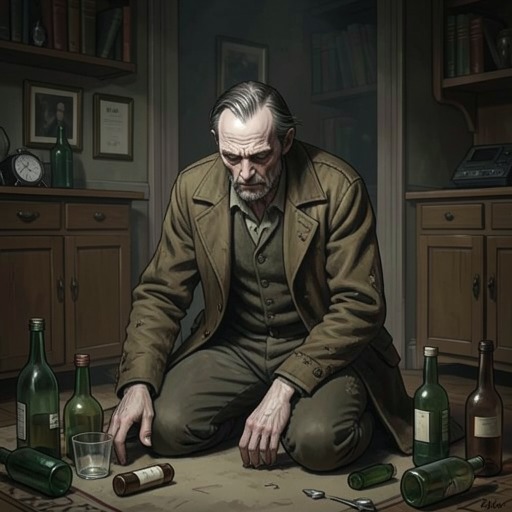
Helen and Arthur Huntingdon establish a loveless separation
The Tenant of Wildfell HallHelen and Arthur Huntingdon establish a loveless separation when Helen, having seen and heard evidence of Arthur’s adultery herself, asks to leave with their child and what remains of her fortune. Arthur refuses, and refuses her alternative request to take the child without money. Unable to secure either freedom or custody, Helen declares that she will remain in the house as the child’s mother and Arthur’s housekeeper, but that they will be husband and wife in name only. The scene turns betrayal into a stark negotiation over money, motherhood, and marital authority.
Causes and Background
Helen approaches the confrontation determined to speak calmly rather than make a scene. She has no wish for a confidante in her distress; she believes she must bear the burden herself. Her composure is not uncertainty about what happened. When Arthur denies knowing what she means, she tells him that she has relied on no third-party testimony: she was in the shrubbery that evening and witnessed and heard the evidence herself. Her direct knowledge closes off the possibility that the dispute can be dismissed as rumor or misunderstanding.
The confrontation also answers Arthur’s earlier assurances that she need not fear being forsaken as other women had been. He had told her that he cared for her more than for any of them; the adultery now exposes the hollowness of that reassurance. Helen’s demand is not simply an expression of injured feeling. She seeks a practical way out of a marriage in which fidelity has failed and in which she no longer wishes to exchange the appearance of affection for its reality.
The Negotiation Over Leaving
Helen first asks Arthur to let her take their child and what remains of her fortune and go somewhere the child will be safe from his influence. Arthur answers with an unqualified refusal. When she asks whether she may take the child without the money, he refuses again, adding that he will not allow her to leave without the child either. His response makes both the mother’s departure and the child’s removal conditional on his consent; Helen cannot turn her moral claim to protect her son into an immediately available practical choice.
Money sharpens the impasse. Helen has access to what remains of her fortune, but the request to take it with her does not give her a route out, because Arthur denies permission to go. Elsewhere, she explains that nearly the whole income from her fortune is committed for years ahead, a financial circumstance she has learned to regard as important through acquaintance with Arthur’s affairs. Her resources are therefore not a simple, unrestricted fund with which she can instantly make a new household. The scene presents money as both a means of independence and a constraint entangled with the marriage.
Arthur frames Helen’s wish to leave as fastidiousness and objects to the prospect of becoming the talk of the country. His concern with public talk contrasts with her stated concern that their son be delivered from a corrupting influence. The exchange leaves the immediate balance of power unchanged: Arthur says no, and Helen cannot take either the child or the money away.
The Terms of the Nominal Marriage
Faced with the refusal, Helen states the arrangement she can impose within the limits left to her: they will be husband and wife only in name. She defines her remaining place in the household narrowly, as the child’s mother and Arthur’s housekeeper, and tells him he need no longer pretend to love her. She will neither ask for nor offer the empty gestures of conjugal affection. The declaration does not secure physical separation, but it marks a decisive emotional boundary: the outward household continues while the intimacy of marriage is repudiated.
The terms are therefore both forceful and incomplete. Helen can name the truth of their relationship and refuse the performance of mutual affection, but Arthur’s refusal prevents her from converting that declaration into an independent departure. Her words distinguish the roles still imposed by circumstance from the relationship she no longer accepts. Motherhood and domestic service remain; the claim of loving partnership does not.
Consequences and Significance
The nominal separation clarifies the stakes of Helen’s later decision to flee. Her appeal to take her son and remaining fortune has already been denied, and she knows that her child’s safety cannot be secured simply by asking Arthur to permit her to leave. When she eventually resolves that her duty to her son requires her to submit no longer, the earlier confrontation supplies the practical and moral background: staying as mother and housekeeper has not ended the danger she sees in Arthur’s influence.
The scene also sits within a narrative that makes the reader’s access to Helen’s experience documentary and retrospective. After Helen gives Gilbert Markham her manuscript, he begins to read it and presents its contents to his correspondent. Within that embedded account, the confrontation is Helen’s own report of the evidence she witnessed and of the terms she proposed. Its force lies in the contrast between her clear recognition of betrayal and her limited power to act on that recognition at once. The declaration of a loveless marriage is not a resolution of the conflict, but the naming of a condition from which her later escape will follow.