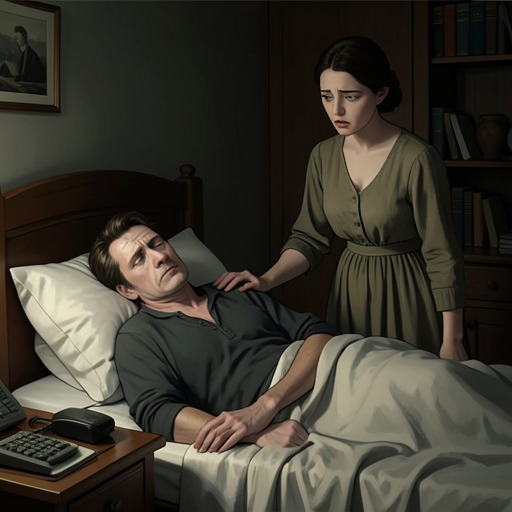
Helen and Arthur Huntingdon's marital estrangement
The Tenant of Wildfell HallHelen and Arthur Huntingdon’s marital estrangement is the transformation of their marriage into a household partnership without affection, freely chosen intimacy, or mutual trust. Helen’s declaration that they are husband and wife only in name gives the rupture its clearest form, but its consequences extend beyond emotional distance: she remains in Arthur’s home, responsible for domestic life and their child, while lacking the freedom to take her son and leave. The strain ultimately turns her private refusal of a false marital bond into a determination to protect the child by escaping Arthur’s influence.
Causes and the attempted separation
The estrangement follows Helen’s discovery of Arthur’s conduct and the collapse of her hope that their marriage can be restored through affection. Arthur tells her that he no longer cares for other women and that he has never loved any of them as much as he loves her. Helen answers that, had she known the truth about his past, she would never have given herself to him. His assurance does not repair the harm: the issue is not simply whom he claims to love now, but the history and conduct that have destroyed her confidence in him.
Helen asks to take their child and what remains of her fortune and go. Arthur refuses. When she asks whether she may at least have the child without the money, he refuses that arrangement too, and refuses to let her leave without the child. His stated concern is that her departure would make him the subject of local talk; his decision makes both money and custody barriers to her independence. The scene establishes a crucial imbalance: Helen can name the marriage’s failure, but cannot secure the practical conditions she believes necessary to leave it with her son.
A marriage in name only
Unable to depart, Helen defines the arrangement that will govern their life together. She tells Arthur that she is his child’s mother and housekeeper, nothing more. She will not demand the loving gestures he cannot sincerely give, nor offer or endure caresses that would disguise the reality of their estrangement. The distinction between the outward household and its inward condition is deliberate: they continue to occupy the roles of husband and wife, but Helen refuses to treat those roles as proof of affection.
On December 20, 1824, the third anniversary of their marriage, Helen records that the arrangement has lasted for nine weeks. She describes two people living together as master and mistress of the house and as the parents of a merry child, with a mutual understanding that they have no love, friendship, or sympathy. The anniversary, which might ordinarily mark union, instead measures how long their domestic life has continued in the absence of companionship.
Helen nevertheless tries to keep the shared household peaceful. She treats Arthur with civility, yields convenience when reasonable, and consults him about domestic matters, even when she considers his judgment inferior to her own. Such conduct is not reconciliation: it is a controlled, practical accommodation that allows her to perform her responsibilities without reviving the emotional pretence she has rejected.
Money, authority, and motherhood
The estrangement is shaped by material dependence as well as by feeling. Helen explains that, after learning about Arthur’s affairs, she has come to regard economy as important; at her own desire, nearly the whole income of her fortune is committed for years ahead. This financial circumstance narrows the resources available to her just as Arthur blocks her attempt to leave with both her child and the remainder of her money. The evidence presents her choices as constrained, rather than suggesting that the separation is simply a private decision she can freely implement.
Her status as mother is central to the conflict. Helen asks for her child because she regards her responsibility for him as inseparable from any departure, while Arthur refuses to let her take him. Later she describes herself as a prisoner and says that the deepest part of her distress is being forbidden to rescue her son from ruin. The household’s outward stability therefore conceals a sharper crisis: she can continue to care for the child in the home, but fears that she cannot protect him from the influence that surrounds him there.
From estrangement to escape
Arthur’s conduct toward their son intensifies Helen’s resolve. She determines to deliver the child from his father’s corrupting influence and tries to keep him with her or in the nursery, instructing Rachel not to let him join the men at dessert. The restriction does not hold. When Arthur later discovers her plans, Helen’s sense of captivity is bound not only to her own inability to leave but to her inability, as she sees it, to prevent her son’s moral harm.
The separation thus changes from an emotional boundary within the marriage into a struggle over where the child will live and who will direct his upbringing. Helen makes concealment part of her plan: she intends not to disclose her refuge even to her uncle, so that he and another relative can truthfully deny knowing where she is, while correspondence sent in care of her brother will reach her. When she is later able to make her child’s safety conditional on Arthur’s agreement to leave him entirely under her care and protection, the demand expresses the practical objective that had been denied at the start: the authority to remove him if she judges it necessary.
Meaning and endpoint
Helen’s conduct distinguishes marital civility from marital intimacy. She continues to manage the household and meet obligations, but does not accept those duties as a reason to feign love or surrender her judgment about her son. The arrangement exposes the distance between a marriage’s visible form and its lived reality, while the obstruction of her departure makes that distance a question of power as well as feeling.
The estrangement is not resolved by the return of affection. Helen says that her former attachment has been crushed and withered away, and her later insistence that she will not build her future on Arthur’s death or on a hoped-for marriage to Gilbert Markham confirms that she does not treat widowhood as a convenient escape or romantic guarantee. The marriage remains binding in life despite its emotional collapse; only Arthur’s death eventually changes the circumstances under which Helen’s future can be considered.