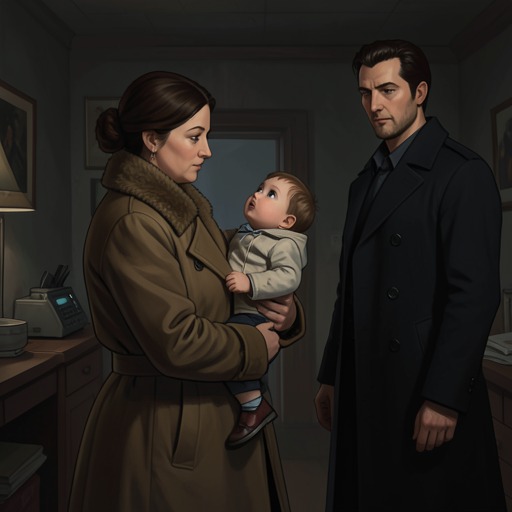
Helen escapes Grassdale with Arthur and Rachel
The Tenant of Wildfell HallHelen’s escape from Grassdale with her young son Arthur and Rachel is the decisive break in her life as Arthur Huntingdon’s wife: she leaves not for a new romantic attachment, but to protect her child from his father’s corrupting influence and to establish a life beyond a household that has become unbearable. Planned in secrecy and carried out before dawn, the flight leads to Wildfell Hall, where the first signs of refuge await them, while its careful preparations reveal the financial and social constraints that make departure perilous.
Causes and Decision
The immediate resolve comes after a morning visit from Rachel, whose news settles Helen’s decision before she has finished speaking. Helen explains what she intends to do and what help she needs, including which belongings Rachel should pack and which she should leave behind. She regrets having to dismiss Rachel after her long and faithful service, but cannot avoid it. The practical difficulty sharpens the moral choice: Helen says she can no longer afford to live like a lady and expects to become her own maid.
Rachel refuses to leave her. She says she has no home apart from Helen and will not take another position if separated from her. Helen initially insists that Rachel must not go with them, fearing the dangers of leaving familiar people and going among strangers. Rachel’s loyalty changes the plan: Helen embraces her and agrees that they will all go together. The exchange makes the escape an act of mutual fidelity as well as a mother’s rescue of her child; Rachel is not merely an attendant to be carried along, but a companion who chooses the risk.
Helen’s motive is explicitly bound to her duty to Arthur. She concludes that she must no longer submit to circumstances that expose her son to his father’s corrupting influence, and that the child must be delivered from it. She does not disclose her refuge to Esther Hargrave or her uncle, because she wants them to be able truthfully to deny knowing where she has gone. Instead, she explains that letters addressed to her under cover to Frederick will reach her. Concealment is therefore part of the protection: even well-wishers are kept ignorant so that they cannot inadvertently reveal the destination.
Preparation and Departure
Once Rachel agrees, Helen writes to Frederick that morning, asking him to prepare the refuge for their immediate reception and warning that she may arrive within a day of his receiving the note. She also writes three farewell letters, including one to Esther, explaining that she cannot remain. The correspondence coordinates a departure whose destination is secure only if its arrangements remain hidden; Helen relies on Frederick to make ready a place she cannot safely name to others.
The preparations are quiet and specific. Little Arthur sleeps while the house is still, and Benson has the boxes corded and taken down the back stairs after dusk. A cart carries them to the M—— coach-office. The travel cards bear the name Mrs. Graham, taken from Helen’s mother’s maiden name. She prefers it to any other name she might use, while daring not to resume her own. The assumed name is not an attempt to invent a past, but a guarded use of her maternal family identity, allowing her to travel without openly reclaiming the name tied to her marriage.
On October 24, Helen records that she is free and safe. The party rises early, dresses quickly and quietly, and descends to the hall, where Benson is waiting with a light to open the door and fasten it behind them. She has barely enough money left for the probable expenses of the journey. At the wicket, she pauses to look back at the dark, still house. She can now leave without the uncertainty and remorse that had accompanied the idea of departure: the setting of guilt and misery is behind her, though fear of detection remains.
The Journey and Arrival
The three travelers keep an unremarkable appearance. Arthur wears his plainest clothes and a coarse woollen shawl; Rachel is wrapped in a grey cloak and an old hood, making her look more like a decent older woman than a lady’s maid. These details turn disguise into practical protection. Helen travels with her child in her arms and Rachel beside her, while the horses carry them away from Grassdale and toward an unknown country. Her account sets the prison and despair of the household against the liberty and hope she associates with the road ahead.
The destination is not a place Helen can assume will be ready. On the way, she worries that Frederick may not have received her letter or may have had too little time to prepare rooms, leaving them without food, fire, or furniture after their journey. At length Wildfell Hall appears, reached by a lane that brings them around to the back. They enter its desolate court and survey the ruinous building; a faint red light offers the first sign that the house is not wholly dark and abandoned.
The rooms Frederick has managed to prepare are well aired and seemingly in good repair, though only partly furnished. Their few pieces are chiefly heavy old black oak, furniture formerly kept as antiquarian relics at his residence and hurriedly brought back. A woman brings supper for Helen and Arthur and reports that the master has prepared the rooms as well as the short notice allowed; Frederick intends to call the next day to receive Helen’s further instructions. The arrival thus provides a real refuge, but not an effortless or luxurious one: its readiness depends on hurried help, and the depleted furniture and scant travel funds preserve the material precariousness of the escape.
Consequences and Significance
The flight converts a private resolve into an irreversible separation from Grassdale. Helen leaves with her son rather than surrendering him to the influence she fears, and she accepts a reduced standard of living in exchange for the possibility of raising him away from his father. Her choice is practical as well as moral: she must economize, take on her own domestic work, conceal her whereabouts, and depend on Frederick’s prepared rooms and Rachel’s continuing loyalty.
The episode also gives concrete form to Helen’s constrained independence. Her fortune and income are not simply free resources: she has already chosen to devote nearly the whole income of her fortune for years to come, and at departure she has only enough left for likely travel costs. The escape therefore does not amount to an easy exercise of wealth or authority. It is accomplished through careful timing, a borrowed family name, hidden luggage, trusted assistance, and a refuge reached by a back lane.
In the retrospective account, Helen’s journey is both a physical departure and a shift in the terms by which she can act. She moves from a house she describes as a prison toward a precarious but self-directed life, carrying the child whose protection supplies the clearest reason for leaving. The darkness of Grassdale, the quiet passage through its wicket, and the coach’s steady movement into an unfamiliar landscape give the escape its central reversal: uncertainty continues, but it now lies ahead as the cost of freedom rather than within the household she has left.