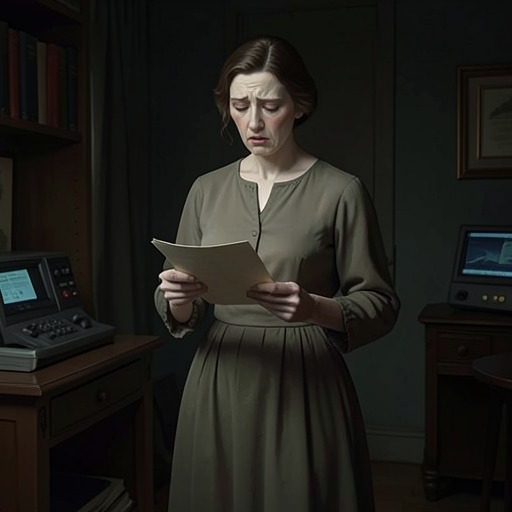
Helen rejects Mr. Boarham’s marriage proposal
The Tenant of Wildfell HallHelen Graham rejects Mr. Boarham’s marriage proposal in a scene that makes her personal consent decisive: although her aunt and uncle have permitted the approach, Helen refuses the match and ultimately tells Boarham that no consideration can make her marry against her inclinations. Her refusal is more than a judgment about one suitor. It sets out a standard she will later invoke under far more painful circumstances: marriage cannot be made meaningful by guardians’ approval, promises of protection, or another person’s persistence when love and consent are absent.
The proposal and its guardians
The proposal reaches Helen through her aunt, who enters with a solemn expression and explains that Mr. Boarham has come on an important errand: he has asked her guardians for Helen’s hand in marriage. Helen’s first response is to hope that they have already told him they cannot give it. Her aunt corrects her: Boarham is waiting to ask Helen himself, and she should consider her answer and be prepared to give reasons if she intends to refuse.
The guardians’ role makes the encounter more than a private exchange between suitor and prospective bride. Their permission has allowed Boarham to proceed, while Helen must now make her own wishes understood within a family setting that treats the proposal as a serious matter. Yet she does not mistake their approval for her consent. She says she will refuse, but asks how to do so civilly and decisively; she wants the interview over before offering her reasons to her aunt.
A refusal made in person
Helen goes to meet Boarham rather than evading him. In the drawing room, he walks up and down, hums snatches of tunes, and nibbles the end of his cane. He begins by invoking her guardian’s permission, as if that approval gives his suit standing. Helen acknowledges that she knows of it, thanks him for his preference, and declines the honor he wishes to confer. Her explanation is measured: she thinks they were not made for each other, and he would soon discover the same if they tried the experiment.
The courteous form of her answer does not make the decision uncertain. When Boarham presses her to explain and offers to love, cherish, and protect her, she tries to end the discussion rather than debate the merits of his promises. The narrative does not reproduce the whole conversation; instead, it emphasizes the pattern of pressure. He repeatedly returns to the same point and arguments, forcing Helen to repeat her replies, until courtesy gives way to sharpness.
Consent against persistence
Helen’s clearest statement comes after Boarham’s persistence has exhausted the possibility of a polite exit. She tells him that the marriage cannot happen: no consideration can induce her to marry against her inclinations. She distinguishes respect from love, saying she cannot love him and never could, and warns that the more he talks, the more he repels her. The episode’s tension therefore lies not in uncertainty about her answer, but in Boarham’s refusal to accept it without repeated explanation.
Her insistence on a direct refusal makes consent an action rather than a feeling left for others to interpret. Helen does not accept protection or material advantage as substitutes for inclination, and she does not treat the suitor’s willingness to care for her as a claim on her future. Boarham eventually wishes her good morning and withdraws, disconcerted; the proposal ends because Helen makes her decision unmistakable, not because her guardians or the suitor decide on her behalf.
The standard carried into later conflicts
The episode gains further significance from Helen’s later experiences of marriage. When she recounts to Arthur Huntingdon the conduct of women he has wronged, Arthur dismisses the earlier attachments and reassures her that he loves her more than any of them. Helen answers that, had he told her these things before, she would never have given herself to him. Her response recalls the principle expressed in refusing Boarham: a choice made without knowledge, affection, or freely given judgment cannot be repaired by a suitor’s later assurances.
That standard is tested again when Helen asks Arthur to let her take their child and what remains of her fortune and go. He refuses to let her leave with the child, or to let her leave without him; Helen responds that from then on they are husband and wife only in name. The contrast sharpens the earlier scene. Boarham’s proposal is rejected before marriage, when Helen can still state a boundary and make it effective. In her marriage, the same assertion of will cannot by itself secure freedom, because Arthur controls whether she may leave with their child.
Helen’s refusal thus introduces a recurring conflict between a woman’s judgment and the authority or persistence that seeks to overrule it. Her later decisions continue to depend on practical circumstances as well as principle: she devotes nearly all the income of her fortune for years to come, and, when duty to her son makes remaining at Grassdale untenable, she plans a refuge whose location her family can truthfully deny knowing. These later actions do not change the meaning of her refusal to Boarham; they reveal how difficult it becomes to maintain the right to choose once marriage has placed a child, property, and safety within the conflict.
Narrative significance
As an early, clearly articulated refusal, the proposal scene gives Helen’s later resistance a history. She is not simply rejecting a particular man’s character or making a passing objection to courtship: she names the determining condition plainly, that she cannot love Boarham and will not marry against her inclination. His repeated arguments show how a woman’s answer can be treated as an obstacle to overcome, while her final words close off that interpretation. The scene makes her consent the measure of the match and foreshadows the novel’s more severe question: what happens when a woman’s right to refuse is morally clear but materially difficult to enforce.