Hidden Portrait of a Man
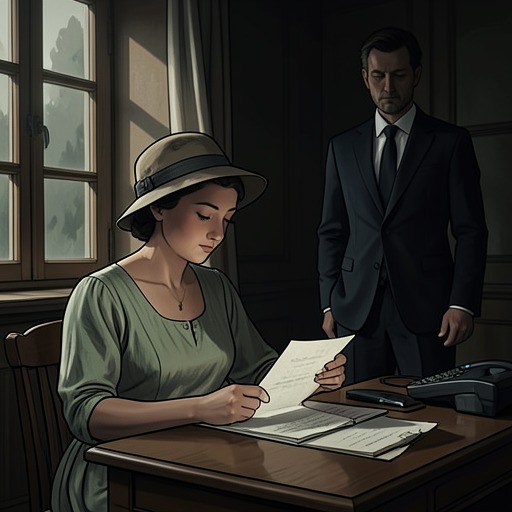
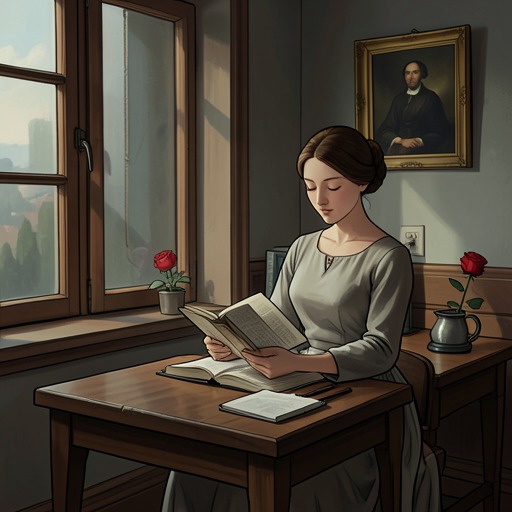
The Tenant of Wildfell HallThe Hidden Portrait of a Man is a painting Helen Graham deliberately keeps turned to the wall, an image of her husband, Arthur Huntingdon, from before his marriage to her. Gilbert Markham’s accidental discovery brings the concealed past into the present: he sees the face, Helen insists that his curiosity will not be satisfied, and the portrait remains hidden until the story embedded in her manuscript gives it meaning. It is both a literal secret and a visual threshold into the history Helen has withheld.
Appearance and concealment
Gilbert finds the portrait behind a painting of Arthur Graham as a baby. That first picture shows the child seated on grass with flowers in his lap, his blue eyes and light-brown curls recognizable to Gilbert as those of the young boy he knows. The contrast matters: the visible image belongs to Helen’s present life with her son, while the picture behind it belongs to a concealed adult history.
The hidden canvas depicts a young man at the height of his physical attractiveness. Gilbert notes bright blue eyes with a teasing expression, full lips seemingly ready to smile, reddish whiskers, and abundant chestnut curls falling over the forehead. He reads the face as handsome and self-conscious of its beauty, yet not foolish. His close inspection turns the portrait into more than a likeness: the details invite him to speculate about its subject before he knows the identity or history that make the image dangerous to Helen.
Gilbert judges it an accomplished likeness, painted with greater minuteness of detail and less freshness of color and freedom of handling than the other pictures he associates with Helen’s work. He has scarcely held it for two minutes when Helen returns. The precision of the description gives the concealed image a strong presence even as its owner restores it to darkness.
The discovery and Helen’s response
Helen explains that someone has come about the pictures, then discovers Gilbert holding the canvas she had turned away. He recognizes that looking was an intrusion and begins to ask whether she painted it herself. Helen cuts off the question: she calls his action impertinent and says she will gratify none of his curiosity. Her flushed cheek and kindling eye show that the rebuke is not merely playful, although she tries to soften it with a smile.
She takes the painting from Gilbert without ceremony, returns it to the dark corner with its face to the wall, and places the portrait of her son in front of it again. This deliberate ordering restores the barrier: the child’s image is visible, the man’s is covered. Gilbert, in no mood to join her subsequent laughter, turns toward the desolate garden; the moment leaves their visit marked by a boundary he has crossed and Helen has firmly reinstated.
From the portrait to the manuscript
The portrait is not itself an explanation. Its face gives Gilbert a question, while Helen’s refusal makes clear that the answer belongs to a history she controls. Later, when Gilbert asks for something that might restore his former opinion of her, Helen rushes to her desk, tears a few leaves from the end of a thick manuscript volume, and thrusts the rest into his hands. She tells him he need not read everything, then calls him back from the window to insist that he return the manuscript after reading and tell no living person what it reveals.
Gilbert takes the document home and reads it, first sampling sentences and then proceeding steadily through it. He presents the manuscript to Halford as the first instalment of his account, offering to send the rest at leisure and inviting his correspondent to say whether he wants the “ungainly, heavy pieces.” The frame makes access to Helen’s history selective: Helen chooses to disclose it to Gilbert, Gilbert chooses to relay it to Halford, and the reader encounters the portrait’s significance through this layered act of narration rather than through the image alone.
Narrative role and significance
The portrait’s concealment gives visual form to the gap between what Gilbert can observe and what he can know. His first encounter supplies an arresting face and a set of impressions, but not the circumstances that would explain Helen’s refusal. The painting therefore anticipates the manuscript: both are objects that hold a story back, and both make revelation depend on permission, handling, and interpretation.
Its placement behind the child’s portrait also sets two stages of Helen’s life beside one another without immediately explaining their relation. The scene initially offers resemblance, color, and expression as evidence, leaving identity and history unresolved. When the manuscript follows, the concealed image becomes legible within a larger account of Helen’s past. Its importance lies less in what Gilbert can infer from the painted features than in the boundary those features expose: Helen’s private history cannot be read simply because someone has found a way to look.