Women’s Economic Independence and Artistic Work
The Tenant of Wildfell HallWomen’s Economic Independence and Artistic Work in The Tenant of Wildfell Hall is embodied in Helen Graham’s painting, which moves from a concealed occupation at Wildfell Hall to a source of income and self-respect after she leaves her husband. Art offers Helen a way to support her household through her own labor, but its meaning is never merely aesthetic: her pictures must be sold, her earnings must be managed, and her ability to work is bound up with the struggle to protect her child and live apart from Arthur Huntingdon.
The studio and the concealed picture
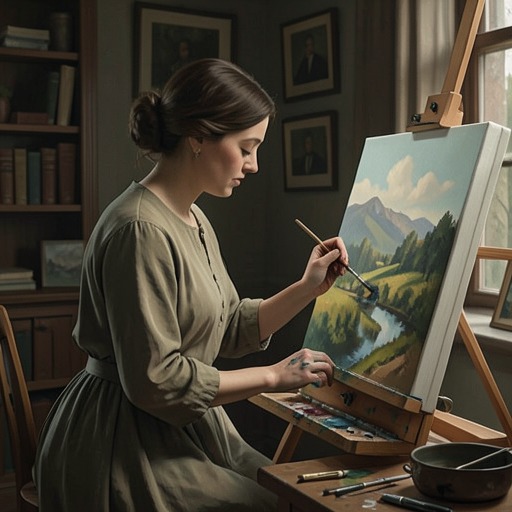
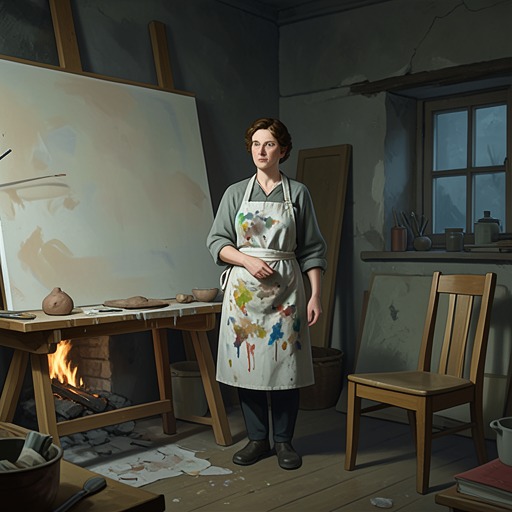
When Gilbert Markham visits Helen’s home with Rose, he finds an easel and a table crowded with rolls of canvas, oil and varnish, palette, brushes, and paints. Sketches at different stages lean against the wall beside finished works, mostly landscapes and figures. This is not an ornamental corner or an idle pastime: Helen is in the midst of a working practice, and, while she talks to her visitors, she keeps glancing at a painting and adding occasional touches with her brush.
The picture she is working on shows Wildfell Hall at early morning, seen from the field below. The Hall rises dark against a silvery-blue sky marked by red on the horizon. Helen has rendered the scene faithfully and with evident skill, but the image also creates a risk: someone familiar with her work might recognize it and trace her whereabouts. She explains that she has acquaintances from whom she wants her present residence concealed. To mislead anyone who tries to find her, she has put false initials on the picture and given the place a false name. The painting thus records the refuge she inhabits while also threatening to disclose it.
Helen does not intend to keep the picture. She cannot afford to paint only for her own amusement, and Arthur explains that his mother sends her work to London, where someone sells it and returns the money. Art is already connected to a route of exchange beyond the secluded household: Helen makes the pictures, another person arranges their sale, and the proceeds come back to her. Her other work confirms the range of her practice, from views of Linden-Car and Wildfell Hall in different light to a small, affecting image of a child looking over withered flowers against autumn fields and dark hills.
Work, privacy, and domestic expectation
The novel sets Helen’s productive attention against expectations that a woman’s domestic place should be organized around others. In the Markham household, Rose complains that her mother directs her to save the best food for Gilbert, keep the parlour tidy for him, maintain a cheerful fire he likes, and make a large pie because the men may be hungry. Rose’s account makes the domestic economy visible as gendered labor: the home is made comfortable for men, while the woman’s preferences and work can be subordinated to their convenience.
Helen’s studio offers a different picture of activity. Its materials, unfinished sketches, and finished canvases place her in the role of maker, while the London sales give that work a monetary consequence. Her art does not simply release her from domestic demands; it helps her meet them on terms other than dependence. The same woman who paints landscapes and figures must also reckon with the cost of raising a child, maintaining a home, and keeping her location secret. The contrast is not between art and practical life, but between work performed without control over its value and work that can contribute to a woman’s own means of living.
Her commitment to paying her way becomes especially clear after her flight from Grassdale. Once settled in her new home, Helen has a piano, a stocked bookcase, painting materials, and a room already arranged for professional work. She is laboring to repay Frederick Lawrence for the expenses he has advanced, even though he does not require repayment. Earning from her pictures gives her particular pleasure because it lets her live on her labor and household economy, and because she wants what she possesses to be legitimately her own. She intends to return every penny if she can do so without offending her brother. Artistic work therefore carries an ethical as well as financial meaning: it makes independence feel earned rather than borrowed.
Money, marriage, and the possibility of leaving
The need for a livelihood becomes urgent within Helen’s marriage. When she asks Arthur to let her take their child and what remains of her fortune and go, the request exposes the material stakes beneath their conflict. Her proposal is not an abstract claim to freedom: she is trying to secure a way out with a child to protect and limited resources to rely on. Earlier, Arthur minimizes his financial position when discussing marriage, describing his property as mostly entailed and mentioning mortgages and debts as though they were small matters. The contrast between his casual treatment of money and Helen’s later attention to income sharpens the unequal consequences of financial dependence.
Helen’s request to leave also follows her recognition that her son must not remain exposed to his father’s corrupting influence. She judges that poverty and obscurity with a fugitive mother would be preferable to luxury and affluence with Arthur. Her choice makes clear why independent earnings matter: a woman’s ability to depart is tied to whether she can support a child outside the husband’s household. The novel presents Helen’s artistic labor not as a complete escape from constraint, but as one of the practical resources through which she can build a life beyond it.
The effort is difficult because Helen cannot safely announce her refuge to everyone who might help her. She plans that messages addressed to her through her brother will reach her, while her family can truthfully deny knowing where she is. Secrecy and work proceed together: she must conceal her location from those who might expose it, yet establish the visible routines and resources of a working household. The room that takes on a professional appearance is evidence of a life being reconstructed under conditions of deliberate concealment.
The value and limits of artistic independence
Helen’s economic independence is real but bounded. She sells pictures through an intermediary in London rather than controlling every stage of their circulation, and she remains grateful for the initial support that furnishes her new home and supplies her with materials. Her determination to repay Frederick expresses agency, but it also shows how precarious that agency is: her working life begins with resources provided by someone else, and the income from her art must be made to sustain a household. The story does not treat artistic talent as a magical solution to the financial and social obstacles facing a married woman who leaves her husband.
Yet the act of painting changes the terms on which Helen understands her labor. She cannot afford to make pictures solely for pleasure, but that necessity does not empty the work of personal meaning. In her studio she remains absorbed in the image even while receiving visitors; after her flight, she takes pleasure in the work, earnings, frugality, and household economy through which she can support herself. The movement from the concealed portrait of Wildfell Hall to the professionally arranged room marks a shift from art that might betray her whereabouts to work that helps sustain her chosen refuge.
The wider significance lies in the connection the novel draws between women’s authorship of images and their ability to claim material room for themselves. Helen’s paintings are objects made by her, sold for money, and used to establish a life in which she can protect her son and answer for her own expenses. Their artistic value matters, but so do the canvases, the London sales, the returned proceeds, and the determination to repay a debt. Independence appears not as a single declaration but as labor repeated: painting, selling, economizing, and insisting that the fruits of that work belong to the woman who made them.