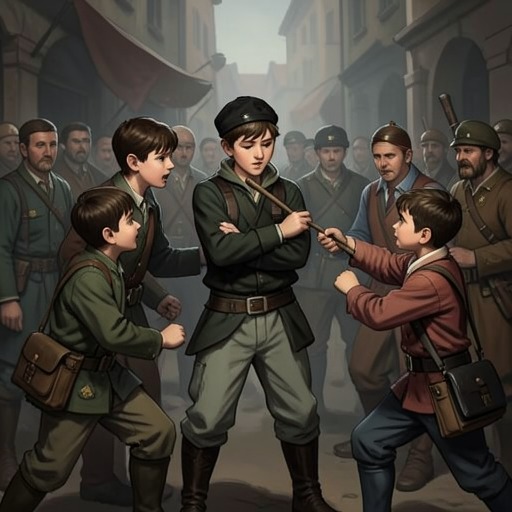
Billy Threemonger
The Tiger RisingBilly Threemonger is a schoolmate who bullies Rob Horton alongside his brother, Norton Threemonger. He turns Rob’s nickname, the rash on his legs, and Rob’s refusal to fight back into occasions for mockery and assault. The evidence presents Billy chiefly through these acts of cruelty: his role is to make Rob’s isolation at school concrete, while the attack that meets Sistine Bailey’s arrival shows the bullying still in progress when she steps in.
Identity and Introduction
Billy is Norton’s brother and one of the few children on Rob’s school bus during the early part of its route. He first joins Norton in ridiculing Rob for being associated with the Kentucky Star Motel. Norton calls Rob a star, and Billy echoes the joke by saying Rob does not know what it is like to be one. The exchange makes the nickname a tool of humiliation rather than praise.
Billy’s taunts then shift from the motel’s name to Rob’s belonging. After following Rob to the back of the bus, Billy insists that the place is Florida, not Kentucky, and tells Rob that he is not a star there or anywhere. Rob answers only, “Okay,” and Billy responds by shoving him. The sequence establishes a pattern in which Billy tests and enforces Rob’s vulnerability through verbal provocation followed by physical aggression.
Bullying on the Bus
Billy participates in the assault with Norton, who grabs Rob’s hair and grinds his knuckles into Rob’s scalp. Rob endures the attack rather than fighting back because resistance tends to make the bullying last longer; the bus driver, Mr. Nelson, pretends not to notice. Billy is therefore not acting in an isolated confrontation: he is part of a repeated, unequal ordeal in which Rob has little protection and has learned to survive by not reacting.
Billy also uses Rob’s leg rash as another means of humiliation. Pointing it out to Norton, he calls attention to Rob’s legs and describes the condition as “the creeping crud.” Later, when Rob sits among the weeds without looking up, Billy and Norton label him a leper and claim that his body parts will rot off. The threat is fabricated, but its purpose is plain in the scene: to make a visible physical condition a public spectacle and intensify Rob’s shame.
Conduct and Characterization
The evidence characterizes Billy through taunting, physical aggression, and his cooperation with Norton. His remarks about the Kentucky Star and Florida attack Rob’s identity; his comments about the rash convert bodily difference into an insult; his shove and participation in the bus assault make the verbal cruelty physical. The recurring pattern gives Billy a sharply defined role as a bully, without evidence of a more private motive or a change in his conduct.
Rob’s refusal to cry frustrates the brothers. He thinks of himself as exceptionally practiced at not crying, and the thought of the tiger gives him additional confidence that he will not break in front of them. Billy’s bullying thus meets a conspicuous form of resistance: Rob does not retaliate, but he also withholds the reaction that the boys seek. That endurance does not remove the danger or make the bus safe; it shows how Rob has adapted to harassment that he expects to continue.
Sistine’s Arrival and Narrative Role
The bus harassment provides the immediate circumstances for Sistine’s entrance into Rob’s school-day life. On the afternoon when she comes running toward him, Billy and Norton are already pelting Rob with date palms before the bus has fully stopped. Sistine dodges the dates and approaches him with the seriousness of a soldier heading into battle, then calls for them to go see the tiger. Billy’s ongoing attack frames her arrival as an intervention into Rob’s isolation, even as the scene moves toward the tiger.
Billy’s documented actions remain consistent across these episodes: he joins Norton in mocking Rob, exploits the rash as a target, and helps make the bus a place where Rob expects to be hurt rather than protected. The contrast between that hostile setting and Sistine’s direct approach clarifies the stakes of Rob’s social isolation. Billy matters to the characterization of Rob not through a reported transformation of his own, but through the repeated pressure against which Rob’s composure—and the significance of someone coming to him—becomes visible.