Tiger
The Tiger RisingThe tiger is a real, large animal whose captivity becomes the novel’s central test of what people owe a creature they cannot safely care for or simply set free. First discovered pacing in a cage, he is treated by Beauchamp as property and a possible source of money or a tiger-skin coat; to Rob and Sistine, he becomes a living being whose freedom matters, even as the risks of release remain unresolved. His escape ends in his death, exposing the gap between the hope of liberation and the conditions required for survival.
Identity and Captivity
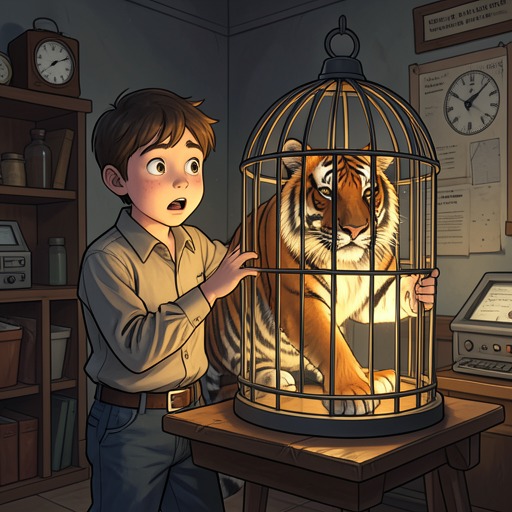
The tiger appears in the woods behind the Kentucky Star Motel beside an old, boarded-up Beauchamp gas station. Rob, who had wandered into the woods hoping to avoid school, sees an animal so large and vividly colored that the discovery seems almost unreal to him. The tiger is not a vision, however: he paces back and forth inside a cage, and the repeated image of his restless movement establishes the reality of his confinement.
The cage is made of rusted chain-link fencing, with a wooden board for a roof and a chain-link door secured by three padlocks. When Rob returns with Sistine, the tiger is still pacing as before. The unchanged motion makes the enclosure feel like a condition from which the animal has no apparent way out, rather than a temporary pause in his life.
Beauchamp’s Ownership and Rob’s Caretaking
Beauchamp speaks of the tiger in terms of what he might do with him. He is considering displaying him outside the motel to attract business, or killing him and making a coat from his skin; he has not decided between those possibilities. He describes the animal as hard work because he needs meat twice a day, then offers Rob two dollars each time he feeds him.
The arrangement makes Rob responsible for the tiger’s immediate care while leaving the animal’s confinement and future in Beauchamp’s hands. Beauchamp gives Rob a set of keys and warns him not to use the large ones, which open the cage door: if the tiger gets out, Beauchamp says, he will eat Rob. The keys thus stand for both practical access to the animal and the danger built into the arrangement. Rob can bring food into the cage, but Beauchamp’s warning makes clear that feeding and freeing the tiger are not equivalent acts.
Freedom, Survival, and the Question of Release
Sistine argues that the tiger should be set free. After reading about big cats in a library book, she believes he could live in the surrounding woods with the panthers. She points out that tigers are endangered and frames saving him as a responsibility. Her confidence gives the release plan a moral urgency, but her proposed refuge rests on an assumption about the local wilderness that Willie May challenges.
Willie May distinguishes between releasing a bird and releasing the tiger, who belongs to Beauchamp, and refuses to tell Rob to unlock the cage. She asks what will happen to the tiger afterward and how he will live. When Sistine replies that panthers survive in those woods, Willie May answers that they used to, but no longer do. Her objection does not deny the cruelty of confinement; it makes the animal’s prospects after release part of the ethical question. Rob feels relief that Willie May will not make him choose, while Sistine accuses her of withholding what she believes. Their disagreement leaves the tiger’s freedom and safety in tension rather than providing an easy answer.
Willie May’s own memory gives this caution a personal history. As a child, she freed a bird because she could not bear to see it confined. Her father beat her and said she had done the bird no favor, because it might become food for a snake. She never saw the bird again, though she sometimes dreams of it flying and singing. The episode does not establish what would happen to the tiger, but it shows why release alone cannot guarantee an animal’s well-being.
Escape and Death
Rob and Sistine eventually open the cage. As they watch, the tiger steps out carefully, pauses, and then runs. Sistine claps, and he looks back at them before bounding away. Rob sees his speed as almost flight; the animal who had seemed inseparable from the cage now moves across the grass under his own power. The scene gives release a moment of unmistakable possibility without confirming that the tiger can survive in the woods.
Willie May has gone to fetch Rob’s father because she has worked out what the children intend to do and fears what the tiger might do once free. She says she brought him so he could save Rob. The intervention changes the outcome: Rob’s father shoots the escaped tiger. Rob stands over the animal afterward and sees a small wound in his head, an understated detail that contrasts with the scale of the decision and its irreversible consequence.
Significance
The tiger is more than a symbol of freedom: the plot gives him concrete needs, a confinement imposed by people, and an uncertain life beyond the cage. Beauchamp’s competing plans treat him as an attraction, a burden, or material for a coat; Rob’s feeding makes him a caretaker, while Sistine’s appeal for release insists that the tiger’s existence matters beyond his usefulness to humans. Willie May’s story complicates that appeal by separating liberation from protection. The tiger’s escape and death do not settle whether freeing him was right; they show that neither captivity nor release, on its own, resolves the human responsibility for his survival.