Tiger cage
The Tiger RisingThe Tiger cage is a crude enclosure behind which the tiger paces, and the central material obstacle in Rob Horton and Sistine Bailey’s attempt to free him. Made from rusted chain-link fence, capped by a wooden board, and fastened with three padlocks, it embodies a captivity that the children can unlock but cannot command away. Its open door creates the possibility of escape; the tiger’s own cautious passage through it makes freedom an action that belongs to the animal, not merely to the people who want to release him.
Construction and Captivity
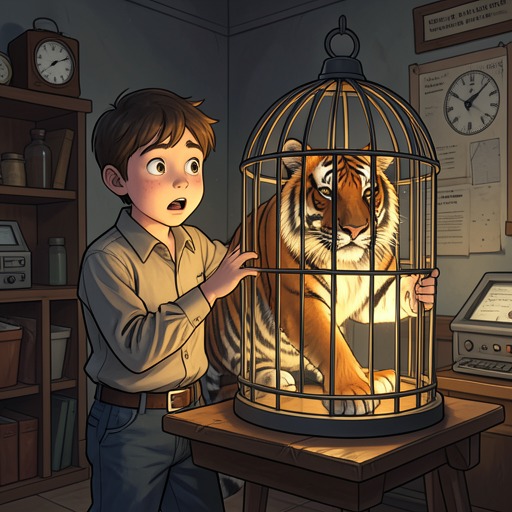
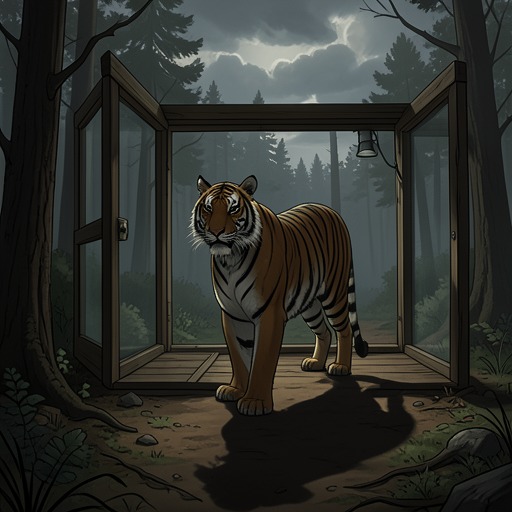
The cage is assembled from humble, deteriorating materials: rusted chain-link fencing for its walls, a wooden board for a roof, and a chain-link door secured by three padlocks. The tiger is still pacing inside when Rob returns, moving back and forth as he had before, so continuously that Rob imagines either that the animal has never stopped or that he himself has never been away. The repeated motion gives the enclosure a measure of time: the tiger’s confinement persists through Rob’s absence, unchanged and unresolved.
The tiger’s pacing is not the only thing the scene insists on. Sistine recognizes the animal’s beauty, while Rob warns her not to stand too close in case the tiger dislikes it. The cage separates them from a powerful creature with its own presence and possible response; it does not turn him into something harmless or fully knowable. His continued movement within the fence makes confinement visible as a condition imposed on a living animal, rather than a neutral setting around an attraction.
A Captivity Challenged
Sistine names the moral problem directly: the tiger should not be in a cage. Rob initially answers that they cannot do anything about it, but she rejects that resignation and proposes letting him go. The cage therefore becomes the object around which their different responses meet: Rob sees a barrier that seems beyond their power, while Sistine treats its locks as a challenge they can act on.
When Willie May accompanies Rob and Sistine through the woods to see the animal, she reacts with awe at the pacing tiger and condemns the decision to cage him. Rob explains that the tiger belongs to Beauchamp; Willie May responds with disgust, saying Beauchamp is precisely the person who should not own a tiger. Her response widens the question beyond the children’s disagreement. The locked enclosure is not simply a practical problem: it is the result of one person’s possession of an animal whose fierceness and independence remain unmistakable.
Unlocking the Door
At the cage, the three padlocks make release seem like a concrete, solvable task. Rob slides the first key into the first lock, and it turns so smoothly that he is dizzy with amazement; freeing the tiger suddenly seems easy. He opens the other two locks, removes them one by one, and hands them to Sistine, who lays them on the ground. The orderly sequence—key, lock, door—contrasts with the much harder question of what the tiger will do once the barrier is gone.
Rob flings the door wide and shouts for the tiger to get out. Instead, the animal ignores the opening and continues pacing, apparently unaware of the escape route. Rob tells him to go, then grows furious, shaking the cage and howling beneath a cloud-thick sky. The scene reverses the children’s expectation: they can remove the padlocks and open the door, but they cannot make the tiger leave. Sistine touches Rob’s arm and tells him to watch; the tiger is already beginning to move.
Passage into Freedom
The tiger steps out with grace and delicacy, first lifting his nose to sniff, then taking one small step and another before stopping. When Sistine claps, he turns to look back at the two children, his eyes blazing, and then runs. His careful first movements give way to speed: Rob sees him as if flying, his muscles moving like a river, and finds it hard to believe that a cage could ever have held him.
As the tiger bounds through the grass and farther away, he resembles the sun rising and setting again and again. Rob feels his own heart rise and fall in time with the animal’s departure. The enclosure has not vanished; its door remains open behind them. But its function has changed: what had contained the tiger now marks the boundary he has crossed. The tiger’s independent choice to leave, rather than an escape performed at the children’s command, gives the opening its significance as an image of release and as a limit on human control over another living being.