Art Institute of Chicago
The Time Traveler's WifeThe Art Institute of Chicago is a recurring setting where Henry’s unstable chronology turns a familiar museum into both a classroom and a site of recognition. In one visit, he teaches his nine-year-old self the theft skills he believes necessary to survive; in another, displaced into an uncertain future, he encounters his ten-year-old daughter, Alba, among a school group. The contrast makes the museum more than a backdrop: it holds together Henry’s practical lessons in living and the family bonds his time travel repeatedly threatens to interrupt.
A Museum Across Dislocated Times
Henry’s visits do not form a simple chronological sequence. In June 1973, he arrives from 1990 with his nine-year-old self, who has traveled from the following Wednesday. In a separate, later episode, Henry appears in the museum’s future without knowing exactly when he is, dressed in a long black coat taken from the coat check and trousers from a guard’s locker. He estimates that the clothing and haircuts are not far removed from 2001, but remains uncertain of his position in time. The museum’s galleries are stable enough to orient him in space, while the date—and the life waiting elsewhere—remains unsettled.
That later displacement is especially painful because Henry’s present is a moment when Clare is about to give birth to Alba, and he wants to be with her. At the same time, he feels strong and unusually present during this forward journey. The museum consequently locates two opposing experiences in one place: a life moment he fears missing, and a visit that makes him feel vividly alive. Its recurrence links a childhood lesson to a father’s encounter with his future child without making those experiences simultaneous for Henry.
Lessons in Survival
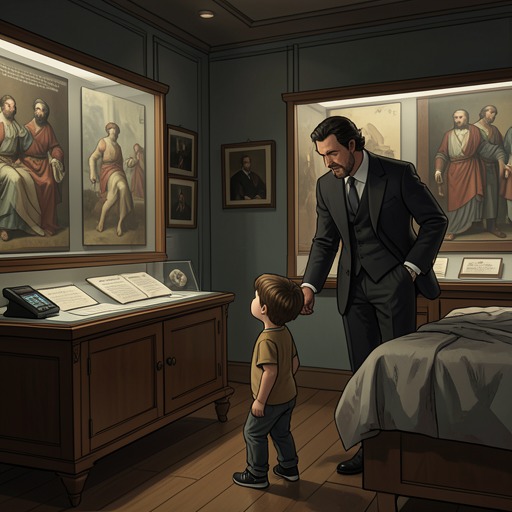
On the 1973 visit, Henry brings his younger self to the Art Institute not simply to look at its art but to teach him how to pick pockets. The child asks if they can just see the paintings, and Henry insists that he needs to learn how to survive. His list of other lessons—shoplifting, beating people up, picking locks, climbing trees, driving, housebreaking, dumpster diving, and using objects such as Venetian blinds and garbage-can lids as weapons—makes clear that the museum excursion belongs to a larger, improvised education in self-protection.
The lesson unfolds inside the museum’s ordinary public routines. It is Free Day, so the building is crowded. The two Henrys climb the central staircase and pass through the European Galleries, moving backward from seventeenth-century Netherlands to fifteenth-century Spain. They pause before Bernardo Martorell’s painting of Saint George and the dragon; Henry recalls that he and his younger self love the yellow-bellied dragon and are relieved each time to find that its moment of doom has not arrived. The child’s attention to the painting offers a brief respite from the lesson’s practical purpose, but Henry soon directs him toward the crowded Impressionist rooms, where the visitors provide opportunities to steal.
Henry demonstrates first on a woman distracted by her crying toddler. He pretends to admire Toulouse-Lautrec’s At the Moulin Rouge, bumps into her, apologizes, and removes her wallet from her purse. He later shows the wallet to the child, identifies its owner as Denise Radke, and points out her cash and other personal information. Because he says they do not need the money and were only practicing, he instructs the boy to return the wallet to a guard, which the child does.
The next demonstration turns the lesson into a test. Henry selects a man who is lecturing his girlfriend about Vincent van Gogh and arranges for his younger self to hand over a wallet supposedly found on the floor. As the man checks his own pocket and explains that the wallet should go to museum security, the child steals his wallet. Henry takes it from him, and the two leave the museum. Their outing ends with milkshakes and French fries at the Artists Cafe; afterward, they put the wallets in a mailbox without the cash and obtain a room at the Palmer House. The sequence pairs instruction with a limit: Henry teaches theft as a survival skill, but has the wallets returned rather than keeping them.
Alba in the Galleries
During the later visit, Henry finds himself in the Surrealist Galleries, where he plans to lift a wallet, buy a T-shirt in the museum store, eat lunch, see art, and then leave for shops and hotel rooms. Instead, he pauses in a dark room filled with Joseph Cornell’s spot-lit boxes and watches a school group on a field trip. A girl in a peacock-blue dress stands apart from her classmates’ matching uniforms. She repeatedly raises her hand, but the docent does not call on her.
When the docent asks why Cornell made the boxes, the girl finally speaks. She argues that the artist was lonely, made the boxes because he had nobody to love, and wanted them—and the birds they sheltered—to be free and safe. Her answer moves from interpretation of the artworks to an account of the maker’s longing. The girl sits down, and the teacher thanks her by name: Alba. Henry recognizes her as his daughter and steps toward her. Alba sees him, jumps up, knocks over her folding chair, and runs into his arms, calling him Daddy repeatedly. A visit planned around theft and a meal becomes an abrupt reunion.
The teacher, Mrs. Cooper, does not immediately know who Henry is or whether he can take Alba away from the group. Alba proposes calling her mother to verify him. Using a cellphone from her school bag, she reaches Clare, then hands the phone to Henry. After speaking with Clare, Mrs. Cooper permits Henry to take Alba to the museum entrance to meet her mother. Alba tells Henry that Clare gave her videos for her birthday and that she is learning to pick locks. The detail quietly recalls Henry’s earlier survival lesson: the skill he once taught his younger self has passed into the life of his daughter, though here it arrives as part of her own upbringing.
Reunion and Separation
Henry and Alba walk through the museum toward the entrance, passing down the spiral staircase and into the Chinese ceramics galleries. As they wait outside, the time displacement begins to pull him away. It is raining, and Alba has no coat, so Henry wraps his coat around both of them. She leans against his bare torso, held close beneath it, while he tries to remain long enough to see Clare. Their closeness gives the reunion a physical immediacy that cannot stop its duration from being limited.
Alba spots her mother’s white car approaching. Clare jumps out before it has properly stopped, leaving it in the intersection and running toward them. Henry tries to run to her but collapses onto the steps. With Alba holding him, he reaches toward Clare, only a few feet away, and tells her he loves her before disappearing. The reunion therefore ends at the threshold of a meeting between husband and wife: Alba has brought Henry and Clare close, but his body’s involuntary departure prevents them from embracing.
The two episodes give the Art Institute a double role in Henry’s story. Its galleries first stage a lesson in which an adult Henry attempts to prepare his child self for a dangerous world; later, a child’s perceptive response to art enables Henry to recognize his daughter. The museum’s repeated public spaces—stairs, galleries, entrances, visitors—accommodate acts of concealment and sudden discovery alike. In a life governed by involuntary arrival and departure, it becomes a place where survival is taught, family is found, and even a reunion can last only until time pulls Henry away.