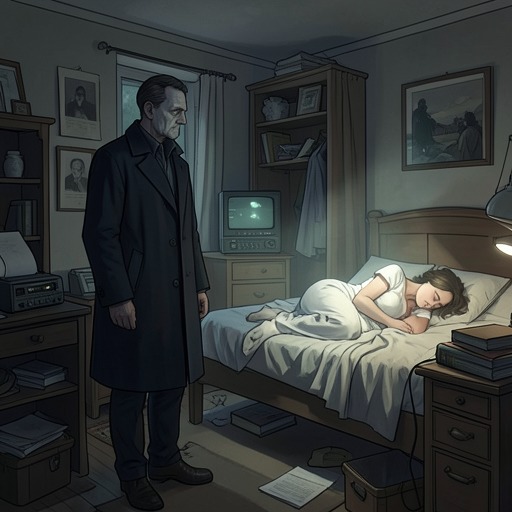
Celia Attley
The Time Traveler's WifeCelia Attley is a friend of Ingrid Carmichel whose intermittent appearances connect Ingrid’s troubled relationship with Henry DeTamble to the later life Henry builds with Clare Abshire. She is at once a guarded keeper of Ingrid’s confidences, a blunt intermediary in the conflict around Henry, and, years later, the person who returns a photograph preserved among Ingrid’s belongings. Her disclosures give the past a human custodian, while her final insistence that Henry is not dead leaves the meaning of survival unresolved.
Identity and Introduction
Celia first enters the story through her association with Ingrid. When Henry identifies her, he remarks that he knows her; the exchange then makes clear that she does not always share what she knows. Celia is described as selectively informative, a quality that matters when she tells Clare that Ingrid died by suicide on January 2, 1994, having shot herself in the chest. The revelation is not merely biographical: it shows Clare, and the reader, that the story of Henry and Ingrid continues beyond their separation and that Celia has possessed knowledge Clare did not.
Celia’s presence is also marked by others’ attempts to identify her. Henry describes her to a companion as a Black woman with short hair, large eyes, and dreadlocks. Later, Clare recognizes her as the short Black woman who had been with Ingrid at the Aragon Ballroom. These brief references establish Celia as a recurring figure at the edge of Henry and Ingrid’s history before she steps directly into Clare’s view.
Warning and Disclosure
Celia’s involvement with Clare begins in a warning. Looking toward Ingrid, she tells Clare that she is intruding where she is not wanted and characterizes Henry as bad news, while insisting that he belongs to Ingrid’s sphere of trouble. The warning is both protective and territorial: it urges Clare to keep out of the relationship, but it also frames Henry and Ingrid as bound together in a way outsiders should not challenge. Celia does not present herself as a neutral observer; she speaks from inside Ingrid’s social world.
Later, Celia is walking between that world and Clare’s. She tells Clare that Ingrid is sitting on a bar stool at Berlin and waiting for her, and says that she is late. In the same encounter, she reports that Henry is running naked down Broadway with skinheads following him. Her matter-of-fact account places the disorder of Henry’s time-displaced life beside the ordinary demands of keeping an appointment with Ingrid. The sudden shift from news of Henry to her own lateness gives Celia’s brief appearance an unsettled, almost passing quality: she is carrying information, but does not stop to make herself its center.
Celia’s loyalties become clearest during the confrontation that follows. Ingrid tells Clare to tell Henry that he can go to hell and that she will see him there, then leaves. Celia remains behind with her face in her hands. The gesture registers the cost of the conflict without explaining it away; she is close enough to Ingrid to share the aftermath, but the evidence does not make her responsible for repairing the relationship or mediating between its participants.
Connections to Henry and Clare
Celia’s relationship to Henry is shaped by the fact that he has been Ingrid’s partner and that Celia knows parts of their shared past. At a dance, she cuts in on Gomez as he dances with Clare, prompting Gomez to cut in on Henry’s partner; Henry then watches Clare dancing with Celia. The sequence makes Celia part of a shifting social scene in which partners change and old connections cross the boundaries of Henry and Clare’s married life. It does not establish a deeper intimacy between Celia and Clare, but it places them together in the same circle rather than leaving Celia solely in Ingrid’s past.
After Henry has undergone surgery, Celia attends a gathering at his home among his and Clare’s nearest and dearest. Her arrival is notable because she walks directly up to Henry and offers her hand. She says she is sorry to see him in his condition, acknowledging the change in his body without turning the encounter into a spectacle. For Henry, who finds the pity in another guest’s gaze difficult to bear, Celia’s directness makes the meeting both compassionate and uncomfortable.
Celia then produces a photograph she found long ago among Ingrid’s things, saying she thought Clare might want it. The picture shows Henry, probably around 1990, laughing shirtless at Oak Street Beach. Henry considers it a good photograph, but cannot remember Ingrid taking it; he recognizes that much of his time with Ingrid has become a blank to him. Celia’s gift therefore carries two histories at once: Ingrid’s act of keeping the image and Henry’s incomplete memory of the relationship it records. By handing it over, Celia makes a fragment of that past available to Clare and Henry’s present.
Change, Loss, and Narrative Role
Celia’s function changes as the story advances. At first she guards the boundary around Ingrid, warning Clare not to interfere and appearing amid the social tensions connected to Henry’s former relationship. She later becomes the bearer of painful information about Ingrid’s death. Still later, she acts as a custodian of an object that outlasted the relationship: a photograph found among Ingrid’s possessions and returned to Henry’s household. The movement is not a conversion from hostility to friendship so much as a change in what she carries—first a warning, then knowledge, and finally a piece of material memory.
Her last exchange with Henry resists a neat conclusion. When he responds to her sympathy, Celia looks at him sharply and insists that he is not dead. The statement distinguishes his condition from death without claiming that he is well or restoring what surgery has taken. In a story where Henry’s presence is repeatedly interrupted and his body bears the consequences of his condition, Celia’s words make survival a fact that must be asserted rather than assumed. She is a supporting character, but her appearances bind the absent Ingrid to the living Henry and Clare, showing how an earlier relationship can remain present through secrets, social encounters, and a photograph passed from one household to another.