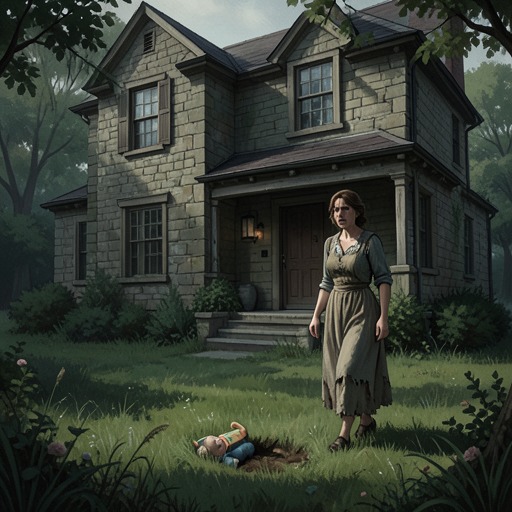
Clare discovers a poem written to her in her mother’s desk
The Time Traveler's WifeClare discovers a poem written to her in her mother’s desk after Lucille Abshire’s death. The event turns a search through a locked desk and a disorderly collection of papers into a moment of recognition: Clare finds direct evidence of her mother’s love, and Henry sees the poem help his wife return from grief.
The Empty Room and the Locked Desk
On November 26, 1998, Clare enters her mother’s room after the medical equipment has been removed. The bed is stripped, and the room’s white, bare appearance contrasts with its antique French furnishings. At its center stands a heavy white Formica desk, conspicuously modern in the otherwise delicate room. Clare has spent an hour looking for its key without success. The locked desk makes the search for her mother’s private thoughts both literal and emotionally charged.
Clare goes downstairs and finds Henry and Nell making pastry together in the kitchen. Henry follows Clare back upstairs when she tells him she wants to open the desk but cannot find the keys. He uses two large paper clips to pick the drawers, working first on the bottom-left drawer and then opening the other four. The drawers contain a crowded assortment of notebooks, loose papers, gardening catalogs, seed packets, pens, short pencils, a checkbook, a candy bar, and a tape measure. Henry leaves the contents untouched and withdraws when Clare signals that she wants to look through them alone.
The Papers and the Poem
Clare sorts the papers on the floor, setting aside anything bearing her mother’s handwriting. Among the older material, she encounters papers from 1979, the year Lucille lost a baby and tried to kill herself. The documents make Clare understand more clearly what her mother was going through at the time, but she cannot continue reading them; she puts them aside. The discovery therefore begins not as simple consolation but as an encounter with painful family history that Clare must choose not to pursue further in that moment.
In another drawer, Clare finds more recent poems, including one addressed to her, titled “The Garden Under Snow.” Its opening image, “now the garden is under snow,” gives the poem’s private address and seasonal metaphor particular force amid the scattered papers. Unlike lists and notes, the poem speaks directly to Clare. Its existence offers a surviving trace of feeling in a room emptied by death, and a specific, enduring object through which Clare can encounter what her mother left unsaid in life.
Recognition and Its Immediate Effect
Henry has been helping Nell in the kitchen when she sends him upstairs to see what Clare is doing. He finds Clare seated on the floor amid white and yellow papers, lit by the desk lamp. Clare holds out the poem and tells him that her mother wrote her one. Henry reads it beside her. The moment changes his own understanding of Lucille: he says that reading the poem allows him to forgive her, in part, for what he had regarded as her selfishness and difficult dying.
For Clare, the poem answers a painful uncertainty about whether her mother truly loved her. Henry recognizes the contrast with his own confidence in his mother’s love, which he had never questioned, and sees the poem as fixed evidence rather than a passing expression. Clare repeats in wonder that her mother wrote her a poem, and tears begin to fall. Henry embraces her; in his perception, she is no longer unreachable but has returned to him. The scene makes the poem’s consequence personal and immediate: it does not erase the loss, but it gives Clare a way back into feeling and connection.
Grief, Memory, and Material Evidence
The discovery follows a period in which Clare’s bereavement has altered her daily behavior. Henry describes her as moving through rooms and forgetting why she entered, sitting before a book without turning its pages, and accepting food or affection without seeming fully present. He misses Lucille, but feels especially bereft of Clare, who appears emotionally absent. Against that context, the poem marks a change without presenting grief as simply resolved: Clare cries and accepts Henry’s embrace, while the loss itself remains.
The desk and its contents shape the scene’s movement from concealment to recognition. Its drawers hold the fragments of an ordinary life alongside the record of a crisis Clare cannot yet read through. The poem rises from that disorder as a message addressed specifically to her. Its importance lies not in explaining everything about Lucille or repairing their entire relationship, but in making maternal love legible at the moment Clare needs evidence of it. The scene thus links mourning to an act of discovery: a private paper, preserved among mundane objects, becomes a support that helps Clare rejoin the living relationship with Henry.