Clare returns to her art
The Time Traveler's WifeClare’s return to her art begins not with an easy recovery but with a room preserved in stillness: after two years away, she finds her tools untouched and cannot make an image appear. The turning point comes when she places indigo-dyed paper on the drawing table and, from memory, makes a floating female figure whose gaze seems to meet hers. By pricking the drawing with a needle until its holes form a constellation, Clare transforms the attempt to recover her former life into an act of making that acknowledges what cannot be restored. The scene’s renewed art is inseparable from grief for Henry, and its final reversal is precise: Clare tells the image to vanish, but it is she who feels herself vanishing.
The studio after two years
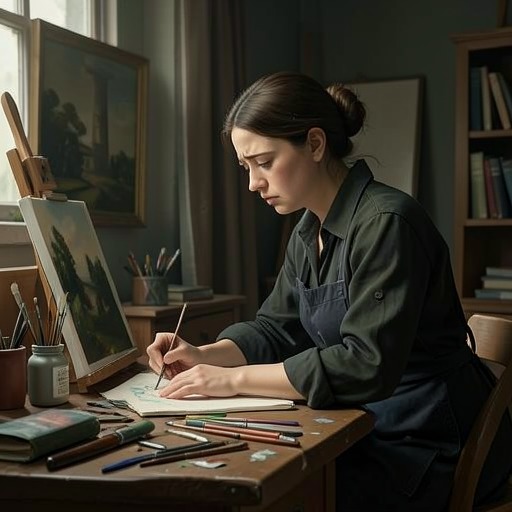
On Thursday, December 4, 2008, Clare unlocks her studio on a cold, bright morning, stamps snow from her boots, opens the shades, and turns up the heat. Dust and stillness cover the room. The drawing table is bare; the beater is clean and empty; molds and deckles are stacked neatly, and the armature wire has gone unused. Paints, pigments, brushes, tools, and books remain where they were, while sketches thumbtacked to the wall have yellowed and curled. Clare removes those old sketches and throws them away, a small but definite clearing of the space rather than a restoration of what had been there.
She sits at the drawing table and closes her eyes, but the studio’s ordinary sounds—the wind against the house, a car splashing through alley slush, the coffeemaker’s hiss—do not make the work return. Clare says that she came because of an urge like a flash of lust, an assignation with her old lover, art. Yet as she waits for something to come to her, nothing does. The old intimacy is an impulse, not a guarantee: the room and its equipment are present, but the act of creating has not resumed.
Memory and the first mark
Clare opens a flat-file drawer and takes out a sheet of indigo-dyed paper. Heavy, slightly rough, and cold to the touch, it gives her a material beginning where inspiration has failed. She lays it on the table, studies it, and weighs a few pieces of soft white pastel in her palm before putting them down to pour coffee. In the pause, she imagines Henry in the house next door to the studio: at his desk, looking back from the window, playing Scrabble with Alba, or making soup. The possibilities are ordinary domestic moments, not a new encounter. Clare tries to make time revert and erase the difference between then and now, but recognizes that memory alone is what holds her there.
She finally stands over the paper with a piece of white pastel. Although she knows an easel would be more comfortable, she bends over the large sheet and measures out a half-life-sized figure. Working lightly, she draws a head and builds the body from remembered features and proportions: the face, sloping shoulders, crossed arms, stomach, hips, bent legs, and downward-pointing feet. The figure appears to float. Its points of measurement become stars in the indigo field, while highlights give the body the depth of a glass vessel. The work advances by concrete decisions—placing a feature, shaping a face, filling in the eyes—until the figure seems astonished to exist.
The constellation and its reversal
Clare finds a needle, tapes the drawing over a window, and begins pricking the paper with tiny holes. Each puncture becomes a sun in another set of worlds; as the holes spread, she pricks out the figure itself, turning it into a network of points of light. The action alters the drawing without undoing its image: the woman remains, but now also belongs to a field of imagined worlds. Clare regards her likeness, and the image returns her gaze. Making has become an encounter with a figure produced from memory, rather than proof that the past has come back.
Clare touches the figure’s forehead and says, “Vanish,” but the command reverses upon its speaker: the image will stay, while Clare is the one who is vanishing. The moment gathers together the scene’s opposed movements. She has returned to the studio and made something where there was nothing, yet the effort to hold Henry and the former life in memory does not cancel their absence. The drawing can endure as an image; Clare cannot use it to make time run backward.
Place in Clare’s story
The scene gives “returns” a qualified meaning. Clare does return to the physical studio and resumes the handwork of drawing, using paper, pastel, a needle, and the remembered shape of a body. But her first attempt is not a simple continuation of an established routine: the room is dormant, the old sketches are discarded, and she must begin with a blank sheet. The new drawing is both an act of artistic attention and a form through which memory can be approached without being mistaken for the present.
Its place in the novel’s divided chronology sharpens that distinction. The episode is dated 2008, while the other dated scenes supplied here range across Clare and Henry’s different ages and moments in their shared history, including their first Newberry Library date in 1991 and Henry’s account of events in 1984 and 2007. The studio scene stays with Clare’s present-tense experience: its focus is not a return to an earlier shared scene but the labor of making after absence. Against the novel’s repeated shifts across years, the drawing’s carefully formed details offer a different kind of persistence—an image Clare can create now, even though it cannot restore the person she remembers.