Clare’s affair with Gomez
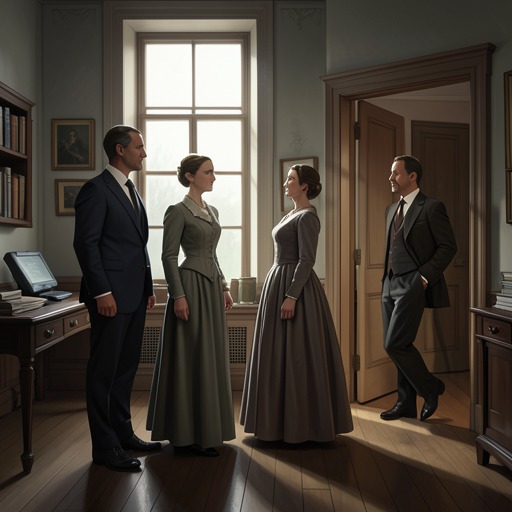
The Time Traveler's WifeClare’s affair with Gomez is a one-night encounter in 1990 that becomes significant less through its duration than through the time-delayed knowledge surrounding it. Clare wakes beside Gomez distressed and longing for Henry; years later, she confesses the encounter to Henry, who must absorb an event from her past that he did not experience alongside her. Their conversation turns secrecy into disclosure and hurt into a tentative reconciliation, while the novel’s divided chronology makes clear that confession can change their present without changing what has already happened.
The encounter and its aftermath
In the dated scene of Saturday, April 14, 1990, Clare is eighteen. She wakes beside Gomez, remembers the previous night, and panics. The account does not elaborate on the encounter itself; it concentrates on Clare’s disorientation and distress afterward. She goes to the bathroom, returns to Gomez’s room, and, when he greets her and reaches out, recoils and begins to cry. Gomez comforts her, but her thoughts turn to Henry and to the times she has cried on his shoulder. Her immediate response makes the contrast plain: Gomez is physically present, yet the person she wants is absent.
Clare’s recollection of this morning later becomes part of the burden of keeping the encounter from Henry. In the later scene, she thinks of Gomez’s bedroom and of the encounter as a mistake, and struggles with whether to tell her husband. The account links her silence to fear that Henry will hate her. The confession therefore concerns not only the past night but also the lasting choice to withhold it.
A past out of sequence
The novel presents the event retrospectively rather than in a simple chronological line. Its date, 1990, is stated when Clare finally tells Henry what happened; her account of waking beside Gomez supplies the scene itself. The reader thus encounters the aftermath and its emotional meaning through Clare’s memory before the full disclosure is staged between the spouses. This structure makes the difference in knowledge part of the event: Clare has carried the memory, while Henry must meet it only when she tells him.
The surrounding narrative also establishes that Henry and Clare do not experience shared time in the same order. A scene dated October 26, 1991, identifies Clare as twenty and Henry as twenty-eight; another dated February 9, 2000, presents Clare at twenty-eight and Henry at thirty-six. These dated fragments underscore the novel’s shifting chronology, but they do not alter the affair’s stated date or make Henry a participant in it. The confession brings an earlier event into the couple’s present without making that past reversible.
Confession and response
Years after the encounter, Clare eventually tells Henry directly that she slept with someone, then identifies Gomez. She explains that she was drunk and that they were at a party while Charisse was in Boston; when Henry asks when it happened, Clare answers that it was in 1990. The detail gives the confession its specific circumstances, but does not erase the emotional difficulty of telling him. Clare has hesitated, and her admission arrives after she has already described the secret to herself as something she might conceal for the rest of their marriage.
Henry’s first response is stillness and disbelief, followed by questions about who, why, and when. The exchange makes room for his hurt rather than treating disclosure as an instant solution. Clare’s explanation includes the fact that she was drunk, but the account does not present that circumstance as undoing the encounter or its effect on their relationship. What changes in the scene is that Henry now knows, and Clare no longer has to keep the event from him.
Reconciliation and significance
After the disclosure, Henry and Clare kiss tentatively. Henry hesitates before kissing her back, and they begin to move toward being all right again. Clare feels relief that she has told him and that he still loves her. Their response is neither a return to an untouched past nor a declaration that the encounter did not matter: the act of telling changes their present relationship, while the event remains part of the history they share.
The scene’s time structure sharpens that distinction. Clare’s encounter occurred years earlier, but Henry learns of it only through her later confession; knowledge arrives after the event and cannot revise its occurrence. By letting the disclosure follow Clare’s private, remembered distress, the novel gives the affair two related but separate narrative moments: the morning after, when Henry is the absent person she longs for, and the later conversation, when he becomes the listener to what she withheld. Its decisive consequence is thus not a change in the past, but the end of the secret between them and the difficult beginning of renewed trust.