Clare’s mother Lucille dies
The Time Traveler's WifeLucille’s death occurs at dawn on August 12, 1998, in her bedroom at Meadowlark House, where illness has turned her refuge into a hospital room. Clare remains with her through the night and recognizes that she has died when her breathing stops. The scene gives private form to a loss the novel places alongside Henry’s long grief for his own mother: death cannot be undone, but memory and care determine how the living continue to bear it.
Illness and the vigil
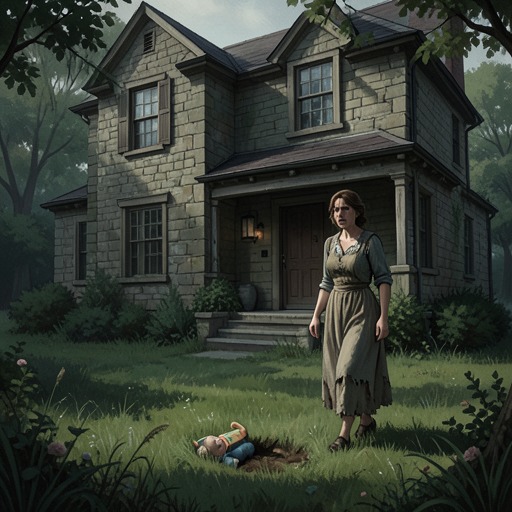
Clare narrates the final night in an intermezzo dated August 12, 1998, when she is twenty-seven. Lucille has escaped from the hospital only to find that her own room has become a place of treatment, crowded with the signs of care and sickness. Clare sits beside her through the night as Lucille drifts among sleep, tears, laughter, and calls for Philip and her mother. The vigil is marked by Clare’s effort not to look directly at the bed, even as she stays in the room and watches for morning.
At dawn Clare turns her attention to the window and the garden beyond it. The light gradually changes the view, revealing familiar flowers, birches, and a crow crossing the grass. This attention to the outdoors does not remove her from the fact of Lucille’s illness; it holds the living world beside the bedside vigil. When Clare turns off the air conditioner, the room becomes silent, and she approaches the bed.
The moment of death
Clare finds Lucille still and checks for signs of life: the breathing has stopped, and she can detect no heartbeat. She kneels beside the bed and holds her mother. For a moment, even in death, Lucille is restored in Clare’s memory as her beautiful, laughing mother, released from the visible effects of illness. The moment joins physical recognition of loss to an act of remembrance: Clare does not mistake memory for recovery, but it briefly gives her mother back in another form.
Etta enters the room, and Clare lowers Lucille onto the pillows, smooths her nightgown and hair, and tells Etta that she is gone. These small gestures close the vigil. The death is not presented as a public event or a sudden interruption, but as the culmination of a night of watching, followed by Clare’s direct acknowledgment to another member of the household.
Family memory and inherited grief
Lucille’s death resonates with Henry’s account of his mother’s death, which he describes as the pivotal loss around which the rest of his life seems to revolve. His time travel repeatedly brings him to the accident and its aftermath, and he recalls having seen the scene from many positions, including comforting his younger self. The contrast is important: Henry’s grief returns through repeated encounters with the past, while Clare’s vigil brings her to the irreversible present of her mother’s death.
Earlier, Henry accidentally lets Clare understand that Lucille will die. He recognizes the harm in his slip and struggles with whether to tell Clare the truth, conceal it, or refuse to answer. The episode establishes that knowledge of the coming loss does not make it easier to meet. Clare still has to live through her mother’s illness and death, and Henry’s foreknowledge cannot spare her the experience or determine what the loss will mean to her relationship with Lucille.
What remains after the loss
Lucille’s care for the garden persists in the family’s recollections after her death. Henry remembers that, when well, she worked among the plants and told the family about the garden; when illness prevented her from doing so, Etta and Philip brought her downstairs and settled her where she could still see it. The garden therefore links Lucille’s ordinary life and her later illness, and its presence helps situate her within a household that continues to care for her when she can no longer tend it herself.
The papers Clare later finds among her mother’s things deepen this relationship beyond the bedside. They show that Lucille had lost a baby and attempted suicide in 1979, and among the poems Clare discovers one addressed to her, titled “The Garden Under Snow.” The discovery gives Clare a new, painful glimpse of her mother’s private history and the words she left behind. Lucille’s death thus does not end Clare’s encounter with her; it changes that encounter into an act of reading, recollection, and belated understanding.
The loss also enters the family’s later generations through particular memories rather than a simple transfer of the event itself. Henry’s grief for his mother remains a defining presence, while Clare’s knowledge of Lucille is enlarged by the poem and the family’s recollections of the garden. Years later, when Henry tells their daughter Alba that he died when she was five, Alba answers a question about her father’s death in the same family world shaped by absence and memory. The novel places these losses beside one another without treating them as interchangeable: each person’s grief has its own history, and each becomes part of what those who remain must carry.