David Kendrick
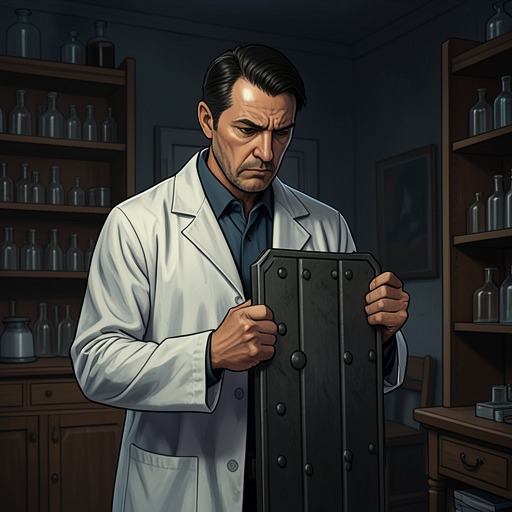
The Time Traveler's WifeDavid Kendrick is the molecular geneticist who investigates Chrono-Impairment, the genetic condition behind Henry DeTamble’s involuntary time travel. Introduced through knowledge that Clare possesses before Henry does, Kendrick becomes both Henry’s doctor and a central figure in the effort to understand the condition. His scientific progress—from a future discovery to a mouse experiment that reproduces time travel—offers the family a measure of hope, but not a cure or certainty. His work ultimately leaves Henry and Clare confronting how much protection they can choose for Alba, and how much must remain unknown.
Identity and Introduction
On their first date at the Newberry Library, Henry is surprised when Clare refers to his restrictions on drinking and explains that Dr. Kendrick is his doctor and an expert on Chrono-Impairment. Henry asks who Kendrick is and what the condition means. Clare describes him as a molecular geneticist who discovers the genetic explanation in 2006, while acknowledging the temporal contradiction: from Henry’s perspective, Kendrick’s finding lies ahead, and he has never heard of anyone else with the impairment. Clare also understands that Kendrick could not yet help Henry in 1991; in her account, an earlier meeting with the doctor might even have prevented the couple from meeting. Kendrick is therefore present in the story first as a name carried backward through Clare’s knowledge, a future authority whose discovery has not yet occurred in Henry’s present.
Kendrick’s later scientific authority is not presented as uncomplicated certainty. Henry and Kendrick argue over what Henry’s condition signifies. Kendrick considers Henry a possible harbinger of a new human species, whereas Henry regards himself as damaged code and sees the couple’s difficulty having children as evidence against the idea that he represents an evolutionary advance. Their exchanges invoke Kierkegaard and Heidegger, turning medical investigation into a dispute about what kind of person Henry is and what his difference means. Kendrick’s research thus proceeds alongside, rather than replacing, Henry’s own account of himself.
Physician and Research Partner
By January 2000, Kendrick is working with Henry and Clare on the condition. Clare recalls him leading them through a windowless conference room, where a covered cage is brought in on a cart. He removes the cloth and shows them a small white mouse. When he flashes a penlight rapidly over it, the mouse tenses and disappears. The demonstration makes the research tangible: time displacement, previously bound to Henry’s unsettling personal experience, has been induced in an experimental animal before the couple’s eyes.
Kendrick explains that the researchers cloned Henry’s genes, used enzymes to remove damaged DNA sections, and introduced the altered material into mouse embryos at the four-cell-division stage. Sequencing of the mouse genome helped them locate the four genes they targeted, though Kendrick says they could have proceeded without it. The account gives the experiment a specific method rather than treating the successful mouse as a miraculous solution. Its achievement is real, but it does not establish that Henry can be cured or that the intervention is ready to be used in people.
After the demonstration, Clare contacts Dr. Montague about immunosuppressants and internal bleeding and is told to come in the following week while the doctor researches the matter. Henry responds cautiously, pointing out that many mouse mothers died before the researchers succeeded. Kendrick’s result therefore prompts further consideration rather than an immediate medical decision: experimental success carries the shadow of the failures and risks involved in reaching it.
Limits of Treatment and the Question of Alba
In July 2006, Henry sits with Kendrick in his office while Kendrick explains why the treatment they have considered will not work. Their familiar chairs, Kendrick’s successive cigarettes, the darkened room, and Henry’s frustrated wish to ask a question frame the scene as a difficult reckoning with the limits of their long collaboration. The research has produced knowledge and a successful animal model, but it has not given Henry a way to remain reliably in the present.
Henry redirects the discussion toward Alba and asks whether the work might help her. Kendrick says they cannot know unless Clare changes her mind about allowing him to work with Alba’s DNA; he recognizes that she fears gene therapy. Henry proposes a cautious alternative: Kendrick could use Alba’s DNA to make mice and investigate the possibilities, leaving Alba free to decide when she is eighteen whether to try a treatment. The proposal does not settle the question, but it shifts the discussion from treating Henry to preparing a possible choice for their daughter.
Henry explains the stakes to Clare in terms of uncertainty rather than prediction. Alba might love time traveling and never feel lost or endangered, but she might instead want the life of an ordinary girl. He asks Clare to let him leave Alba a safety net, acknowledging that it may never work or be used. Clare consents. Kendrick’s research has therefore become part of a family decision about future autonomy: it might provide an option, but cannot determine whether Alba will want it or whether it will succeed.
Relationships and Later Contact
Kendrick’s relationship with Henry combines professional collaboration with personal familiarity. He is the doctor who investigates Henry’s condition, but their conversations also carry the weight of an ongoing intellectual disagreement about whether Henry’s difference is damage or evolutionary change. Henry’s questions about the work remain direct, and he treats Kendrick’s scientific explanations with dry skepticism; their rapport allows him to question the research without diminishing its importance.
His relationship with Clare is shaped by their shared participation in the research and by disagreement over what it may mean for Alba. At a later gathering, Kendrick apologizes to Clare and offers to show her what he has been doing for Alba in the laboratory. She accepts the apology but postpones the visit, asking to come another time when it is quieter. Her response preserves both the connection and the unresolved distance between them: the work concerns her daughter, but she is not ready to engage with it at that moment.
Kendrick also remains present in Clare’s later life through the future he has helped make imaginable. In Henry’s letter, Henry recounts a time displacement from Kendrick’s waiting room into a house where he sees Clare as an old woman. The image returns in 2053, when Henry finds her in a bright room beside a window and recognizes her. The episode does not show Kendrick causing or controlling this journey; rather, his waiting room is the point from which Henry is displaced, linking the physician’s ordinary clinical setting to the novel’s wider pattern of temporal crossings.
Narrative Role and Significance
Kendrick’s story is told across the novel’s fractured chronology, so his role arrives in two directions. Clare can describe in 1991 what Henry will later learn about his doctor and the genetic basis of his condition, while Kendrick’s discovery belongs to a future that has not yet reached Henry. The reader must hold these unequal positions together: the research is already known to Clare as a fact of Henry’s future, yet remains unavailable to him in the scene where she first explains it. Kendrick’s name makes the difference between chronological time and personal knowledge part of the plot’s structure.
As the investigation develops, Kendrick embodies both the reach and the boundary of scientific explanation. He can identify genetic targets and produce a time-displacing mouse, but the evidence does not show him curing Henry or resolving the risks for Alba. The contrast between a controlled laboratory demonstration and the family’s unanswerable choices keeps his work from becoming a simple rescue narrative. His significance lies in making biological inheritance investigable—and in showing that explanation, even when experimentally powerful, cannot remove the uncertainty or ethical responsibility that accompany it.