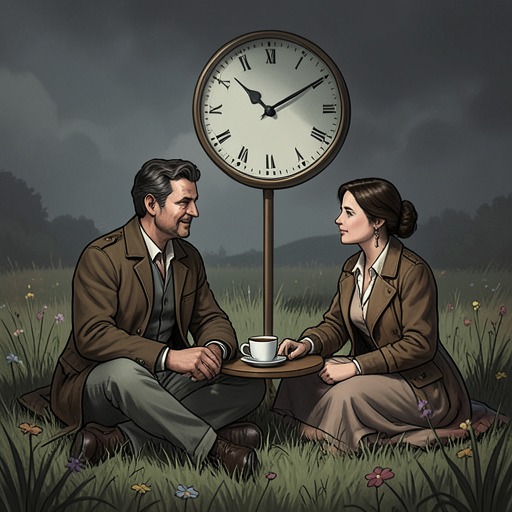
Determinism and Fixed Timeline
The Time Traveler's WifeDeterminism and the fixed timeline in The Time Traveler’s Wife describe a world in which Henry DeTamble can move among dates but cannot alter the history that makes those journeys possible. He may act within another time, even try to intervene, but his actions belong to the events already fixed there. The result is not simply a puzzle about fate: it is a lived conflict between the appearance of choice and the obligation to behave responsibly.
The Rule of the Fixed Past
Henry explains the rule through his repeated return to a fatal accident at an ice-skating rink. He has seen a little girl struck in the head by a hockey puck and later learns that she died in hospital. Each time he travels back to the day, he wants to warn her mother, but he can only witness the scene, as if from an audience or as a ghost. His knowledge does not grant him power over the event. The repetition turns time travel into enforced witnessing: Henry is present, but the past remains beyond his reach.
That helplessness also shapes his account of trying to intervene. Henry tells Clare that his attempt to speak up is itself part of what happened; had he not said something, Clare would not have got up. The effort to change the past does not break the sequence but participates in it. The distinction is crucial: Henry can act, but he cannot make the past become a different past. In his formulation, events recur as they already occurred, captured by the phrase “Immer wieder,” or always again.
The Future Becomes the Past
The same constraint extends forward. Henry describes a journey to the future, an action taken there, and a return to the present. Once he comes back, what he did in that future is now part of his past. The future, from the perspective of the traveler who reaches it, is no more available for revision than the past he revisits. Thus the timeline closes around action in both directions: a journey may change what the traveler knows, but it does not create an unrecorded alternative history.
This structure produces a paradox between experience and outcome. Henry and Clare encounter events from different positions in time, and a moment that is still ahead for one may already be remembered by the other. The dated narrative makes that difference legible: Henry and Clare’s first meeting at the Newberry Library occurs on October 26, 1991, when he is twenty-eight and she is twenty; another dated passage sets Henry’s arrival in the past on January 2, 1988, at an event in 1968, when he is twenty-four and five. Later, the narrative places Henry’s fatal shooting on October 27, 1984, alongside January 1, 2007, and carries his encounter with elderly Clare forward to July 24, 2053. These dates do not present a single, steadily advancing experience. They show how the novel’s chronology makes the fixed sequence visible through people who occupy different points in it.
Determinism, Freedom, and Responsibility
Henry’s account does not resolve the tension by declaring that choice is meaningless. He distinguishes between the past, where he can only do what he did and can only be present if he was there, and the present, where a person may have free will. He also reports an idea from another version of himself: freedom may belong only to the person acting within time and the present. From outside that moment, an event is fixed; from inside it, decision remains part of the experience.
The distinction offers no simple escape from responsibility. Henry tells Clare that even if everything seems already to have happened, a person must behave as though free will exists and as though actions carry responsibility. His dry relief when Clare wonders whether he is accountable for what he does while displaced does not cancel that principle. Instead, his explanation holds two positions together: the traveler cannot undo the established event, yet the person acting must still treat conduct as consequential.
Clare tests the rule against specific details of their shared life. She says Henry’s notes about a baby with Down syndrome and the List of his visits have changed what she knows and what she does; without the List, she would not know when to meet him. Henry answers that he can do only what works toward what has already happened. His example is deliberately small: after Clare takes off her shoes, he cannot undo that choice, even if he wanted to. The fixed timeline therefore encompasses not only catastrophe but ordinary gestures. History is not made immutable only at moments of death; even the placement of shoes has become part of it.
The Block Universe and Faith
In a conversation with thirteen-year-old Clare, Henry sets determinism beside two alternative accounts of existence. One is a block universe, in which past, present, and future coexist and everything has already happened. Another is chaos, where events cannot be predicted because not all variables are known. A third is a Christian universe in which God has made everything for a purpose while human beings nevertheless retain free will. The alternatives make clear that fixed history is not presented as the only imaginable explanation; it is one position in a question neither character can settle conclusively.
Clare’s answer changes as she grows older. At thirteen, her practical judgment and her romantic feelings about Jesus and Mary are almost balanced, and she says she wants God. Henry anticipates that, ten years later, she will favor determinism, and that ten years after that she will believe the universe is arbitrary, that cause and effect are inescapable, and that any God who exists does not hear prayers. Her changing convictions give the idea a personal history: the same fixed sequence is interpreted at different ages through faith, skepticism, and experience, rather than arriving as a final doctrine.
The novel’s form reinforces that uncertainty without erasing the rule. Dated sections jump between Henry’s and Clare’s ages and between the dates they experience, so the reader pieces together chronology from events narrated out of sequence. An encounter can be new to one character and already familiar to the other; a future scene can appear before the life that leads to it. This arrangement makes the fixed timeline something to be reconstructed, while preserving the emotional difference between knowing an outcome and living toward it.
Significance
Determinism gives Henry’s time travel its defining limit: movement across time is not mastery over it. The repeated visit to the rink, the futile wish to warn the girl’s mother, and the small irreversibility of Clare’s removed shoes all make the same rule tangible at different scales. The past is not a storehouse of opportunities to repair; it is the history in which Henry’s very attempts to intervene already belong.
Yet the novel does not reduce its characters to passive figures awaiting predetermined outcomes. Henry’s insistence that people act as if they have free will preserves a practical and ethical demand inside a fixed chronology. Clare’s List, Henry’s notes, and their meetings can shape the course through which they encounter one another, even if they do not create a branch of history outside what has occurred. The concept’s force lies in that unresolved conjunction: actions cannot undo the timeline, but they remain the means by which life within it is lived.