Field Museum of Natural History
The Time Traveler's WifeThe Field Museum of Natural History is a Chicago museum whose ordered displays of life and deep-time remains frame two decisive moments in Henry DeTamble’s experience of time. At five, Henry visits with his parents and is overwhelmed by the museum’s collections; years later, an adult version of him arrives there by involuntary time displacement and waits to guide his younger self. The building thus becomes more than a childhood destination: its exhibits make time and death seem suspended, while its halls hold a meeting between two ages of the same person.
Setting and Collections
On Henry’s fifth birthday, June 16, 1968, his parents take him to the museum. He has been excited all week by their descriptions of the stuffed elephants, dinosaur skeletons, and caveman dioramas. The family drives along Lake Shore Drive, has some trouble finding Sunday parking, then walks beside the lake past boats and statues before entering through the museum’s heavy columns. The building’s domed stone facade initially seems ordinary to Henry, who has already been taken around Europe’s capital cities; inside, however, the collections transform his sense of the place.
The museum presents nature as something captured, labeled, and arranged. Henry’s five-year-old imagination reads that order as nearly timeless, even divinely organized: the galleries seem to preserve an account of Creation. The visit moves among cases of butterflies from Brazil, Madagascar, and Australia; crystals, cougars, muskrats, mummies, fossils, birds, alligators, and Neanderthals. Its dark, cold, old interior intensifies the impression that time and death have been halted within the walls. The collection is not merely a sequence of specimens to Henry; it makes the natural world feel complete enough to enter, like Eden.
Henry’s First Visit
Henry arrives already attached to a particular object: an immense blue Papilio ulysses butterfly that his mother has brought back from Sydney. He holds it close enough for its color to fill his vision, and recalls the feeling it gives him as one of unity and oblivion. At the museum he sees cases of butterflies, including one like his own, and the personal wonder of the framed specimen expands into an encounter with a world of collected life. The museum’s scale answers the intensity he had found in a single butterfly without diminishing it.
The day ends not with Henry ready to leave but with exhaustion overtaking his desire to stay. After a picnic lunch on the museum lawn, the family goes inside again; when the guards gently herd visitors toward the doors, Henry struggles not to cry. His father carries him back to the car, where he falls asleep. The first visit therefore joins enchantment to bodily limits: the museum seems inexhaustible to the child, but closing time and fatigue finally carry him out of it.
That night, the museum becomes the setting for Henry’s first time displacement. At twenty-four, after dancing, he finds himself at 4:03 a.m. on January 2, 1988, in the museum during his five-year-old self’s birthday visit. Disoriented and vomiting on the tile, he recognizes the surrounding displays—tigers, cavemen, and wolfish dogs—and then the beetle cases and high windows. Once he understands where and when he is, the remembered childhood visit gives him a task: he is about to become the unknown adult who appeared in his own past, and he needs clothes.
The Museum as a Meeting Place Across Time
The adult Henry moves through the building with practical purpose. He crosses the beetle gallery, takes the west staircase, and enters the gift shop, where he uses a bobby pin to open display cases and takes two dinosaur T-shirts. He then goes upstairs to the museum’s library. The contrast is telling: the child’s museum is a world to be absorbed in, while the adult’s is also a route to a meeting whose outline he remembers but whose immediate experience he cannot control.
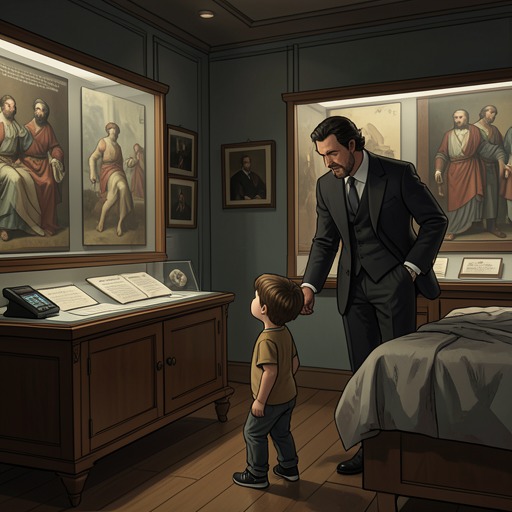
In the Field Museum’s closed-stacks library, the reading room contains heavy wooden tables, maroon carpet, a large reference desk, and shelves of Victorian science periodicals. Henry picks a lock and approaches a book displayed alone in a glass-and-oak case. He lifts it onto felt and support pads, then has his five-year-old self stand on a chair so the child can see it. The scene places the museum’s adult institutional order alongside a carefully staged act of attention: the older Henry is not simply transported into his past but prepares a small lesson and a view for the boy he was.
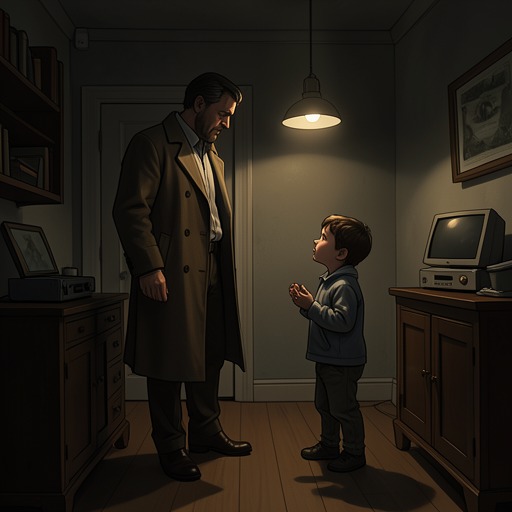
Elsewhere in the museum, adult Henry waits near the coat room, eats ten Oreos slowly, and listens for the arrival he expects. When he hears the child, he calls softly, offers the T-shirt, and watches it fall almost to the boy’s knees. The encounter makes the building a meeting place for two versions of one person, but not a reunion between equals: the five-year-old is still protected by ordinary childhood and his parents’ care, while the adult knows that everything is about to change. The museum’s exhibits provide a shared environment; the time displacement turns that familiar environment into a threshold between a remembered day and the adult life shaped by it.
Narrative and Thematic Significance
The museum’s importance depends on the novel’s crossed chronology. The birthday visit belongs to Henry’s childhood, yet the adult visitor enters it from 1988 and encounters the event as both memory and present circumstance. A reader first sees the museum through the child’s wonder and only later meets the adult Henry who knows he will appear there. The same building consequently holds different kinds of knowledge: for the child, its collections disclose an immense, ordered world; for the adult, its rooms are places whose earlier events have become instructions he must fulfill.
The collections also give the museum a precise thematic resonance. Fossils, mummies, mounted butterflies, and arranged specimens make time and death visible as things gathered and held still. Henry’s own condition defeats that stillness: his body arrives in a time not its own, and the museum’s preserved order becomes the setting for an experience that cannot be made orderly. Yet the book in the library and the T-shirt offered to the child are tangible acts of care within that rupture. The Field Museum joins wonder to constraint, preserving the image of a childhood world even as Henry’s first displacement makes that world impossible to inhabit in the same way again.