Forward-only causality
The Time Traveler's WifeForward-only causality is the principle that events happen once and that their causes do not run backward, making advance knowledge no guarantee of control. In Henry DeTamble’s account, the rule explains why foreknowledge can feel like imprisonment rather than power: a person may know what is coming and still be unable to change it. The idea governs both his explanation of time travel to Gomez and his response to Clare’s question about whether he would choose to stop traveling through time. Its force lies in the contrast between a fixed sequence of events and the freedom Henry associates with not knowing them in advance.
Definition and Explanation
Henry states the principle directly when Gomez asks why he will not tell him the particulars of his future. He explains that causation only runs forward and that things happen only once. Knowing an event beforehand does not make it alterable; instead, Henry says, such knowledge can leave him feeling trapped. By contrast, not knowing what lies ahead allows a person to live without the burden of carrying an unchangeable future in mind.
This explanation makes forward-only causality more than a technical rule about time travel. It sets a limit on what knowledge can accomplish. Henry refuses to provide Gomez with a detailed forecast, even though he tells him that they will become close friends, that Gomez will be the best man at his wedding, and that they will each serve as best man at the other’s. The distinction is selective rather than absolute: Henry discloses the broad shape of their future but withholds its particulars, then entertains Gomez’s request for stock tips. His account presents foreknowledge as a complicated burden, not a simple advantage.
Time Travel and Its Limits
Henry’s own theory of time travel gives the causal principle a personal setting. He describes his account as a theory specific to his experience, not a general explanation of time travel. He suspects that the condition involves the brain and compares its triggers and physical cues to epilepsy: stress can prompt an episode, and flashing light can also contribute. Running, sex, and meditation, by contrast, tend to help him remain in the present.
Those possible patterns do not amount to control. Henry says he cannot consciously choose when or where he travels, how long he stays, or when he returns. He therefore rejects the idea of planned journeys, such as a time-travel tour of the Riviera. He does, however, think that his subconscious has considerable influence over where he ends up: he often revisits events he finds interesting or important, and he expects to spend a great deal of time visiting Clare. He tends to arrive in places he has already visited in ordinary time, though he also finds himself in more random times and places. His travels tend more often toward the past than the future, although he has been to the future as well.
The contrast is central to the principle. Henry may move across time, but that movement does not give him command over causation. The involuntary nature of the journeys, alongside his inability to decide their timing or duration, makes foreknowledge especially different from agency: seeing an event is not the same as being able to choose its outcome.
Knowledge, Friendship, and Freedom
Gomez’s request to hear his future tests the limits Henry has described. Henry initially refuses, calling the request a bad idea, and explains that knowing about events in advance makes things strange. His reluctance is not a claim that he knows nothing about Gomez’s future; he proceeds to disclose that the two men will be good friends and will be present at one another’s weddings. Rather, he draws a line between offering a broad assurance about their bond and supplying particulars that could make the future feel inescapable.
Henry links that restraint to the experience of freedom. In his account, not knowing lets a person inhabit the present without already carrying the knowledge of what will happen. The principle therefore produces a paradox: Henry’s unusual access to other times can supply knowledge, but that access cannot free him from the events he sees. If anything, knowing what cannot be changed intensifies the feeling of constraint. For Gomez, who is not described as a time traveler, Henry’s refusal to disclose more preserves the possibility of meeting life without that particular burden.
Henry and Clare’s Counterfactual
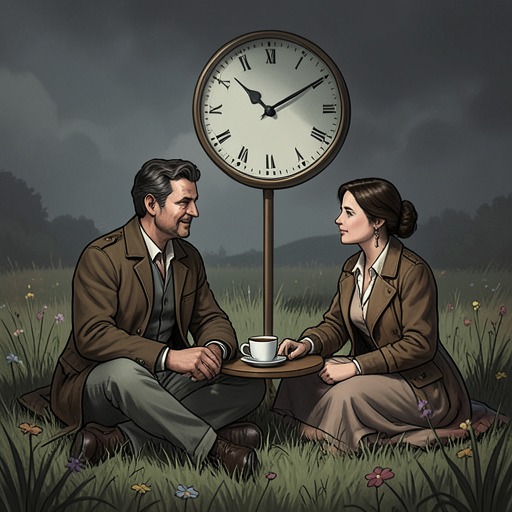
Clare frames the principle as a choice when she asks Henry whether he would stop time traveling if he could do so immediately and with no consequences. Henry’s answer is conditional: he would stop if he could still meet her. Clare replies that they have already met, drawing attention to the unequal position created by their shared history. She has memories that he would never acquire if he stopped traveling, and she says the experience resembles being with someone who has amnesia. She has felt that way since they arrived at their present location.
The exchange puts the abstract rule into the intimate terms of a relationship shaped by uneven knowledge and memory. Henry’s willingness to give up time travel does not mean he would accept losing the meeting that binds him to Clare. His answer makes their encounter the condition of the hypothetical, while Clare’s response shows that the relationship already contains an imbalance between what each has lived and remembers. Forward-only causality here names a limit on changing events, but the conversation also reveals the emotional cost of inhabiting different versions of a shared past and future.
Significance
Across these conversations, forward-only causality holds together two claims: events cannot be remade by knowing them in advance, and a person’s experience of freedom depends partly on not carrying that advance knowledge. Henry’s time travel exposes him to events beyond the present without giving him reliable control over when he arrives or what he can change. His refusal to tell Gomez everything, and his answer to Clare’s question, show how the rule shapes both disclosure and desire.
The principle also clarifies the limit of a seemingly powerful ability. Henry can encounter other moments in time, but such access does not make him master of the sequence. The future may be glimpsed, and the past revisited, yet the causal order remains beyond his conscious direction. What the conversations preserve is not a promise that knowledge will rescue anyone from what happens, but a distinction between living with an unchangeable event already known and meeting life without that foreknowledge.