Freedom will
The Time Traveler's WifeFree will in the novel is not a settled doctrine but a pressure point in the lives of Henry and Clare: time travel makes the past seem fixed, the future appear already lived, and responsibility difficult to locate. Henry’s understanding of agency is neither a promise that he can change events nor permission to abandon responsibility. It is the difficult practice of choosing in the present while living with evidence that some outcomes cannot be undone.
Time Travel and the Limits of Choice
Henry describes himself as altered by involuntary journeys through time, reduced to a desperate version of himself who must hide and acquire clothes after arriving without possessions. The episodes can be triggered by exhaustion, noise, stress, sudden movement, or flashing light, yet they can also interrupt an ordinary morning: he may be reading beside Clare and find himself in 1976, watching his thirteen-year-old self mow a lawn. The journeys make the distinction between chosen action and imposed circumstance concrete. Henry arrives in moments he did not choose, but must act within them.
That predicament bears directly on his account of free will. Recalling a conversation with a version of himself from 1992, Henry explains that choice may belong only to being in time—in the present. In the past, he can be present only if he was already there, and he can do only what he did. A journey into the future appears similarly bound: whatever he does there becomes part of his past when he returns, and may therefore have been inevitable all along. The structure of time travel turns agency into a paradox: Henry can act, but his actions seem already incorporated into the history he encounters.
Responsibility Within a Fixed History
Henry recognizes the despair latent in this account. If everything has already happened, he asks whether he is responsible for what he does while displaced from his own present. The answer he relays is not that responsibility disappears. Even if events are inevitable, people must behave as though they possess free will and are accountable for their actions; otherwise, Henry says, the alternative is depressing. The demand to act responsibly survives the uncertainty about whether an action could have been otherwise.
This position distinguishes fatalism from the practical conduct the characters need. Henry believes he can affect events only in ways that contribute to what has already happened. He and Clare discuss concrete examples: Henry has written instructions about a baby with Down syndrome for Clare to give him in 1991, and Clare’s List tells her when to meet him. Such acts plainly shape what the other person knows and does, yet Henry sees them not as departures from history but as parts of its completion. He cannot undo even a small event that has just occurred, such as Clare taking off her shoes. The example makes the limit intimate rather than abstract: the universe’s unalterability reaches into ordinary gestures.
Clare, Foreknowledge, and Everyday Agency
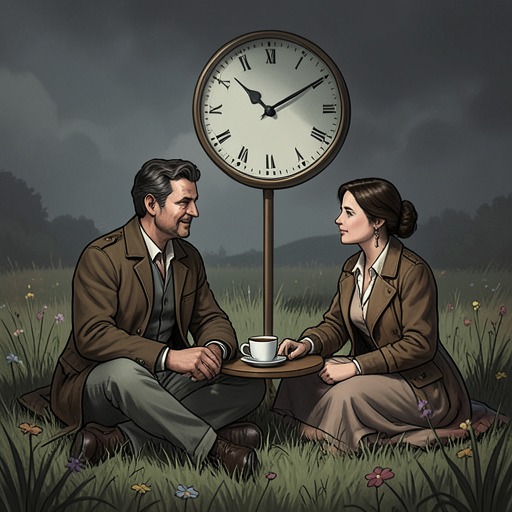
Clare experiences this theory not only as an argument about time but as a problem of personal independence. When Henry tells her what she supposedly likes before she has decided for herself, she worries that she may adopt his description rather than discover her own preference. She distinguishes that influence from learning about the future: foreknowledge and a prediction about her tastes do not feel alike. Their exchange brings the philosophical question down to the scale of a cup of coffee, where agency means being able to recognize a preference as one’s own.
Henry connects the issue to free will, while Clare associates free will with sin. He counters that choosing to remove one’s shoes is still an exercise of freedom even when it is neither virtuous nor sinful and affects no future event. Clare remains troubled by the possibility that her future has already happened in the past and cannot be changed. Henry calls that determinism and acknowledges that it haunts him too. Their disagreement does not resolve the theory; it reveals its emotional cost. Henry’s foreknowledge can make Clare feel boxed in, even as their relationship depends on information carried across time.
Henry also considers the alternative of chaos. In conversation with Clare, he describes chaos as offering total freedom but no meaning. He wants his actions both to be free and to matter, and the two desires do not comfortably coincide. Clare raises the possibility that God might give meaning to freedom, but Henry’s response is unease rather than a settled theological answer. The exchange leaves open whether meaning comes from divine purpose, from responsibility, or from the consequences of choices made under conditions no one controls.
Choices About Parenthood
The question becomes especially consequential when Henry and Clare decide to try to have a child. About two years into their marriage, Clare embraces the possibility of a baby while avoiding questions she fears may have answers: whether Henry has seen a future without a child and whether his time-travel condition could be inherited or interfere with pregnancy. Her wish to become a mother coexists with uncertainty about what the future already contains. The decision is an exercise of desire made without secure knowledge, not a choice made from freedom from risk.
Henry later decides to have a vasectomy without telling Clare. The decision is framed by his concern about their prospects and by the painful history surrounding their attempts to conceive, but it does not end the matter: Clare becomes pregnant after a time-travel encounter connected to their earlier efforts to have a child. Henry recognizes how the different temporal order has produced the pregnancy: what was years in his past is only weeks in Clare’s. Their experience shows that decisions about parenthood take place across unequal experiences of time, and that an attempt to control one possible outcome cannot guarantee control over what follows.
At the birth, Clare is frightened when the medical team observes that the baby’s heartbeat is very fast. The scene places choice alongside vulnerability: the couple have wanted a child, but neither desire nor planning gives them command of the immediate circumstances. The novel does not present parenthood as a problem solved by choosing correctly. Instead, their decisions unfold amid incomplete knowledge and consequences that become real before they can be fully understood.
Agency as Care for Alba
Henry’s later concern for Alba gives the problem of responsibility a forward-looking form. When he learns that further help from Kendrick is unavailable, he does not know what will happen, but fears that Alba may face dangers associated with time travel. She may enjoy the condition or never become lost; she may also encounter hardship. Henry asks Clare to let him try to leave their daughter a safety net, even though the effort may not work and Alba may never need it. His reasoning is not that he can guarantee her future, but that uncertainty does not excuse him from trying to help.
This effort completes the novel’s distinction between controlling events and acting within them. Henry’s account of time makes outcomes seem fixed, but his choices still alter what others know and what support may be available. His wish to protect Alba is therefore meaningful without being a promise of rescue. Free will remains unresolved as a metaphysical question; as a lived obligation, it appears in the repeated decision to behave responsibly, to respect another person’s agency, and to care for someone whose future cannot be secured.