Grief as gravity
The Time Traveler's WifeGrief as gravity names the force that organizes Henry DeTamble’s life after his mother dies: the accident becomes a center around which memory, time travel, family conflict, and love repeatedly circle. Henry does not return to the loss only in recollection. He travels back into the accident and its aftermath, seeing it from many positions and encountering his younger self there. The image of gravity makes grief at once an emotional weight and a structure of recurrence: everything else seems to move around the death, while Henry is drawn back to it.
The Accident as a Center
Henry explains the image through the physical analogy of mass and gravitational pull. Something larger exerts a stronger force, pulling smaller things toward it into orbit. He applies that pattern to his mother’s death, describing it as the pivotal event around which everything else goes around. The analogy gives the loss an organizing power: it is not one episode among many but the center that shapes the arrangement of what follows.
That force is made concrete by Henry’s repeated time travel to the fatal accident. During one account of the crash, he recalls that he was absent from the scene for ten minutes and forty-seven seconds, though he cannot remember where he went and allows that the interval may have felt like only a second or two to him. He reappeared on the shoulder of the road; a little girl in a green Chevrolet station wagon was the only person who saw him arrive. The discrepancy between measured time and remembered duration gives the event two simultaneous scales: the public clock records an absence of more than ten minutes, while Henry experiences the displacement as almost instantaneous.
Repetition and Witnessing
Henry’s returns do not offer a single, stable view of the accident. He says he has seen it from every angle and imagines a view wide enough to include every person, car, tree, and snowdrift. Across these visits, he appears in different places around the scene—in cars, behind bushes, on the bridge, and in a tree. The repeated journey turns the catastrophe into a landscape he knows from multiple positions, but that breadth of vision does not make it preventable or emotionally distant.
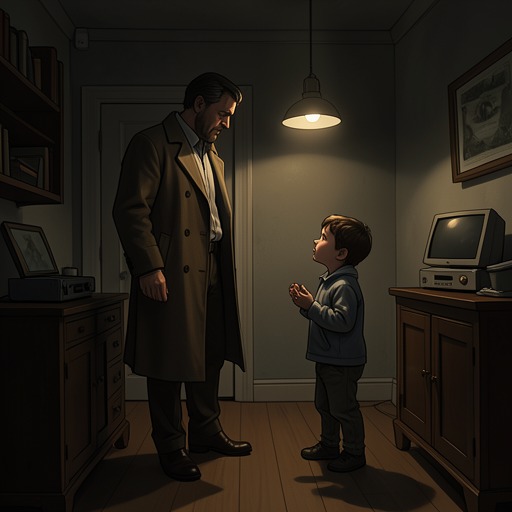
His time travel also carries him beyond the collision into its aftermath. From a nearby gas station he calls the airport to page his father and tell him to come to the hospital. At the hospital he watches his father walk through the waiting room, looking gray and ravaged, on his way to find him. Henry then waits by the roadside for his younger self to appear. When the child arrives, Henry puts a blanket around his thin shoulders and looks into the boy’s uncomprehending face. The act of care is intimate, but it cannot undo the loss that brought the child there.
The narration’s movement from a detailed account of the accident to Henry’s silences and tears makes the act of telling part of the scene’s meaning. He begins to explain what he thought as he looked at his younger self, breaks off, and weeps while Clare holds him. Grief is thus both a recurring destination and something difficult to put into words. His returns supply more and more detail, yet the decisive thought remains caught at the edge of speech.
Rings, Father, and Inheritance
The loss also enters Henry’s relationship with his father, Richard DeTamble. When Henry asks to give Clare his mother’s wedding and engagement rings, he explains that he thinks his mother would have wanted it. Richard challenges his claim to know what she would have wanted, pointing out that Henry hardly remembers her. The disagreement exposes the different terms on which father and son hold the past: Richard questions the authority of Henry’s memory, while Henry’s experience of time travel makes the dead mother unusually present to him.
Henry answers that he has seen her hundreds of times since her death. He describes seeing her around the neighborhood with Richard and with himself, at the park learning scores, shopping, having coffee with Mara at Tia’s, with Uncle Ish, and at Juilliard. He has heard her sing and once stood beside her on a crowded train, touching her. These encounters do not erase her death; instead, they complicate the boundary between absence and presence. Henry presents time travel not only as a curse but as the means by which he has been able to see his mother again.
The conversation intensifies when Henry tells Richard that his mother would have deplored the way he has let her death ruin his life. Richard lowers his head and weeps without covering his face. Henry fetches toilet paper, and the two sit together for a few minutes. The scene does not settle their disagreement about memory, but it shifts their exchange from accusation toward shared mourning. The rings Henry wants to give Clare make that mourning tangible: a material remnant of his mother can pass into the life he has built with someone else.
Meaning of the Image
Grief as gravity binds the novel’s temporal pattern to a family loss. Henry’s journeys repeatedly draw him back to the accident, while the distinction between clock time and his subjective experience remains unstable: a measured ten minutes and forty-seven seconds may register as a second or two. Recurrence makes the death inescapably present, but the scenes also show what Henry can do within that return—witness the aftermath, wait for his younger self, and offer the child a blanket.
The image therefore holds together both the weight of bereavement and the continuing motion of life around it. Henry’s mother remains the center of his orbit, present in repeated encounters and in the rings he hopes to give Clare. Yet the orbit includes others: Richard’s grief, Clare’s embrace, and the younger Henry whom the adult Henry meets on the roadside. The metaphor does not promise release from the loss. It describes the enduring force by which memory draws these relationships back toward the death, and through which acts of care carry something of the dead into the living.